
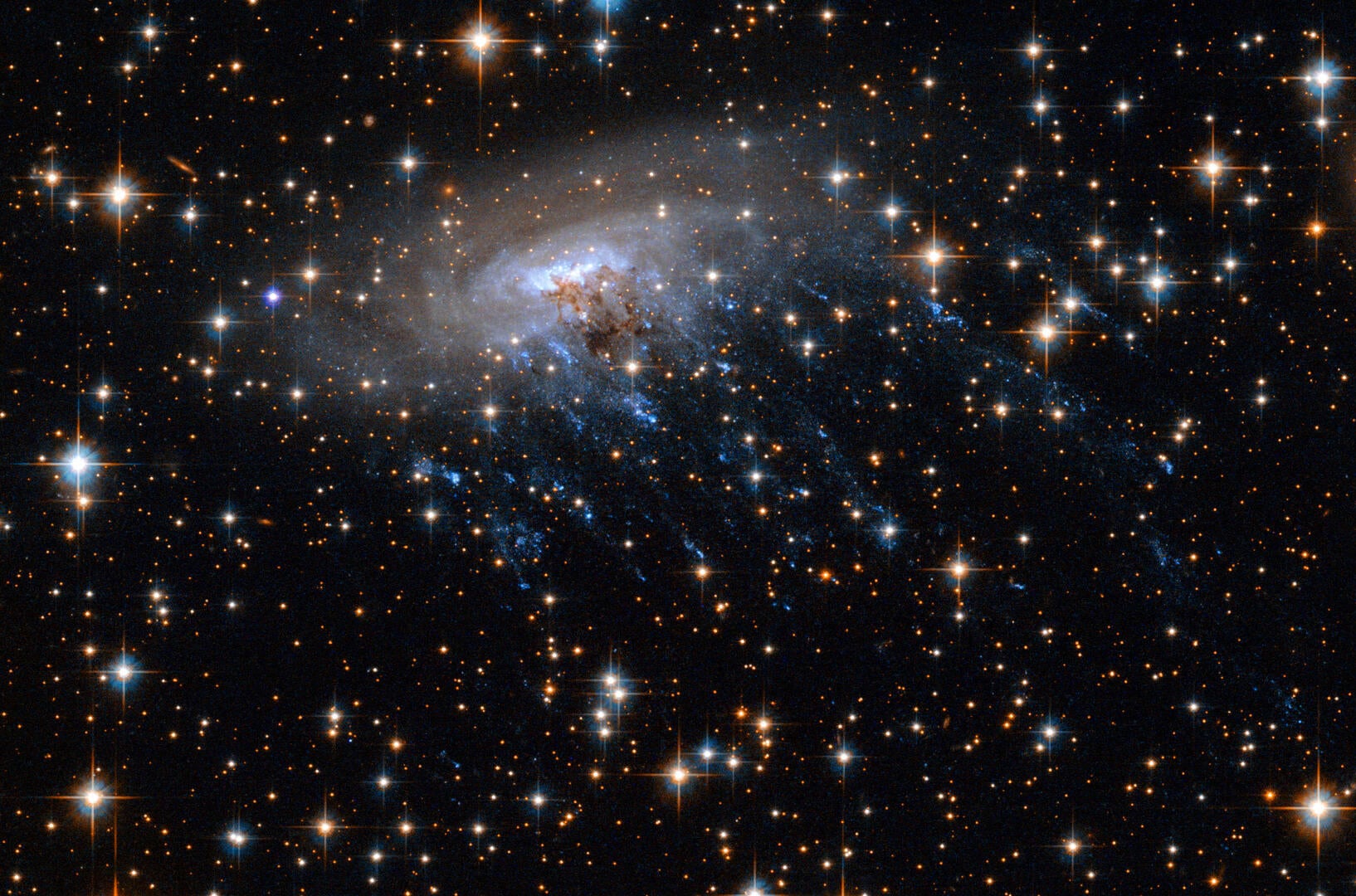
A newly discovered jellyfish galaxy, seen as it existed 8.5 billion years ago, is challenging assumptions about conditions in the early universe.
Astrophysicists at the University of Waterloo have identified a newly discovered jellyfish galaxy that is now the most distant example of its kind ever observed.
Jellyfish galaxies get their name from the long, tentacle-like streams of gas and stars that extend behind them. These galaxies race through the hot, crowded environment of a galaxy cluster. As they move, the surrounding gas behaves like a powerful headwind, pushing gas out of the galaxy and stretching it into trailing tails. Astronomers refer to this process as ram-pressure stripping.
The team located this galaxy in deep space observations taken by the James Webb Space Telescope (JWST). It has a redshift of z = 1.156, which means its light has traveled for about 8.5 billion years to reach us. In other words, scientists are seeing the galaxy as it existed when the universe was far younger than it is today.
These observations offer a rare window into how galaxies were reshaped in the early universe and challenge previous assumptions about conditions 8.5 billion years ago.
A Search in the COSMOS Field
The discovery emerged from a detailed analysis of the COSMOS field, short for Cosmic Evolution Survey Deep field, a region of the sky that has been extensively studied by multiple telescopes to investigate distant galaxies.
Astronomers selected this area because it lies well away from the plane of the Milky Way, reducing interference from foreground stars and dust. It is also positioned so that it can be observed from both the northern and southern hemispheres. The absence of bright nearby objects provides a clear and unobstructed view into deep space.

“We were looking through a large amount of data from this well-studied region in the sky with the hopes of spotting jellyfish galaxies that haven’t been studied before,” said Dr. Ian Roberts, Banting Postdoctoral Fellow at the Waterloo Centre for Astrophysics in the Faculty of Science. “Early on in our search of the JWST data, we spotted a distant, undocumented jellyfish galaxy that sparked immediate interest.”
Young Stars in Stripped Gas
The newly identified jellyfish galaxy features a typical disk structure. Extending from it are bright blue clumps embedded within its trailing streams. These blue regions are extremely young stars.
Their ages indicate that they formed not inside the main body of the galaxy, but within the streams of gas that had been stripped away. This type of star formation is consistent with what astronomers expect to see in galaxies undergoing ram-pressure stripping.
Closer study of this system has prompted scientists to reconsider what was happening in galaxy clusters at that point in cosmic history. Previously, researchers thought many clusters were still in the process of forming and that ram-pressure stripping was relatively rare.
Roberts and his colleagues identified three findings that could reshape that view.
“The first is that cluster environments were already harsh enough to strip galaxies, and the second is that galaxy clusters may strongly alter galaxy properties earlier than expected,” Roberts said. “Another is that all the challenges listed might have played a part in building the large population of dead galaxies we see in galaxy clusters today. This data provides us with rare insight into how galaxies were transformed in the early universe.”
To learn more about this jellyfish galaxy, Roberts and the team have requested additional time on the JWST to delve deeper into its mysteries.
Reference: “JWST Reveals a Candidate Jellyfish Galaxy at z = 1.156” by Ian D. Roberts, Michael L. Balogh, Visal Sok, Adam Muzzin, Michael J. Hudson and Pascale Jablonka, 17 February 2026, The Astrophysical Journal.
DOI: 10.3847/1538-4357/ae3824
Never miss a breakthrough: Join the SciTechDaily newsletter.
Follow us on Google and Google News.