

Close Menu
    Facebook X (Twitter) Instagram
    SciTechDaily
    • Biology
    • Chemistry
    • Earth
    • Health
    • Physics
    • Science
    • Space
    • Technology
    Facebook X (Twitter) Pinterest YouTube RSS
    SciTechDaily
    Home»Biology»Why Food Tastes Better When We’re Hungry – Researchers Find Neural Circuit in the Hypothalamus
    Biology

    Why Food Tastes Better When We’re Hungry – Researchers Find Neural Circuit in the Hypothalamus

    By National Institutes of Natural SciencesOctober 17, 2019No Comments3 Mins Read
    Facebook Twitter Pinterest Telegram LinkedIn WhatsApp Email Reddit
    Share
    Facebook Twitter LinkedIn Pinterest Telegram Email Reddit

    Delicious Cheeseburger

    How Hunger Makes Food Tastier: A Neural Circuit in the Hypothalamus

    Researchers at the National Institute for Physiological Sciences in Okazaki identify the neural pathways that cause hunger-induced increases in the preference for sweet foods and the decreased sensitivity to aversive tastes in mice.

    Why does everything taste better when we’re hungry? According to recent research from Japan’s National Institute for Physiological Sciences, not only does food taste sweeter when our stomachs rumble, but bitter food also becomes easier to eat—and both effects are modulated by a neural circuit in the hypothalamus.

    Generally, we prefer sweet tastes because they signal calorie-rich food, and avoid bitter and sour tastes because they signal spoiled food. However, these preferences are modified by internal states such as hunger. In a study published in Nature Communications last week, researchers found that starved mice had a greater preference for sweetness and a decreased sensitivity to aversive tastes. The research team focused on Agouti-related peptide (AgRP)-expressing neurons, which are known to be activated during hunger states to trigger feeding behavior, and identified two neural pathways that underlie hunger-induced changes in taste preferences.
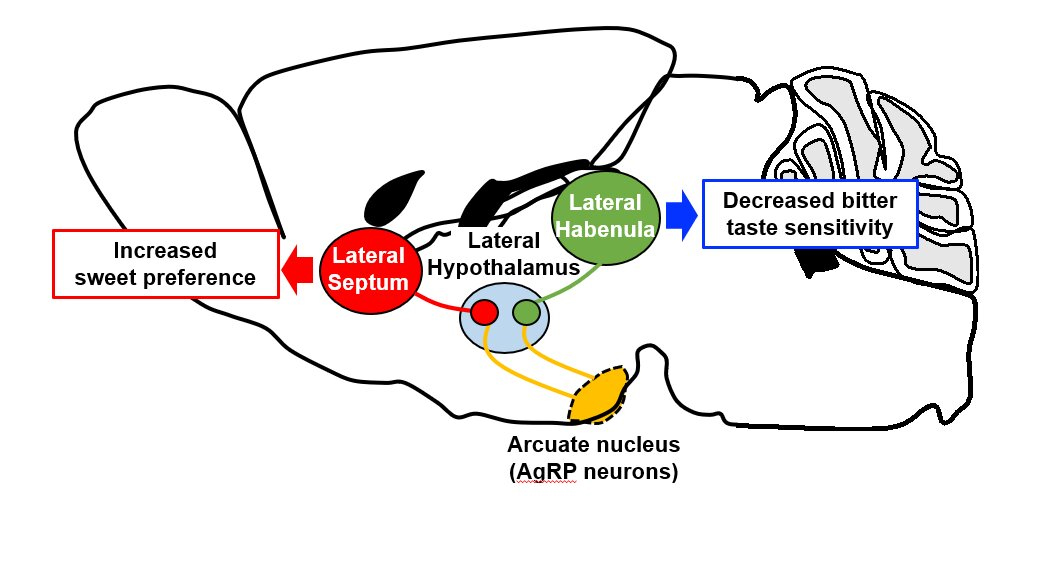
    Hunger-Promoting AgRP Neurons in the Hypothalamus
    Hunger-promoting AgRP neurons in the hypothalamus modulate sweet and bitter tastes through the lateral hypothalamus that send distinct neural projections to the lateral septum and the lateral habenula. Credit: Ken-ichiro Nakajima

    “AgRP-expressing neurons are found in the hypothalamus, which is a brain region that plays a vital role in appetite regulation,” says first author Ou Fu. “We selectively activated these AgRP-expressing neurons in mice using chemogenetic and optogenetic techniques to see whether they influence the perception of tastes observed under fasting conditions.”

    Optogenetic and chemogenetic techniques are popular methods for studying neuronal activity because they can manipulate neural activity very precisely. Optogenetics introduces light-sensitive agents into target neurons, whose activity can then be manipulated by light, and chemogenetics introduces designer receptors to affect the target neurons’ activity by their specific synthetic ligands.

    After AgRP-expressing neuron activation, downstream glutamate neurons in the lateral hypothalamus in turn modulated mice’s taste preferences via two different pathways. Glutamate neurons projecting to the lateral septum increased the preference for sweet tastes, and those projecting to the lateral habenula decreased the sensitivity to bitter tastes.

    “The next steps will be to investigate whether these hypothalamic neuronal pathways are altered in pathophysiological conditions such as diabetes and obesity,” says Yasuhiko Minokoshi, co-author of the study. “For example, we already know that people with obesity have a strong preference for sweetness; this might be associated with a change in the activity of the glutamate neurons projecting to the lateral septum.”

    These new findings could therefore provide the groundwork for the future development of methods to control taste preferences, which would have significant health benefits. However, much work remains to be done before this becomes a reality.

    Reference: “Hypothalamic neuronal circuits regulating hunger-induced taste modification” by Ou Fu, Yuu Iwai, Masataka Narukawa, Ayako W. Ishikawa, Kentaro K. Ishii, Ken Murata, Yumiko Yoshimura, Kazushige Touhara, Takumi Misaka, Yasuhiko Minokoshi and Ken-ichiro Nakajima, 8 October 2019, Nature Communications.
    DOI: 10.1038/s41467-019-12478-x

    Never miss a breakthrough: Join the SciTechDaily newsletter.
    Follow us on Google and Google News.

    Brain National Institutes of Natural Sciences Neuroscience Physiology
    Share. Facebook Twitter Pinterest LinkedIn Email Reddit

    Related Articles

    New Research Uncovers That Everyone’s Brain Has a Unique “Pain Fingerprint”

    Mental Fatigue Is No Illusion: Scientists Figure Out Why Thinking Hard Makes You Tired

    NIH Study Provides an Atlas to Pinpoint Neurons Involved in Neurodegenerative Diseases

    Bird Brains Are Surprisingly Complex: Extraordinary Cognitive Performance

    Human Brains Take Longer to Wire Up Than Simian Ones

    Researchers Use fMRI to Study How Humor Activates Kids’ Brain Regions

    Neuroscientists Decode Correlation Between Sound and Brain Activity

    Mother’s Nurturing Results in Larger Hippocampus in Children

    Neuroscientists Study Cortical Areas Specialized in Processing Visual Inputs in Mice

    Leave A Reply Cancel Reply

    • Facebook
    • Twitter
    • Pinterest
    • YouTube

    Don't Miss a Discovery

    Subscribe for the Latest in Science & Tech!

    Trending News

    Your Blood Pressure Reading Could Be Wrong Because of One Simple Mistake

    Astronomers Stunned by Ancient Galaxy With No Spin

    Physicists May Be on the Verge of Discovering “New Physics” at CERN

    Scientists Solve 320-Million-Year Mystery of Reptile Skin Armor

    Scientists Say This Daily Walking Habit May Be the Secret to Keeping Weight Off After Dieting

    New Therapy Rewires the Brain To Restore Joy in Depression Patients

    Giant Squid Detected off Western Australia in Stunning Deep-Sea Discovery

    Popular Sugar-Free Sweetener Linked to Liver Disease, Study Warns

    Follow SciTechDaily
    • Facebook
    • Twitter
    • YouTube
    • Pinterest
    • Newsletter
    • RSS
    SciTech News
    • Biology News
    • Chemistry News
    • Earth News
    • Health News
    • Physics News
    • Science News
    • Space News
    • Technology News
    Recent Posts
    • Researchers Solve 15-Year Mystery Behind Cancer-Causing Gut Toxin
    • One of the World’s Most Popular Weedkillers May Be Fueling Deadly Superbugs
    • Scientists Create Laser “Whirlpools” That Spin Tiny Cells Without Touching Them
    • Scientists Discover “Hidden” Materials That Could Transform Clean Energy and Batteries
    • Scientists Just Measured an Energy Pulse Smaller Than a Trillionth of a Billionth of a Joule
    Copyright © 1998 - 2026 SciTechDaily. All Rights Reserved.
    • Science News
    • About
    • Contact
    • Editorial Board
    • Privacy Policy
    • Terms of Use

    Type above and press Enter to search. Press Esc to cancel.