
Close Menu
    Facebook X (Twitter) Instagram
    SciTechDaily
    • Biology
    • Chemistry
    • Earth
    • Health
    • Physics
    • Science
    • Space
    • Technology
    Facebook X (Twitter) Pinterest YouTube RSS
    SciTechDaily
    Home»Space»You’ve Seen the New Image of the Milky Way’s Black Hole – Now Hear It!
    Space

    You’ve Seen the New Image of the Milky Way’s Black Hole – Now Hear It!

    By Chandra X-ray ObservatoryMay 15, 202215 Comments2 Mins Read
    Facebook Twitter Pinterest Telegram LinkedIn WhatsApp Email Reddit
    Share
    Facebook Twitter LinkedIn Pinterest Telegram Email Reddit
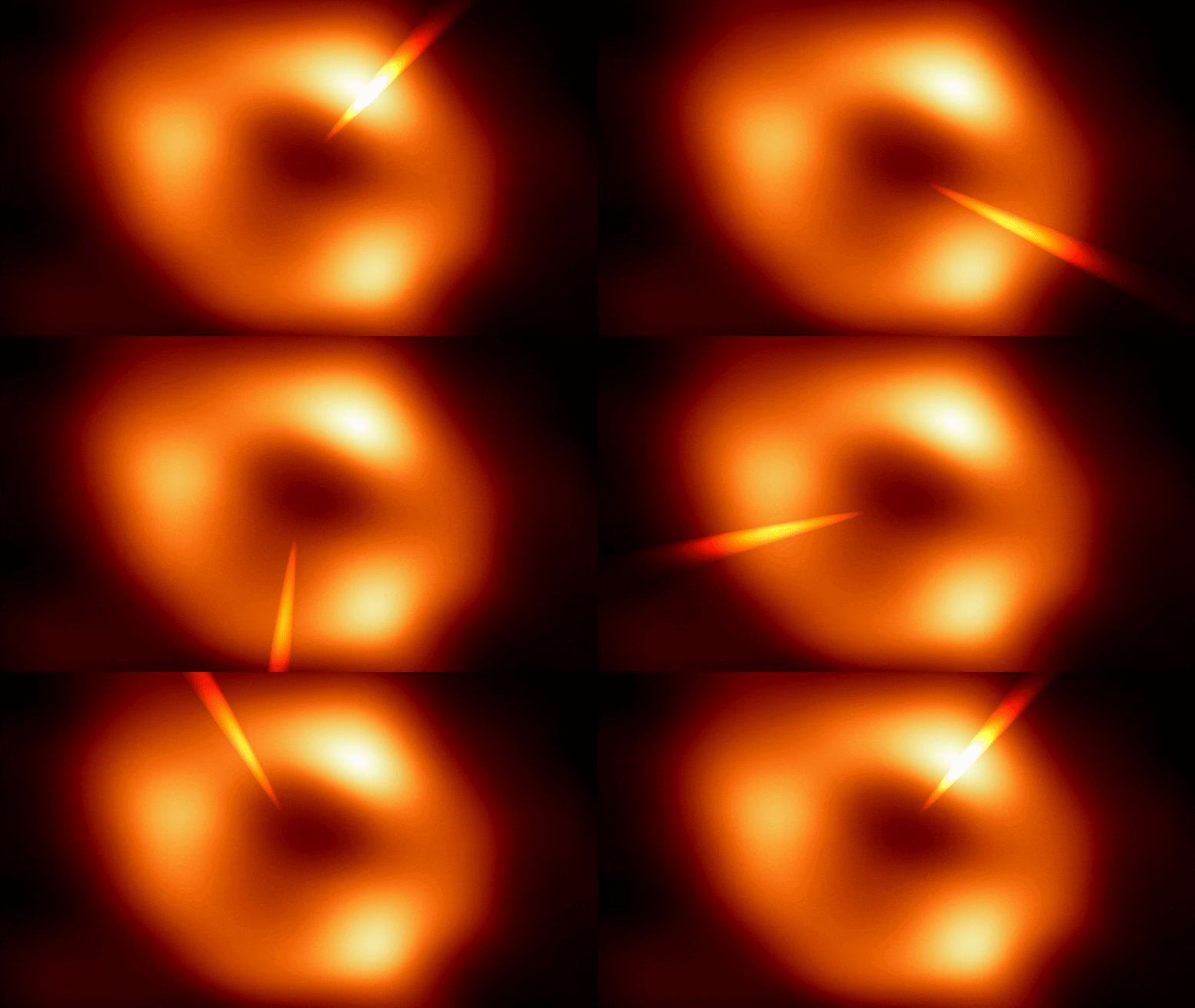
    EHT Sagittarius A* Black Hole Sonification
    EHT Sagittarius A* Black Hole Sonification. Credit: Radio: EHT Collaboration; X-ray (NASA/CXC/SAO); Infrared (NASA/HST/STScI)

    This is a sonification — translation into sound — of the latest image from the Event Horizon Telescope (EHT) of the supermassive black hole at the center of the Milky Way called Sagittarius A* (Sgr A*). Using a radar-like scan, the sonification begins at the 12 o’clock position and sweeps clockwise. Changes in the volume represent the differences in brightness the EHT observed around the event horizon of Sgr A*. The material that is closer to the black hole and hence moving faster corresponds to higher frequencies of sound. This sonification was processed in a special way to allow a listener to hear the data in 3D stereo sound, in which the sounds seem to start directly ahead and then move clockwise to one ear and then the other as the sweep is made.

    About the Sound:

    • This is a radar-like scan, starting from 12 o’clock and moving clockwise.
    • The brightness controls the volume and the radial position controls the frequencies that are present.
    • The emission from material closer to the black hole (which orbits faster) is mapped to higher frequencies.
    • The sound is rendered in binaural audio. When listened to with headphones, the sound will appear to start directly in front of you and then move clockwise all the way around your head.
    • Listen for the three bright regions at about 1, 5, and 9 o’clock, as well as the very low tones indicating fainter light from outside the main ring.

    Sonification Credit: NASA/CXC/SAO/K.Arcand, SYSTEM Sounds (M. Russo, A. Santaguida);

    Image Credit: Radio: EHT Collaboration; X-ray (NASA/CXC/SAO); Infrared (NASA/HST/STScI)

    Never miss a breakthrough: Join the SciTechDaily newsletter.
    Follow us on Google and Google News.

    Black Hole Chandra X-ray Observatory Event Horizon Telescope Popular
    Share. Facebook Twitter Pinterest LinkedIn Email Reddit

    Related Articles

    World’s Most Powerful Telescopes Unite in Unprecedented Observations of Famous Black Hole

    NASA Telescopes Reveal That Sagittarius A* May Be Producing Neutrinos

    Astronomers Measure Distant Black Hole’s Spin

    NASA Image of the Day – Black Holes Have Simple Feeding Habits

    NASA Data Suggests Black Holes Abundant Among the Earliest Stars

    Survey Reveals “Ultramassive” Black Holes Weighing 40 billion Times the Mass of the Sun

    Evidence Suggests Black Holes Can “Change Gears”

    Spacecraft to Explore Supermassive Black Holes at Center of Galaxies

    NASA’s Chandra Finds 20 Million MPH Wind

    15 Comments

    1. John Mausen on May 16, 2022 9:45 am

      Sound doesn’t travel in a vacuum. I don’t know what this is, but it’s definitely not sound from a black hole.

      Reply
    2. SilversX on May 16, 2022 10:07 am

      I agree John. This is just a blurred photo of some low watt lights with an animation and sound to mess with peoples minds. Oh my I can here a black hole from Uranus wha… yeah ok, and I got a bridge for sale.

      Reply
    3. Alan on May 16, 2022 5:38 pm

      Obviously the BH doesn’t emit sound in vacuum, this is a down frequency translation converted to sound, is just a modest appreciation for the masses to understand something of the universe mechanism

      Reply
    4. Chris on May 16, 2022 6:20 pm

      Sound doesn’t travel in a vacuum, but other types of waves do. These waves can be “translated” into sound that humans can hear. This process is called sonification, and has led to discoveries that would have been overlooked otherwise.

      Reply
    5. Bill G. on May 16, 2022 7:15 pm

      Why reply to people who don’t read the article? The description of the process was stated.

      Reply
    6. M on May 16, 2022 9:29 pm

      Yeah. No kidding sound doesn’t travel in a vaccuum. What we can do though is create an emulator that translates light into sound based on what that type of radiation would sound like if experienced under air pressure. It’s not that hard to understand. But. Hey. Conspiracy theories in these two comments. Way more believable.

      Reply
    7. Me on May 16, 2022 11:58 pm

      How stupid do they really think we are? So you can just about see Pluto from a telescope on earth, and you need to send up robots to take pictures of Mars, yet you can take pictures from way beyond our own galaxy of another galaxy? And now they say they can hear the sound of the black hole from that distance!? Complete rubbish!
      Ooohhh I’ve lost all the data to get to the moon! But now I can take pictures and hear sounds from other galaxy’s. OK nasa 👌

      Reply
    8. Hema Jain on May 17, 2022 8:13 am

      Ppl r dumbass ,who keep 9n commenting ridiculous things without prior knowledge…these sound effects r took by researchers through converting the pressure waves into audio .
      .

      Reply
    9. Liz on May 17, 2022 8:30 am

      Pressure waves, people…they sonified pressure waves.

      Reply
    10. e on May 17, 2022 11:37 am

      e

      Reply
    11. lisa on May 17, 2022 11:43 am

      To the guy who said e.
      Thank you.

      Reply
    12. Kianu on May 17, 2022 11:45 am

      To dumb it down.. Its sound produced from the waves of the image…
      I personally think a black hole will have a dusturbing “hum” rather. It’s cool to theorize rather than jumping down our throats about consipiracy theories. Open your mind people.

      Reply
    13. e on May 17, 2022 11:47 am

      e.

      Reply
    14. Dick on May 20, 2022 7:04 am

      I was expecting something more like a Metallica riff but o.k.

      Reply
    15. Adam on May 20, 2022 5:24 pm

      Me – are you a flat earther? You sound like an absolute moron, I suggest you read up about the Event Horizon Telescope project and science in general before you give your dumb opinions.

      Reply
    Leave A Reply Cancel Reply

    • Facebook
    • Twitter
    • Pinterest
    • YouTube

    Don't Miss a Discovery

    Subscribe for the Latest in Science & Tech!

    Trending News

    Artificial Sweeteners May Harm Future Generations, Study Suggests

    Splashdown! NASA Artemis II Returns From Record-Breaking Moon Mission

    What If Consciousness Exists Beyond Your Brain

    Scientists Finally Crack the 100-Million-Year Evolutionary Mystery of Squid and Cuttlefish

    Beyond “Safe Levels”: Study Challenges What We Know About Pesticides and Cancer

    Researchers Have Found a Dietary Compound That Increases Longevity

    Scientists Baffled by Bizarre “Living Fossil” From 275 Million Years Ago

    Your IQ at 23 Could Predict Your Wealth at 27, Study Finds

    Follow SciTechDaily
    • Facebook
    • Twitter
    • YouTube
    • Pinterest
    • Newsletter
    • RSS
    SciTech News
    • Biology News
    • Chemistry News
    • Earth News
    • Health News
    • Physics News
    • Science News
    • Space News
    • Technology News
    Recent Posts
    • Why Losing Too Much Fat Can Be Just As Dangerous as Obesity
    • Beef vs. Chicken: Surprising Results From New Prediabetes Study
    • Alzheimer’s Breakthrough: Scientists Discover Key Protein May Prevent Toxic Protein Clumps in the Brain
    • Scientists Discover New Way To Make Protein Shakes Taste Better
    • Scientists Break Optical Limits With Quantum Dot-Powered Nanoscopy
    Copyright © 1998 - 2026 SciTechDaily. All Rights Reserved.
    • Science News
    • About
    • Contact
    • Editorial Board
    • Privacy Policy
    • Terms of Use

    Type above and press Enter to search. Press Esc to cancel.