
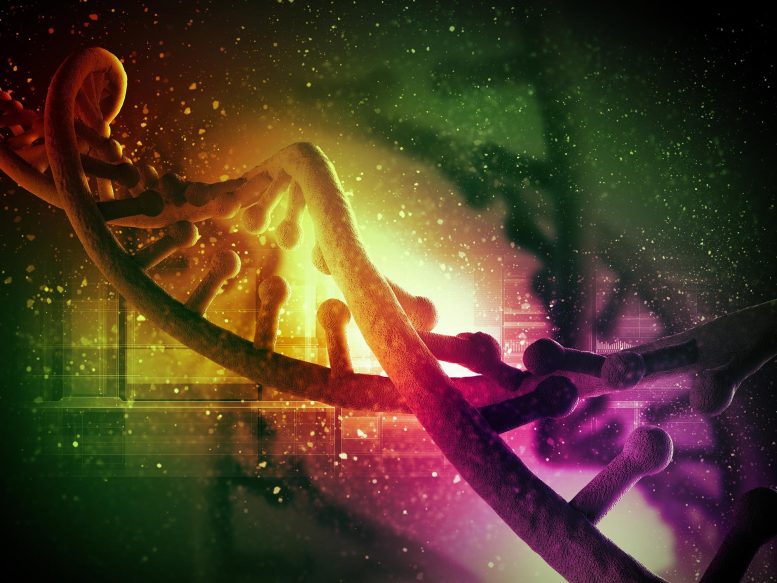
Researchers discovered that quantum tunneling in DNA hydrogen bonds can cause mutations during replication. Protons tunnel between DNA strands, sometimes leading to base pairing errors.
The molecules of life, DNA, replicate with astounding precision, yet this process is not immune to mistakes and can lead to mutations. Using sophisticated computer modeling, a team of physicists and chemists at the University of Surrey has shown that such errors in copying can arise due to the strange rules of the quantum world.
The two strands of the famous DNA double helix are linked together by subatomic particles called protons – the nuclei of atoms of hydrogen – which provide the glue that bonds molecules called bases together. These so-called hydrogen bonds are like the rungs of a twisted ladder that makes up the double helix structure discovered in 1952 by James Watson and Francis Crick based on the work of Rosalind Franklin and Maurice Wilkins.
Quantum Tunneling and DNA Mutations
Normally, these DNA bases (called A, C, T, and G) follow strict rules on how they bond together: A always bonds to T and C always to G. This strict pairing is determined by the molecules’ shape, fitting them together like pieces in a jigsaw, but if the nature of the hydrogen bonds changes slightly, this can cause the pairing rule to break down, leading to the wrong bases being linked and hence a mutation. Although predicted by Crick and Watson, it is only now that sophisticated computational modeling has been able to quantify the process accurately.
The team, part of Surrey’s research program in the exciting new field of quantum biology, have shown that this modification in the bonds between the DNA strands is far more prevalent than has hitherto been thought. The protons can easily jump from their usual site on one side of an energy barrier to land on the other side. If this happens just before the two strands are unzipped in the first step of the copying process, then the error can pass through the replication machinery in the cell, leading to what is called a DNA mismatch and, potentially, a mutation.
Protons, Energy Barriers, and the Mechanism of Tunneling
In a paper that will be published today (May 5, 2022) in the journal Nature Communications Physics, the Surrey team based in the Leverhulme Quantum Biology Doctoral Training Centre used an approach called open quantum systems to determine the physical mechanisms that might cause the protons to jump across between the DNA strands. But, most intriguingly, it is thanks to a well-known yet almost magical quantum mechanism called tunneling – akin to a phantom passing through a solid wall – that they manage to get across.
It had previously been thought that such quantum behavior could not occur inside a living cell’s warm, wet, and complex environment. However, the Austrian physicist Erwin Schrödinger had suggested in his 1944 book What is Life? that quantum mechanics can play a role in living systems since they behave rather differently from inanimate matter. This latest work seems to confirm Schrödinger’s theory.
In their study, the authors determine that the local cellular environment causes the protons, which behave like spread-out waves, to be thermally activated and encouraged through the energy barrier. In fact, the protons are found to be continuously and very rapidly tunneling back and forth between the two strands. Then, when the DNA is cleaved into its separate strands, some of the protons are caught on the wrong side, leading to an error.
Dr. Louie Slocombe, who performed these calculations during his PhD, explains that:
“The protons in the DNA can tunnel along the hydrogen bonds in DNA and modify the bases which encode the genetic information. The modified bases are called “tautomers” and can survive the DNA cleavage and replication processes, causing “transcription errors” or mutations.”
Dr. Slocombe’s work at the Surrey’s Leverhulme Quantum Biology Doctoral Training Centre was supervised by Prof Jim Al-Khalili (Physics, Surrey) and Dr Marco Sacchi (Chemistry, Surrey) and published in Communications Physics.
Prof Al-Khalili comments:
“Watson and Crick speculated about the existence and importance of quantum mechanical effects in DNA well over 50 years ago, however, the mechanism has been largely overlooked.”
Dr. Sacchi continues:
“Biologists would typically expect tunneling to play a significant role only at low temperatures and in relatively simple systems. Therefore, they tended to discount quantum effects in DNA. With our study, we believe we have proved that these assumptions do not hold.”
Reference: “An open quantum systems approach to proton tunnelling in DNA” by Louie Slocombe, Marco Sacchi and Jim Al-Khalili, 5 May 2022, Communications Physics.
DOI: 10.1038/s42005-022-00881-8
The Leverhulme Trust was established by the Will of William Hesketh Lever, the founder of Lever Brothers. Since 1925 the Trust has provided grants and scholarships for research and education. Today, it is one of the largest all-subject providers of research funding in the UK, distributing approximately £100m a year.
Never miss a breakthrough: Join the SciTechDaily newsletter.
Follow us on Google and Google News.
2 Comments
Does that mean that our evolution here is tied to evolution everywhere in the Universe?
ANO