
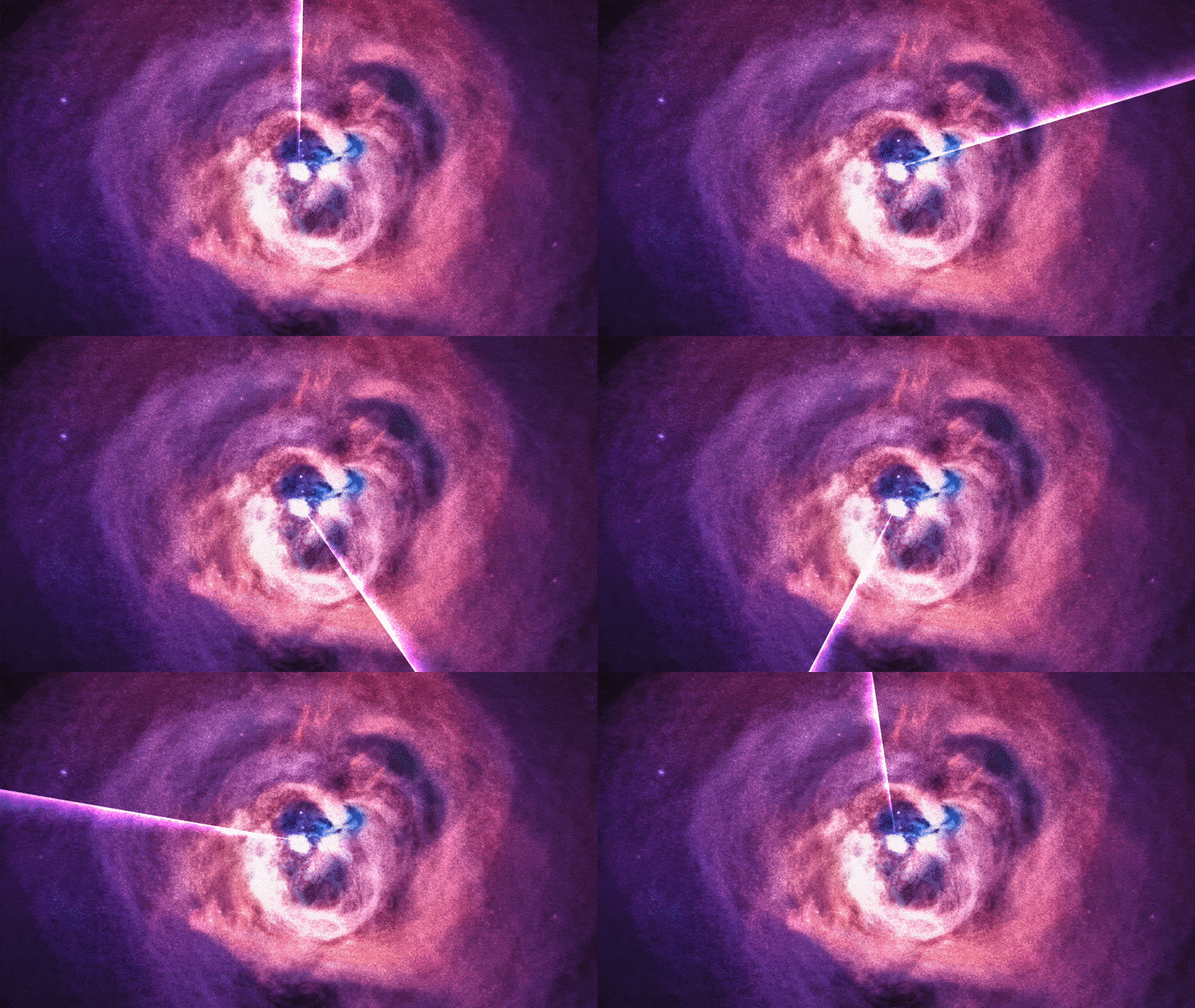
- Two new sonifications of well-known black holes have been released for NASA’s Black Hole Week.
- The Perseus galaxy cluster was made famous because of sound waves detected around its black hole by NASA’s Chandra X-ray Observatory in 2003.
- Scanning like a radar around the image, the data have been resynthesized and scaled up by 57 and 58 octaves into the human hearing range.
- For M87, listeners can hear representations of three different wavelengths of light — X-ray, optical, and radio — around this giant black hole.
Black Hole at the Center of the Perseus Galaxy Cluster
Since 2003, the black hole at the heart of the Perseus galaxy cluster has been associated with sound. This is because astronomers discovered that pressure waves emitted by the black hole generated ripples in the cluster’s hot gas that could be translated into a note — one that humans cannot hear some 57 octaves below middle C. Now a new sonification brings more notes to this black hole sound machine. This new sonification — that is, the translation of astronomical data into sound — is being released for NASA’s Black Hole Week 2022.
New sonification of the black hole at the center of the Perseus galaxy cluster. Credit: NASA/CXC/SAO/K.Arcand, SYSTEM Sounds (M. Russo, A. Santaguida)
In some ways, this sonification is unlike any other done before because it revisits the actual sound waves discovered in data from NASA’s Chandra X-ray Observatory. The popular misconception that there is no sound in space originates with the fact that most of space is essentially a vacuum, providing no medium for sound waves to propagate through. A galaxy cluster, on the other hand, has copious amounts of gas that envelop the hundreds or even thousands of galaxies within it, providing a medium for the sound waves to travel.
In this new sonification of Perseus, the sound waves astronomers previously identified were extracted and made audible for the first time. The sound waves were extracted in radial directions, that is, outwards from the center. The signals were then resynthesized into the range of human hearing by scaling them upward by 57 and 58 octaves above their true pitch. Another way to put this is that they are being heard 144 quadrillion and 288 quadrillion times higher than their original frequency. (A quadrillion is 1,000,000,000,000,000.) The radar-like scan around the image allows you to hear waves emitted in different directions. In the visual image of these data, blue and purple both show X-ray data captured by Chandra.
New sonification of the black hole at the center of galaxy M87. Credit: NASA/CXC/SAO/K.Arcand, SYSTEM Sounds (M. Russo, A. Santaguida)
Black Hole at the Center of Galaxy M87
In addition to the Perseus galaxy cluster, a new sonification of another famous black hole is being released. Studied by scientists for decades, the black hole in Messier 87, or M87, gained celebrity status in science after the first release from the Event Horizon Telescope (EHT) project in 2019. This new sonification does not feature the EHT data, but rather looks at data from other telescopes that observed M87 on much wider scales at roughly the same time. The image in visual form contains three panels that are, from top to bottom, X-rays from Chandra, optical light from NASA’s Hubble Space Telescope, and radio waves from the Atacama Large Millimeter Array in Chile. The brightest region on the left of the image is where the black hole is found, and the structure to the upper right is a jet produced by the black hole. The jet is produced by material falling onto the black hole. The sonification scans across the three-tiered image from left to right, with each wavelength mapped to a different range of audible tones. Radio waves are mapped to the lowest tones, optical data to medium tones, and X-rays detected by Chandra to the highest tones. The brightest part of the image corresponds to the loudest portion of the sonification, which is where astronomers find the 6.5-billion solar mass black hole that EHT imaged.
These sonifications were led by the Chandra X-ray Center (CXC) and included as part of NASA’s Universe of Learning (UoL) program with additional support from NASA’s Hubble Space Telescope/Goddard Space Flight Center. The collaboration was driven by visualization scientist Kimberly Arcand (CXC), astrophysicist Matt Russo, and musician Andrew Santaguida (both of the SYSTEMS Sound project). NASA’s Marshall Space Flight Center manages the Chandra program. The Smithsonian Astrophysical Observatory’s Chandra X-ray Center controls science from Cambridge Massachusetts and flight operations from Burlington, Massachusetts. NASA’s Universe of Learning materials are based upon work supported by NASA under cooperative agreement award number NNX16AC65A to the Space Telescope Science Institute, working in partnership with Caltech/IPAC, Center for Astrophysics | Harvard & Smithsonian, and the Jet Propulsion Laboratory.
Never miss a breakthrough: Join the SciTechDaily newsletter.
Follow us on Google and Google News.
4 Comments
Light can’t scape but sound can. How funny 😂🤣😂🤣
Bend over and fart BLACK HOLE SOUNDS. BRILLIANT I KNOW.
This is serious technologicall advancement movement I have ever heard in history.
Sounds like the meditation of many monks chanting mantras. Deep resonant sound like the droning of thousands of bees. Extroidanary! Thank you.