
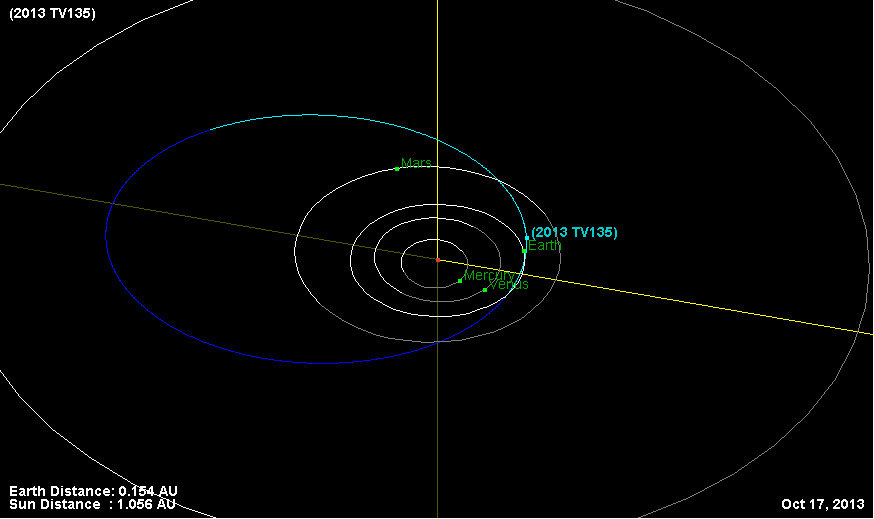
Asteroid 2013 TV135 was discovered on October 8, 2013, roughly three weeks after it made a “close” approach to Earth.
Newly discovered asteroid 2013 TV135 made a close approach to Earth on September 16, when it came within about 4.2 million miles (6.7 million kilometers). The asteroid is initially estimated to be about 1,300 feet (400 meters) in size and its orbit carries it as far out as about three-quarters of the distance to Jupiter’s orbit and as close to the sun as Earth’s orbit. It was discovered on October 8, 2013, by astronomers working at the Crimean Astrophysical Observatory in Ukraine. As of October 14, asteroid 2013 TV135 is one of 10,332 near-Earth objects that have been discovered.
With only a week of observations for an orbital period that spans almost four years, its future orbital path is still quite uncertain, but this asteroid could be back in Earth’s neighborhood in 2032. However, NASA’s Near-Earth Object Program Office states the probability this asteroid could then impact Earth is only one in 63,000. The object should be easily observable in the coming months and once additional observations are provided to the Minor Planet Center in Cambridge, Massachusetts, the initial orbit calculations will be improved and the most likely result will be a dramatic reduction, or complete elimination, of any risk of Earth impact.
“To put it another way, that puts the current probability of no impact in 2032 at about 99.998 percent,” said Don Yeomans, manager of NASA’s Near-Earth Object Program Office at the Jet Propulsion Laboratory in Pasadena, California. “This is a relatively new discovery. With more observations, I fully expect we will be able to significantly reduce, or rule out entirely, any impact probability for the foreseeable future.”
NASA detects, tracks, and characterizes asteroids and comets passing close to Earth using both ground- and space-based telescopes. The Near-Earth Object Observations Program, commonly called “Spaceguard,” discovers these objects, characterizes a subset of them, and identifies their orbits to determine if any could be potentially hazardous to our planet.
JPL manages the Near-Earth Object Program Office for NASA’s Science Mission Directorate in Washington. JPL is a division of the California Institute of Technology in Pasadena.
More information about asteroids and near-Earth objects is at: http://www.jpl.nasa.gov/asteroidwatch.
Never miss a breakthrough: Join the SciTechDaily newsletter.
Follow us on Google and Google News.
4 Comments
Every asteroid travelling towards the Sun will strike the gas giants like Jupiter and Saturn or got caught in the asteroid belt. The frequency of impact on earth will be spaced in epochs of very large time duration. They can strike the earth with big asteroids only in the Cambrian Age, Pre-Cambrian age, Calciferous age, Jurassic age etc and the present age is immune to it with lots of more milleniums to go and never in 2030. In cosmic scale their trajectories towards this tiny earth can easily be distorted by super giants like Jupiter, Saturn etc.Thank You.
Technically, 1:63000 is “comparatively high” odds as cosmic impacts go. Considering there’s like 10,000 Near-Earth Objects being tracked, if they ALL had those kind of odds, that’d raise your odds of getting smacked by at least one of them to, what, 1:6??
I hate this site; I wish my friends would quit linking to it. You lot never get anything quite right.
The article clearly states, “NASA’s Near-Earth Object Program Office states the probability this asteroid could then impact Earth is only one in 63,000.” The odds are based on this asteroid, not the combined likelihood of all NEOs.
I’m aware of additive probability; I also clearly state “if”. My point, which apparently got lost, is do you realize that 1:63,000 odds are comparatively actually quite high? Your odds of being hit by lightening in any given year are 1:500,000. Your odds of winning a state powerball, for comparison, are 1:175,223,510.
Compare 63,000 to NSC “causes of death” odds…So this thing is twice as likely to hit the Earth than you, or me, personally, are to die from a dog bite, or storms, and roughly as likely as you dying from bee stings, or in a fire. That’s *really* high for something this major. You should stop feeling like you should say “only” 1:63000, and feel free to upgrade it to “OMG 1:63,000, we’re all going to die1!1!” …It’s good enough for TIME, apparently.