
Close Menu
    Facebook X (Twitter) Instagram
    SciTechDaily
    • Biology
    • Chemistry
    • Earth
    • Health
    • Physics
    • Science
    • Space
    • Technology
    Facebook X (Twitter) Pinterest YouTube RSS
    SciTechDaily
    Home»Space»Astronomers Discover 5,400 mph Winds on Exoplanet HD 189733b
    Space

    Astronomers Discover 5,400 mph Winds on Exoplanet HD 189733b

    By Tom Frew, University of WarwickNovember 18, 2015No Comments4 Mins Read
    Facebook Twitter Pinterest Telegram LinkedIn WhatsApp Email Reddit
    Share
    Facebook Twitter LinkedIn Pinterest Telegram Email Reddit
    5,400 mph Winds Discovered Hurtling around Exoplanet HD 189733b
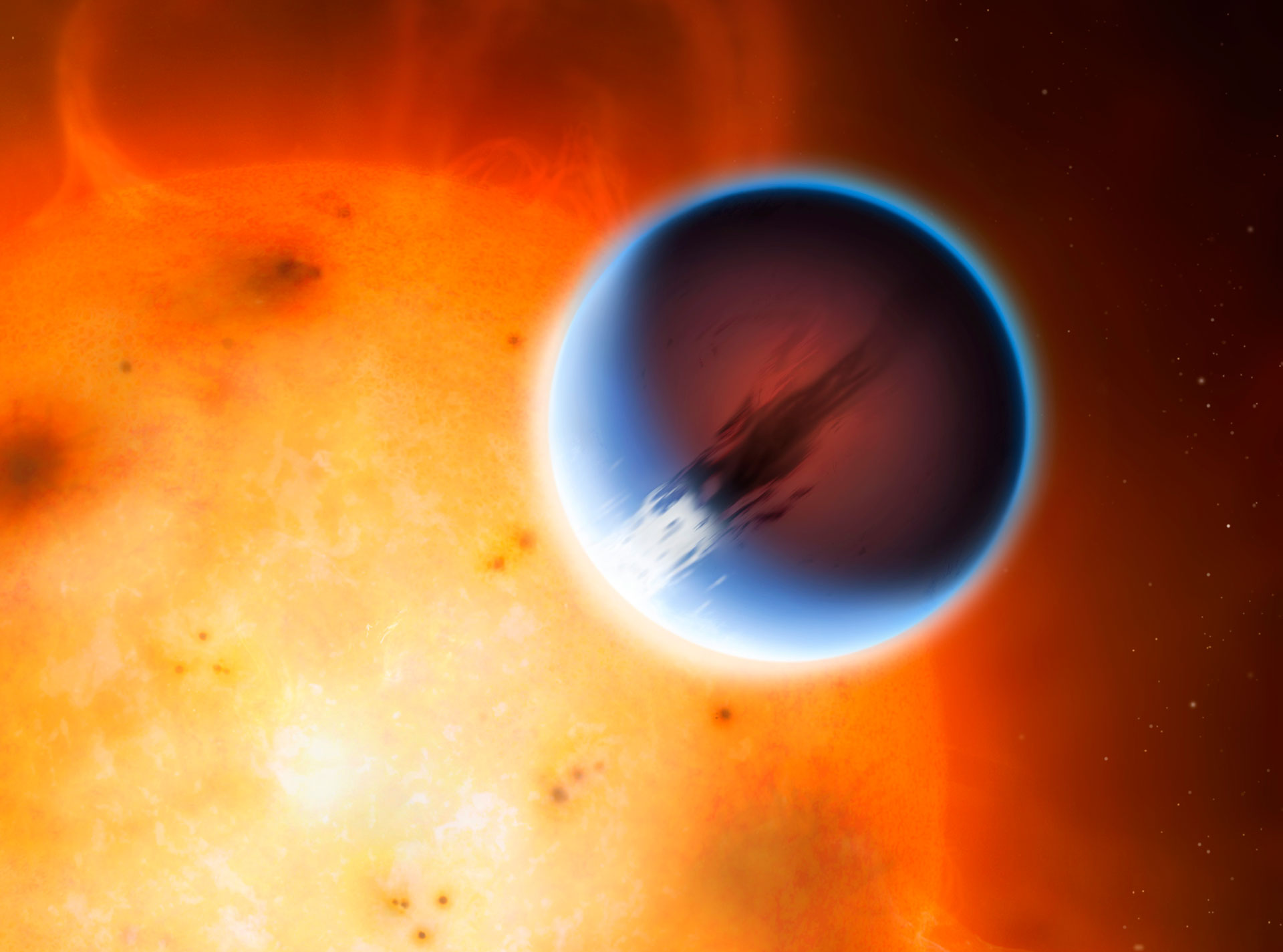
    The planet HD 189733b is shown here in front of its parent star. A belt of wind around the equator of the planet travels at 5,400 mph from the heated day side to the night side. The day side of the planet appears blue due to scattering of light from silicate haze in the atmosphere. The night side of the planet glows a deep red due to its high temperature. Credit: Mark A. Garlick/University of Warwick

    New research from the University of Warwick reveals that exoplanet HD 189733b has winds of over 5,400 mph blowing from its day side to its night side.

    The University of Warwick discovery is the first time that a weather system on a planet outside of Earth’s solar system has been directly measured and mapped. The wind speed recorded is 20x greater than the fastest ever known on earth, where it would be seven times the speed of sound.

    Commenting on the discovery lead researcher Tom Louden, of the University of Warwick’s Astrophysics group, said: “This is the first ever weather map from outside of our solar system. Whilst we have previously known of wind on exoplanets, we have never before been able to directly measure and map a weather system.”

    Discovered on the exoplanet HD 189733b, the Warwick researchers measured the velocities on the two sides of HD 189733b and found a strong wind moving at over 5,400 mph (2,400 m/s) blowing from its day side to its night side. Mr Louden explains: “HD 189733b’s velocity was measured using high resolution spectroscopy of the Sodium absorption featured in its atmosphere. As parts of HD 189733b’s atmosphere move towards or away from the Earth the Doppler effect changes the wavelength of this feature, which allows the velocity to be measured”.

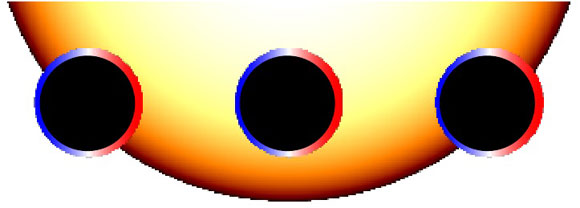
    Explaining how this information was used to measure velocity Mr Louden says: “The surface of the star is brighter at the center than it is at the edge, so as the planet moves in front of the star the relative amount of light blocked by different parts of the atmosphere changes. For the first time, we’ve used this information to measure the velocities on opposite sides of the planet independently, which gives us our velocity map.”
    Spatially Resolved Eastward Winds and Rotation of HD 189733b
    The planet is shown at three positions as it crosses its parent star. The changing background illumination allows us to separate absorption from different parts of the planetary atmosphere. By measuring the Doppler shift of the absorption we are able to measure wind velocities. The blue-shaded region of the atmosphere is moving toward the Earth at 12,000 mph (5,400 m/s), while the red-shaded region is moving away from the Earth at 5,000 mph (2,200 m/s). After correcting for the expected spin of the planet we measure a wind velocity of 5,400 mph on the blue side, indicating a strong eastward wind flow from the heated day side to the night side of the planet.

    The researchers say that the techniques used could help the study of Earth-like planets. Co-researcher, Dr Peter Wheatley of the University of Warwick’s Astrophysics Group explains: “We are tremendously excited to have found a way to map weather systems on distant planets. As we develop the technique further we will be able to study wind flows in increasing detail and make weather maps of smaller planets. Ultimately this technique will allow us to image the weather systems on Earth-like planets.”

    HD 189733b is one of the most studied of a class of planets known as ‘Hot Jupiters’. At over 10% larger than Jupiter, but 180x closer to its star, HD 189733b has a temperature of 1,200ºC (2,200ºF). Its size and relative closeness to our solar system make it a popular target for astronomers. Past research has shown that the day side of the planet would appear a bright shade of blue to the human eye, probably due to clouds of silicate particles high in its atmosphere.

    The data was collected by HARPS, the High Accuracy Radial velocity Planet Searcher, in La Silla, Chile.

    The research, Spatially resolved eastward winds and rotation of HD 189733b, is published by Astrophysical Journal Letters.

    Reference: “Spatially resolved eastward winds and rotation of HD189733b” by Tom Louden and Peter J. Wheatley, 25 November 2015, The Astrophysical Journal Letters.
    DOI: 10.1088/2041-8205/814/2/L24
    arXiv:1511.03689

    Never miss a breakthrough: Join the SciTechDaily newsletter.
    Follow us on Google and Google News.

    Astronomy Astrophysics Exoplanet Planetary Science Popular University of Warwick
    Share. Facebook Twitter Pinterest LinkedIn Email Reddit

    Related Articles

    JWST Reveals a “Forbidden” Planet With a Baffling Composition

    Scientists Say This Hellish “Day-Night” Planet May Support Life

    A Sun-Like Star Went Dark for 9 Months – Astronomers Just Found Out Why

    Webb Telescope Spots “Impossible” Atmosphere Around Ancient Super-Earth

    “What the Heck Is This?” – Astronomers Discover Entirely New Type of Exoplanet With Bizarre Atmosphere

    James Webb Detects Strongest Evidence Yet of an Atmosphere on a Rocky Exoplanet

    Astronomers Stunned by Bizarre Three-Planet System That Rewrites the Rules of Space

    NASA’s Webb Just Found a Hidden Moon Factory Beyond Our Solar System

    New Study Revives Doubted Exoplanet Fomalhaut b

    Leave A Reply Cancel Reply

    • Facebook
    • Twitter
    • Pinterest
    • YouTube

    Don't Miss a Discovery

    Subscribe for the Latest in Science & Tech!

    Trending News

    Scientists May Have Found the Key to Jupiter and Saturn’s Moon Mystery

    Scientists Uncover Brain Changes That Link Pain to Depression

    Saunas May Do More Than Raise Body Temperature – They Activate Your Immune System

    Exercise in a Pill? Metformin Shows Surprising Effects in Cancer Patients

    Hidden Oceans of Magma Could Be Protecting Alien Life

    New Study Challenges Alzheimer’s Theories: It’s Not Just About Plaques

    Artificial Sweeteners May Harm Future Generations, Study Suggests

    Splashdown! NASA Artemis II Returns From Record-Breaking Moon Mission

    Follow SciTechDaily
    • Facebook
    • Twitter
    • YouTube
    • Pinterest
    • Newsletter
    • RSS
    SciTech News
    • Biology News
    • Chemistry News
    • Earth News
    • Health News
    • Physics News
    • Science News
    • Space News
    • Technology News
    Recent Posts
    • Physicists Discover a Strange New Kind of One-Dimensional Particle
    • Scientists Discover Unexpected Climate Benefit Hidden in Forest Soils
    • The Grand Canyon’s “Swiss Cheese” Rocks Hold a Critical Secret
    • Scientists Discover 430,000-Year-Old Wooden Tools, Rewriting Human History
    • Scientists Make Breakthrough on 40-Year-Old 2D Physics Puzzle
    Copyright © 1998 - 2026 SciTechDaily. All Rights Reserved.
    • Science News
    • About
    • Contact
    • Editorial Board
    • Privacy Policy
    • Terms of Use

    Type above and press Enter to search. Press Esc to cancel.