
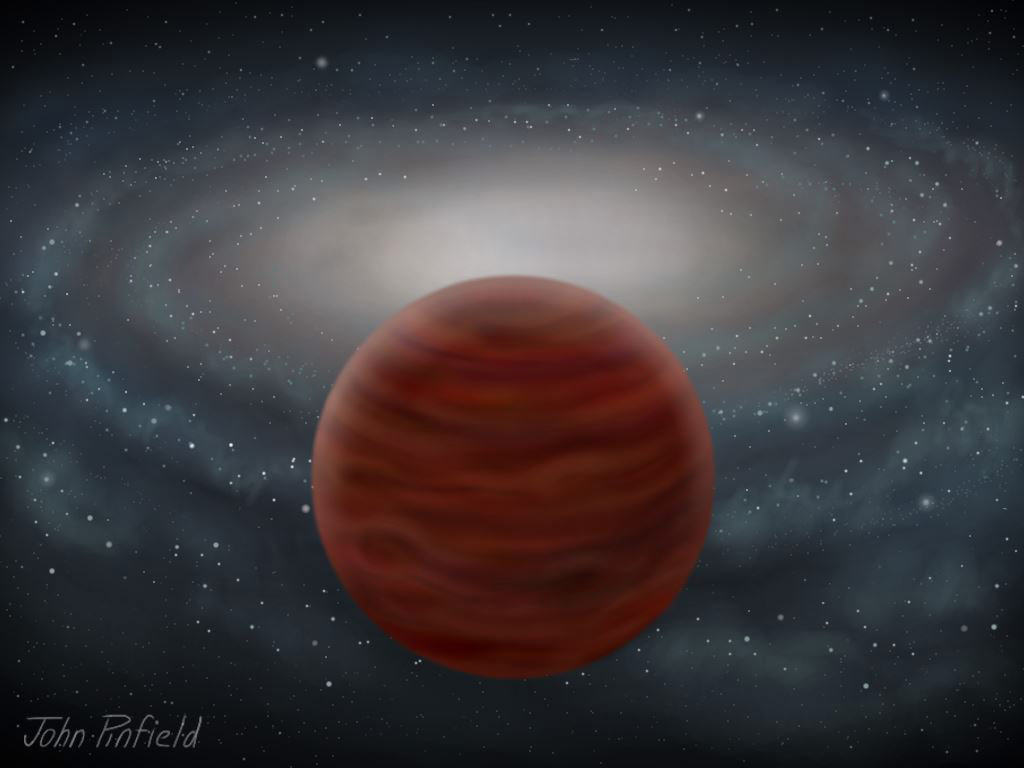
In a newly published study, astronomers detail the discovery of two ancient brown dwarfs that are moving at speeds of 100-200 kilometers per second.
A team of astronomers led by Dr David Pinfield at the University of Hertfordshire have discovered two of the oldest brown dwarfs in the Galaxy. These ancient objects are moving at speeds of 100-200 kilometers (62-124 miles) per second, much faster than normal stars and other brown dwarfs and are thought to have formed when the Galaxy was very young, more than 10 billion years ago. Intriguingly the scientists believe they could be part of a vast and previously unseen population of objects. The researchers published their results in the Oxford University Press journal Monthly Notices of the Royal Astronomical Society.
Brown dwarfs are star-like objects but are much less massive (with less than 7% of the Sun’s mass), and do not generate internal heat through nuclear fusion like stars. Because of this brown dwarfs simply cool and fade with time and very old brown dwarfs become very cool indeed – the new discoveries have temperatures of 250-600 degrees Celsius (480-1,100 degrees Fahrenheit), much cooler than stars (in comparison to the Sun has a surface temperature of 5600 degrees Celsius or 10,000 degrees Fahrenheit).
Pinfield’s team identified the new objects in the survey made by the Wide-field Infrared Survey Explorer (WISE), a NASA observatory that scanned the mid-infrared sky from orbit in 2010 and 2011. The object names are WISE 0013+0634 and WISE 0833+0052, and they lie in the Pisces and Hydra constellations respectively. Additional measurements confirming the nature of the objects came from large ground-based telescopes (Magellan, Gemini, VISTA, and UKIRT). The infrared sky is full of faint red sources, including reddened stars, faint background galaxies (large distances from our own Milky Way), and nebulous gas and dust. Identifying cool brown dwarfs in this messy mixture is akin to finding needles in a haystack. But Pinfield’s team developed a new method that takes advantage of the way in which WISE scans the sky multiple times. This allowed them to identify cool brown dwarfs that were fainter than other searches had revealed.
The team of scientists then studied the infrared light emitted from these objects, which are unusual compared to typical slower moving brown dwarfs. The spectral signatures of their light reflects their ancient atmospheres, which are almost entirely made up of hydrogen rather than having the more abundant heavier elements seen in younger stars. Pinfield comments on their venerable ages and high speeds, “Unlike in other walks of life, the Galaxy’s oldest members move much faster than its younger population”.
Stars near to the Sun (in the so-called local volume) are made up of 3 overlapping populations – the thin disk, the thick disk, and the halo. The thick disk is much older than the thin disk, and its stars move up and down at a higher velocity. Both these disk components sit within the halo that contains the remnants of the first stars that formed in the Galaxy.
Thin disk objects dominate the local volume, with thick disk and halo objects being much rarer. About 97% of local stars are thin disk members, while just 3% are from the thick-disk or halo. Brown dwarfs population numbers probably follow those of stars, which explains why these fast-moving thick-disk/halo objects are only now being discovered.
There are thought to be as many as 70 billion brown dwarfs in the Galaxy’s thin disk, and the thick disk and halo occupy much larger Galactic volumes. So even a small (3%) local population signifies a huge number of ancient brown dwarfs in the Galaxy. “These two brown dwarfs may be the tip of an iceberg and are an intriguing piece of astronomical archaeology”, said Pinfield. “We have only been able to find these objects by searching for the faintest and coolest things possible with WISE. And by finding more of them we will gain insight into the earliest epoch of the history of the Galaxy.”
Reference: “A deep WISE search for very late type objects and the discovery of two halo/thick-disc T dwarfs: WISE 0013+0634 and WISE 0833+0052” by D. J. Pinfield, J. Gomes, A. C. Day-Jones, S. K. Leggett, M. Gromadzki, B. Burningham, M. T. Ruiz, R. Kurtev, T. Cattermole, C. Cardoso, N. Lodieu, J. Faherty, S. Littlefair, R. Smart, M. Irwin, J. R. A. Clarke, L. Smith, P. W. Lucas, M. C. Gálvez-Ortiz, J. S. Jenkins, H. R. A. Jones, R. Rebolo, V. J. S. Béjar and B. Gauza, 16 November 2013, Monthly Notices of the Royal Astronomical Society.
DOI: 10.1093/mnras/stt1437
arXiv:1308.0495
Never miss a breakthrough: Join the SciTechDaily newsletter.
Follow us on Google and Google News.
2 Comments
“100-200 kilometers per second” relative to what?
“100-200 km/s” is the instantaneous velocity of rotation around the dwarfs’ star. To put this into perspective, the earth’s instantaneous velocity around the sun is about 30 km/s, which means that these dwarfs’ travel 3-6 times faster than the earth does around the sun.