
Close Menu
    Facebook X (Twitter) Instagram
    SciTechDaily
    • Biology
    • Chemistry
    • Earth
    • Health
    • Physics
    • Science
    • Space
    • Technology
    Facebook X (Twitter) Pinterest YouTube RSS
    SciTechDaily
    Home»Space»New Earth-Like Planet HD 40307g May Be Capable of Supporting Life
    Space

    New Earth-Like Planet HD 40307g May Be Capable of Supporting Life

    By University of HertfordshireNovember 8, 20121 Comment4 Mins Read
    Facebook Twitter Pinterest Telegram LinkedIn WhatsApp Email Reddit
    Share
    Facebook Twitter LinkedIn Pinterest Telegram Email Reddit
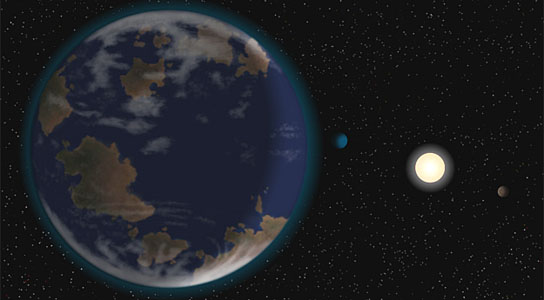
    artist's impression shows HD40307g
    This artist’s impression shows HD40307g in the foreground (on the left hand side), with its host star HD40307 and two other planets in the system (on the right-hand side). The depicted atmosphere and continents are not detected or constrained by this work. Credit: J. Pinfield, for the RoPACS network at the University of Hertfordshire

    An international team of astronomers has discovered a new Earth-like planet, known as HD 40307g, that may be capable of supporting life and is located forty-two light-years from Earth.

    A new super-Earth planet that may have an Earth-like climate and be just right to support life has been discovered around a nearby star by an international team of astronomers, led by Mikko Tuomi, University of Hertfordshire, and Guillem Anglada-Escude, University of Goettingen.

    The new super-Earth planet exists in the habitable zone of a nearby star and is part of a six-planet system. The system was previously thought to contain three planets in orbits too close to the star to support liquid water. By avoiding fake signals caused by stellar activity, the researchers have identified three new super-Earth planet candidates also in orbit.

    Mikko Tuomi said: “We pioneered new data analysis techniques including the use of the wavelength as a filter to reduce the influence of activity on the signal from this star. This significantly increased our sensitivity and enabled us to reveal three new super-Earth planets around the star known as HD 40307, making it into a six-planet system.”

    Of the new planets, the one of greatest interest is the one with the outermost orbit from the star – with a mass at least seven times of the Earth. Its orbit around the host star is at a similar distance to Earth’s orbit around our Sun, so it receives a similar amount of energy from the star as the Earth receives from the Sun – increasing the probability of it being habitable. This is where the presence of liquid water and stable atmospheres to support life is possible and, more importantly, the planet is likely to be rotating on its own axis as it orbits around the star creating a daytime and night-time effect on the planet which would be better at creating an Earth-like environment.

    Guillem Angla-Escude said: “The star HD 40307, is a perfectly quiet old dwarf star, so there is no reason why such a planet could not sustain an Earth-like climate.”

    Hugh Jones, University of Hertfordshire, added: “The longer orbit of the new planet means that its climate and atmosphere may be just right to support life. Just as Goldilocks liked her porridge to be neither too hot nor too cold but just right, this planet or indeed any moons that it has lie in an orbit comparable to Earth, increasing the probability of it being habitable.”

    Earlier this year, the Kepler spacecraft found a planet with a similar orbit. However, Kepler 22d is located 600 light-years from Earth, whereas this new super-Earth planet known as HD 40307g is much closer being located at forty-two light-years from Earth.

    Mikko Tuomi carried out this work as a member of the European science network RoPACS (Rocky Planets Around Cool Stars) – an initiative with a research focus on the search for planets around cool stars. RoPACS has pan-European membership and is led from the University of Hertfordshire by David Pinfield, who commented: “Discoveries like this are really exciting, and such systems will be natural targets for the next generation of large telescopes, both on the ground and in space.”

    Reference: “Habitable-zone super-Earth candidate in a six-planet system around the K2.5V star HD 40307” by M. Tuomi, G. Anglada-Escudé, E. Gerlach, H. R. A. Jones, A. Reiners, E. J. Rivera, S. S. Vogt and R. P. Butler, 17 December 2012, Astronomy & Astrophysics.
    DOI: 10.1051/0004-6361/201220268

    Never miss a breakthrough: Join the SciTechDaily newsletter.
    Follow us on Google and Google News.

    Astronomy Planetary Science Popular University of Hertfordshire
    Share. Facebook Twitter Pinterest LinkedIn Email Reddit

    Related Articles

    Monster Storms on Jupiter Unleash Lightning Beyond Anything on Earth

    Scientists May Have Found the Key to Jupiter and Saturn’s Moon Mystery

    Hidden Oceans of Magma Could Be Protecting Alien Life

    JWST Reveals a “Forbidden” Planet With a Baffling Composition

    Scientists Say This Hellish “Day-Night” Planet May Support Life

    Kepler Data Used to Identify 41 New Transiting Planets

    NASA’s Curiosity Readies for First Drive on Mars

    Color HiRISE Image of Curiosity Rover on Mars

    A Connection Between Volatiles in the Subsurface of Mars and the Impact Process

    1 Comment

    1. CACA on November 9, 2023 9:43 am

      hello

      Reply
    Leave A Reply Cancel Reply

    • Facebook
    • Twitter
    • Pinterest
    • YouTube

    Don't Miss a Discovery

    Subscribe for the Latest in Science & Tech!

    Trending News

    Breakthrough Bowel Cancer Trial Leaves Patients Cancer-Free for Nearly 3 Years

    Natural Compound Shows Powerful Potential Against Rheumatoid Arthritis

    100,000-Year-Old Neanderthal Fossils in Poland Reveal Unexpected Genetic Connections

    Simple “Gut Reset” May Prevent Weight Gain After Ozempic or Wegovy

    2.8 Days to Disaster: Scientists Warn Low Earth Orbit Could Suddenly Collapse

    Common Food Compound Shows Surprising Power Against Superbugs

    5 Simple Ways To Remember More and Forget Less

    The Atomic Gap That Could Cost the Semiconductor Industry Billions

    Follow SciTechDaily
    • Facebook
    • Twitter
    • YouTube
    • Pinterest
    • Newsletter
    • RSS
    SciTech News
    • Biology News
    • Chemistry News
    • Earth News
    • Health News
    • Physics News
    • Science News
    • Space News
    • Technology News
    Recent Posts
    • After 37 Years, the World’s Longest-Running Soil Warming Experiment Uncovers a Startling Climate Secret
    • NASA Satellite Captures First-Ever High-Res View of Massive Pacific Tsunami
    • ADHD Isn’t Just a Deficit: Study Reveals Powerful Hidden Strengths
    • Scientists Uncover “Astonishing” Hidden Property of Light
    • Scientists Discover Stem Cells That Could Regrow Teeth and Bone
    Copyright © 1998 - 2026 SciTechDaily. All Rights Reserved.
    • Science News
    • About
    • Contact
    • Editorial Board
    • Privacy Policy
    • Terms of Use

    Type above and press Enter to search. Press Esc to cancel.