
Close Menu
    Facebook X (Twitter) Instagram
    SciTechDaily
    • Biology
    • Chemistry
    • Earth
    • Health
    • Physics
    • Science
    • Space
    • Technology
    Facebook X (Twitter) Pinterest YouTube RSS
    SciTechDaily
    Home»Space»Astronomers Use Pan-STARRS to Detect Brown Dwarf Companion Stars
    Space

    Astronomers Use Pan-STARRS to Detect Brown Dwarf Companion Stars

    By Harvard-Smithsonian Center for AstrophysicsSeptember 3, 2013No Comments3 Mins Read
    Facebook Twitter Pinterest Telegram LinkedIn WhatsApp Email Reddit
    Share
    Facebook Twitter LinkedIn Pinterest Telegram Email Reddit
    Astronomers Study the Early Stages of Brown Dwarf Development
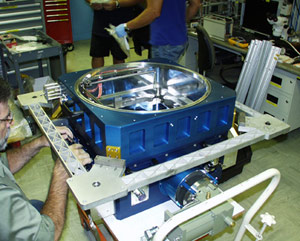
    The 1.4 billion pixel camera of the Panoramic Survey Telescope & Rapid Response System (Pan-STARRS). Astromomers have used the system to study young brown dwarf stars in binary orbits around more normal young stars. Credit: Pan-STARRS

    Using Pan-STARRS and UKIDSS, astronomers discovered 673 binaries with candidate brown dwarf companions.

    Astronomers trying to understand how the Sun and Earth formed, and why they have their characteristic properties, have made progress on a closely related problem: the nature of the lowest mass stars, so-called “brown dwarfs.” These stars have masses of less than about 8% of the Sun’s mass. They are basically failed normal stars, and lack a sufficient force of gravitational contraction to heat up their interiors to the roughly ten million kelvin temperatures needed for hydrogen burning (hydrogen burning fuels the Sun). Not surprisingly they are extremely faint and hard to detect, and as a consequence our understanding of their evolution and interior properties is incomplete. Theorists predict that there could be as many brown dwarf stars as there are normal stars.

    CfA astronomer Adam Kraus has joined with eight colleagues to use the Pan-STARRS 1 survey (the Panoramic Survey Telescope & Rapid Response System) and an infrared survey (UKIDSS) to search in a young, 5-10 million-year-old star-forming region for brown dwarfs. Pan-STARRS is a wide-field imaging telescope that combines a relatively small mirror, only 1.8 meters (6 feet), with a very large digital camera, about 1.4 billion pixels, to survey the sky on a continuous basis. The prototype single-mirror telescope PS1 has been operating on Mount Haleakala, Hawaii, since 2010; eventually, there will be four such systems working in concert.

    The astronomers were studying the very early stages of brown dwarf development, and to help obtain reliable age estimates they used these surveys to search for objects that were in a binary system with young stars whose ages might be more tightly constrained, thus constraining the brown dwarf ages as well. The survey was able to pick out objects whose cool temperatures and reddish colors signaled that they were brown dwarfs, and the team discovered 673 binaries with candidate brown dwarf companions. Spectroscopic follow-up observations on four of them allowed the team to reach several conclusions: These companion brown dwarfs are infrequent, making up only about 0.6% of binaries, at least for those in which the stars are widely spaced (closer pairs were much more difficult to study). More puzzling, the scientists found that the brown dwarf companions are well enough understood to conclude that they did not form at the same time as their more normal, companion star. The puzzling result highlights the theoretical uncertainties in our understanding of brown dwarfs, while the new technique promises many more objects to begin the task of modeling. Meanwhile, the team has begun studying brown dwarfs in more normally spaced binaries, where they could be mistaken for large planets.

    Reference: “A Pan-STARRS + UKIDSS Search for Young, Wide Planetary-Mass Companions in Upper Scorpius” by Kimberly M. Aller, Adam L. Kraus, Michael C. Liu, William S. Burgett, Kenneth C. Chambers, Klaus W. Hodapp, Nick Kaiser, Eugene A. Magnier and Paul A. Price, 25 July 2013, The Astrophysical Journal.
    DOI: 10.1088/0004-637X/773/1/63
    arXiv:1307.0506


    Never miss a breakthrough: Join the SciTechDaily newsletter.
    Follow us on Google and Google News.

    Astronomy Astrophysics Brown Dwarf Harvard-Smithsonian Center for Astrophysics
    Share. Facebook Twitter Pinterest LinkedIn Email Reddit

    Related Articles

    Harvard Astronomers Examine Y-Type Brown Dwarfs

    Coldest Brown Dwarfs Are Warmer Than Previously Thought

    Two Planets Separated by Less Than 5 Earth Moon Distances

    Study Challenges Prevailing Ideas About How Supermassive Black Holes Grow

    Calculations Show the Ideal Time to Study the Cosmos

    Using Infrared Images from Hubble & Spitzer, Scientists Discover 25 Distant Galaxies

    Supernova Shock Wave Breaks Through a Cocoon of Gas

    Astronomers Discover Radio Emissions From a Brown Dwarf

    Origins of Type Ia Supernovae

    Leave A Reply Cancel Reply

    • Facebook
    • Twitter
    • Pinterest
    • YouTube

    Don't Miss a Discovery

    Subscribe for the Latest in Science & Tech!

    Trending News

    Scientists Discover How Coffee Impacts Memory, Mood, and Gut Health

    Why Did the Neanderthals Disappear? Scientists Reveal Humans Had a Hidden Advantage

    Physicists Propose Strange Experiment Where Time Goes Quantum

    Magnesium Magic: New Drug Melts Fat Even on a High-Fat, High-Sugar Diet

    Weight-Loss Drugs Like Ozempic May Come With an Unexpected Cost

    Mezcal “Worm” in a Bottle Mystery: DNA Testing Reveals a Surprise

    New Research Reveals That Your Morning Coffee Activates an Ancient Longevity Switch

    This Is What Makes You Irresistible to Mosquitoes

    Follow SciTechDaily
    • Facebook
    • Twitter
    • YouTube
    • Pinterest
    • Newsletter
    • RSS
    SciTech News
    • Biology News
    • Chemistry News
    • Earth News
    • Health News
    • Physics News
    • Science News
    • Space News
    • Technology News
    Recent Posts
    • Scientists Turn Cancer’s Own Bacteria Against It in Breakthrough Therapy
    • Cannabis Can Make You Remember Things That Never Happened
    • Doctors Are Surprised by What This Vaccine Is Doing to the Heart
    • Quantum Breakthrough Turns Simple Forces Into Powerful New Interactions
    • Blue Origin’s New Moon Lander Passes a Crucial Test for NASA Missions
    Copyright © 1998 - 2026 SciTechDaily. All Rights Reserved.
    • Science News
    • About
    • Contact
    • Editorial Board
    • Privacy Policy
    • Terms of Use

    Type above and press Enter to search. Press Esc to cancel.