
Close Menu
    Facebook X (Twitter) Instagram
    SciTechDaily
    • Biology
    • Chemistry
    • Earth
    • Health
    • Physics
    • Science
    • Space
    • Technology
    Facebook X (Twitter) Pinterest YouTube RSS
    SciTechDaily
    Home»Space»CfA Astronomers Confirm and Characterize Exoplanet K2-33b
    Space

    CfA Astronomers Confirm and Characterize Exoplanet K2-33b

    By Harvard-Smithsonian Center for AstrophysicsSeptember 20, 2016No Comments3 Mins Read
    Facebook Twitter Pinterest Telegram LinkedIn WhatsApp Email Reddit
    Share
    Facebook Twitter LinkedIn Pinterest Telegram Email Reddit
    Astronomers Confirm and Characterize Exoplanet K2-33b
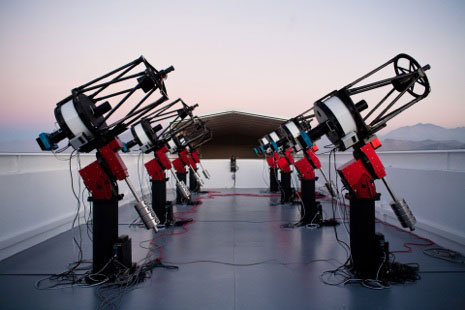
    A photo of an array of exoplanet-hunting telescopes in the MEarth Project, which emphasizes M-dwarf stars.

    Astronomers from the Harvard-Smithsonian Center for Astrophysics take a closer look at migrating exoplanets.

    Many known exoplanets orbit close to their host star, within one-tenth of an astronomical unit (one AU is the average distance of the Earth from the Sun). Since their orbital periods are therefore very short and their gravitational influences on the host star’s wobble comparatively large, they can be readily detected by the transit and velocity methods. What astronomers do not yet know is whether these planets formed near their present positions from natal circumstellar material close to their star, or if instead they formed at distances larger than an AU and subsequently migrated inwards.

    There is solid evidence for the effectiveness of migration from computer simulations and observed planetary characteristics. But there are three possible physical mechanisms for migration and (if the planets did migrate) it is not known which mechanism was responsible. The mechanisms all involve planetary interactions: with the protoplanetary disk, with a stellar companion (like a binary), or among multiple planets. Each one imposes its own set of conditions, with different timescales that offer a possible way to discriminate between them. Simulations show, for example, that migrations due to interactions with another body typically take much longer than disk migration. Therefore, close-in super-Earths or Jupiter-size planets around stars younger than one hundred million years would not have had enough time to migrate inward by a slow process such as planet–planet or planet–star interaction.

    CfA astronomers Elisabeth Newton, Jonathan Irwin, David Charbonneau, and Andrew Vanderburg and their team of colleagues have studied the close-in exoplanet K2-33b, a super-Neptune-sized object with a radius of 5.04 Earth-radii orbiting a young (only eleven million years old) star every 5.425 days. The team considered many alternative explanations to a transiting exoplanet for the light variations (like star spots) before concluding that the planet is real. Because the star is so young, they also conclude that close-in planets can form in situ, or else they must be able to migrate in short times – a possibility with planet-disk interactions but not with the other two mechanisms. A precise interpretation of the transiting data also required knowing the star’s mass and radius, which the astronomers carefully modeled, and the new result is also significant for being one of the most precise characterizations of a young star’s radius (to within 7%) and mass (to within 16%).

    Reference: “Zodiacal Exoplanets in the (ZEIT). III. A Short-Period Planet Orbiting a Pre-Main-Sequence Star in the Upper Scorpius OB Association” by Andrew W. Mann, Elisabeth R. Newton, Aaron C. Rizzuto, Jonathan Irwin, Gregory A. Feiden, Eric Gaidos, Gregory N. Mace, Adam L. Kraus, David J. James, Megan Ansdell, David Charbonneau, Kevin R. Covey, Michael J. Ireland, Daniel T. Jaffe, Marshall C. Johnson, Benjamin Kidder and Andrew Vanderburg, 18 August 2016, The Astrophysical Journal.
    DOI: 10.3847/0004-6256/152/3/61
    arXiv:1604.06165

    Never miss a breakthrough: Join the SciTechDaily newsletter.
    Follow us on Google and Google News.

    Astronomy Astrophysics Exoplanet Harvard-Smithsonian Center for Astrophysics Planetary Science
    Share. Facebook Twitter Pinterest LinkedIn Email Reddit

    Related Articles

    Kepler Detects A Super-Earth Transiting the Bright K-Dwarf HIP 116454

    Architecture of Kepler’s Multi-Transiting Systems

    A New Approach in the Search for Extraterrestrial Intelligence

    Exoplanets Can Be Divided Into Three Groups: Terrestrials, Gas Giants, and Mid-Sized Gas Dwarfs

    New Research Reveals Harsh Space Weather May Doom Potential Life on Red-Dwarf Planets

    Kepler-56b and Kepler-56c Will Be Swallowed by Their Star

    Astronomers Discover the First Earth-Mass Transiting Planet

    Water Planets in the Habitable Zone: A Closer Look at Kepler 62e and 62f

    Earth-like Planets May Have Older and More Evolved Life

    Leave A Reply Cancel Reply

    • Facebook
    • Twitter
    • Pinterest
    • YouTube

    Don't Miss a Discovery

    Subscribe for the Latest in Science & Tech!

    Trending News

    The Universe Is Expanding Too Fast and Scientists Can’t Explain Why

    “Like Liquid Metal”: Scientists Create Strange Shape-Shifting Material

    Early Warning Signals of Esophageal Cancer May Be Hiding in Plain Sight

    Common Blood Pressure Drug Shows Surprising Power Against Deadly Antibiotic-Resistant Superbug

    Scientists Uncover Dangerous Connection Between Serotonin and Heart Valve Disease

    Scientists Discover a “Protector” Protein That Could Help Reverse Hair Loss

    Bone-Strengthening Discovery Could Reverse Osteoporosis

    Scientists Uncover Hidden Trigger Behind Stem Cell Aging

    Follow SciTechDaily
    • Facebook
    • Twitter
    • YouTube
    • Pinterest
    • Newsletter
    • RSS
    SciTech News
    • Biology News
    • Chemistry News
    • Earth News
    • Health News
    • Physics News
    • Science News
    • Space News
    • Technology News
    Recent Posts
    • Scientists Overcome Major Quantum Bottleneck, Potentially Transforming Teleportation and Computing
    • Quantum Physics’ Strangest Problem May Hold the Key to Time Itself
    • Scientists Create “Liquid Gears” That Spin Without Touching
    • The Simple Habit That Could Help Prevent Cancer
    • Forgotten Medicinal Plant Shows Promise in Fighting Dangerous Superbugs
    Copyright © 1998 - 2026 SciTechDaily. All Rights Reserved.
    • Science News
    • About
    • Contact
    • Editorial Board
    • Privacy Policy
    • Terms of Use

    Type above and press Enter to search. Press Esc to cancel.