
Close Menu
    Facebook X (Twitter) Instagram
    SciTechDaily
    • Biology
    • Chemistry
    • Earth
    • Health
    • Physics
    • Science
    • Space
    • Technology
    Facebook X (Twitter) Pinterest YouTube RSS
    SciTechDaily
    Home»Space»New Research Reveals Harsh Space Weather May Doom Potential Life on Red-Dwarf Planets
    Space

    New Research Reveals Harsh Space Weather May Doom Potential Life on Red-Dwarf Planets

    By Harvard-Smithsonian Center for AstrophysicsJune 9, 2014No Comments4 Mins Read
    Facebook Twitter Pinterest Telegram LinkedIn WhatsApp Email Reddit
    Share
    Facebook Twitter LinkedIn Pinterest Telegram Email Reddit
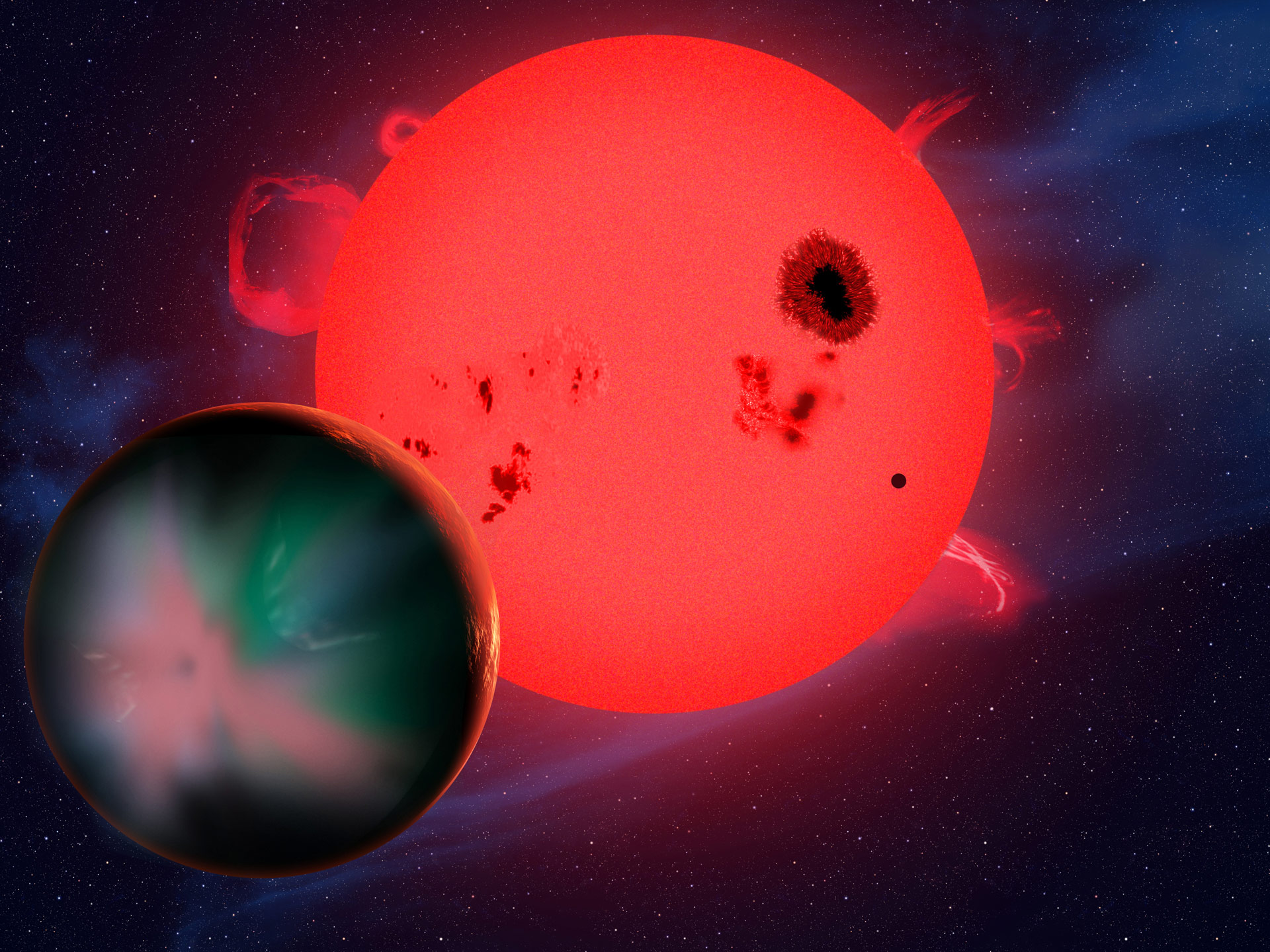
    This artist’s conception shows a hypothetical alien world orbiting a red dwarf star. Although it is in the star’s habitable zone, this planet faces an extreme space environment that is stripping its atmosphere and generating powerful aurorae. Since they are subjected to such harsh physical conditions, red dwarf planets may not be habitable after all, so life in the universe might be even rarer than we thought. Credit: David A. Aguilar (CfA)

    New research presented at the meeting of the American Astronomical Society reveals that harsh space weather may strip the atmosphere of any rocky planet orbiting in a red dwarf’s habitable zone, making the possibility of finding life as we know it less likely.

    Life in the universe might be even rarer than we thought. Recently, astronomers looking for potentially habitable worlds have targeted red dwarf stars because they are the most common type of star, comprising 80 percent of the stars in the universe. But a new study shows that harsh space weather might strip the atmosphere of any rocky planet orbiting in a red dwarf’s habitable zone.

    “A red-dwarf planet faces an extreme space environment, in addition to other stresses like tidal locking,” says Ofer Cohen of the Harvard-Smithsonian Center for Astrophysics (CfA).

    Cohen is presenting their findings in a press conference at a meeting of the American Astronomical Society.

    Earth is protected from solar eruptions and space weather by its magnetic field. Just like the shields of the Starship Enterprise, Earth’s magnetic field deflects incoming energy blasts. We also are protected by distance since Earth orbits 93 million miles from the Sun.

    Red dwarf stars are smaller and cooler than the Sun. To be in the star’s habitable zone, where the temperature is warm enough for liquid water, a planet would have to be much closer to its star than the Earth is to the Sun. As a result, such a planet would be subjected to severe space weather.

    Previous work has looked at the impact of stellar flares from a red dwarf on a nearby planet. In contrast, the new research examines the effect of the red dwarf’s constantly blowing stellar wind. The team used a computer model developed at the University of Michigan to represent three known red dwarf planets circling a simulated, middle-aged red dwarf.

    They found that even an Earth-like magnetic field could not necessarily protect a habitable-zone world from the star’s continuous bombardment. Although there were moments when the planet’s magnetic shields held firm, it spent far more time with weak shields than strong shields.

    “The space environment of close-in exoplanets is much more extreme than what the Earth faces,” explains co-author Jeremy Drake (CfA). “The ultimate consequence is that any planet potentially would have its atmosphere stripped over time.”

    The extreme space weather also would trigger spectacular aurorae, or Northern Lights. The aurora on a red-dwarf planet could be 100,000 times stronger than those on Earth, and extend from the poles halfway to the equator.

    “If Earth were orbiting a red dwarf, then people in Boston would get to see the Northern Lights every night,” adds Cohen. “Oh the other hand, we’d also be in constant darkness because of tidal locking, and blasted by hurricane-force winds because of the dayside-nightside temperature contrast. I don’t think even hardy New Englanders want to face that kind of weather.”

    Reference: “Magnetospheric Structure and Atmospheric Joule Heating of Habitable Planets Orbiting M-dwarf Stars” by O. Cohen, J.J. Drake, A. Glocer, C. Garraffo, K. Poppenhaeger, J.M. Bell, A.J. Ridley and T.I. Gombosi, 3 July 2014, The Astrophysical Journal.
    DOI: 10.1088/0004-637X/790/1/57

    Headquartered in Cambridge, Massachusetts, the Harvard-Smithsonian Center for Astrophysics (CfA) is a joint collaboration between the Smithsonian Astrophysical Observatory and the Harvard College Observatory. CfA scientists, organized into six research divisions, study the origin, evolution and ultimate fate of the universe.

    Never miss a breakthrough: Join the SciTechDaily newsletter.
    Follow us on Google and Google News.

    Astronomy Astrophysics Exoplanet Harvard-Smithsonian Center for Astrophysics Planetary Science
    Share. Facebook Twitter Pinterest LinkedIn Email Reddit

    Related Articles

    Study Details Why Super-Earths Have Long-Lasting Oceans

    Kepler Detects A Super-Earth Transiting the Bright K-Dwarf HIP 116454

    Architecture of Kepler’s Multi-Transiting Systems

    A New Approach in the Search for Extraterrestrial Intelligence

    Exoplanets Can Be Divided Into Three Groups: Terrestrials, Gas Giants, and Mid-Sized Gas Dwarfs

    Kepler-56b and Kepler-56c Will Be Swallowed by Their Star

    Astronomers Discover the First Earth-Mass Transiting Planet

    Water Planets in the Habitable Zone: A Closer Look at Kepler 62e and 62f

    Earth-like Planets May Have Older and More Evolved Life

    Leave A Reply Cancel Reply

    • Facebook
    • Twitter
    • Pinterest
    • YouTube

    Don't Miss a Discovery

    Subscribe for the Latest in Science & Tech!

    Trending News

    Artificial Sweeteners May Harm Future Generations, Study Suggests

    Splashdown! NASA Artemis II Returns From Record-Breaking Moon Mission

    What If Consciousness Exists Beyond Your Brain

    Scientists Finally Crack the 100-Million-Year Evolutionary Mystery of Squid and Cuttlefish

    Beyond “Safe Levels”: Study Challenges What We Know About Pesticides and Cancer

    Researchers Have Found a Dietary Compound That Increases Longevity

    Scientists Baffled by Bizarre “Living Fossil” From 275 Million Years Ago

    Your IQ at 23 Could Predict Your Wealth at 27, Study Finds

    Follow SciTechDaily
    • Facebook
    • Twitter
    • YouTube
    • Pinterest
    • Newsletter
    • RSS
    SciTech News
    • Biology News
    • Chemistry News
    • Earth News
    • Health News
    • Physics News
    • Science News
    • Space News
    • Technology News
    Recent Posts
    • Researchers Expose Hidden Chemistry of “Ore-Forming” Elements in Biology
    • Geologists Reveal the Americas Collided Earlier Than We Thought
    • 20x Difference: Study Reveals True Source of Airborne Microplastics
    • Scientists Uncover Hidden Force Powering Yellowstone’s Supervolcano
    • This Metal Melts in Your Hand – and Scientists Just Discovered Something Strange
    Copyright © 1998 - 2026 SciTechDaily. All Rights Reserved.
    • Science News
    • About
    • Contact
    • Editorial Board
    • Privacy Policy
    • Terms of Use

    Type above and press Enter to search. Press Esc to cancel.