
Close Menu
    Facebook X (Twitter) Instagram
    SciTechDaily
    • Biology
    • Chemistry
    • Earth
    • Health
    • Physics
    • Science
    • Space
    • Technology
    Facebook X (Twitter) Pinterest YouTube RSS
    SciTechDaily
    Home»Biology»Genetic Trickery Coaxes Heart to Heal Itself
    Biology

    Genetic Trickery Coaxes Heart to Heal Itself

    By SciTechDailyDecember 6, 2012No Comments2 Mins Read
    Facebook Twitter Pinterest Telegram LinkedIn WhatsApp Email Reddit
    Share
    Facebook Twitter LinkedIn Pinterest Telegram Email Reddit
    damaged-heart-muscle-repair
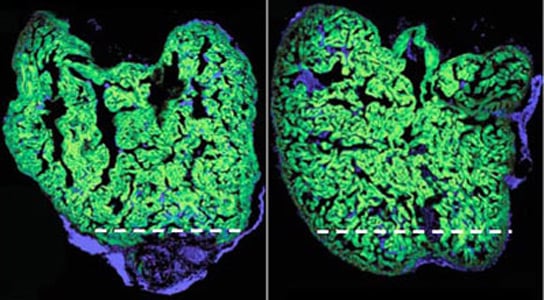
    The green-glowing heart cells are shown at 7 and 14 days after injury. Credit: Chris Jopling

    Two new studies suggest that heart muscle cells can make copies of themselves at a very low rate, but researchers have developed a genetic trick that prompts them to improve their efficiency.

    The scientists published their findings in two papers in the journal Nature. This could imply that hearts may be coaxed into healing themselves. Richard Lee and his colleagues at the Brigham and Women’s Hospital and Harvard Medical School, Boston Massachusetts, traced the birth and fate of heart muscle cells in mice. They found that less than 1% can regenerate themselves normally. After a heart attack this proportion goes up, but only to 3%.

    The heart doesn’t have a robust ability to regenerate, however, the existence of such cells gives hope that the heart might have some capacity for new heart muscle cells. The second paper was able to improve the efficiency of this process by using microRNAs to stimulate heart cells into regenerating.

    Hundreds of microRNAs were screened for the ability to prompt mouse and rat heart cells to multiply. Heart attacks were induced into live mice and it was shown that two particular microRNAs helped build the damaged hearts back up again so that they were almost functioning normally again. After two months, the area of the tissue killed by the heart attack was reduced by half, improving blood flow.

    These microRNAs need further testing in larger animal models that have more human-like hearts before any clinical consideration is prompted.

    References:

    “Mammalian heart renewal by pre-existing cardiomyocytes” by Samuel E. Senyo, Matthew L. Steinhauser, Christie L. Pizzimenti, Vicky K. Yang, Lei Cai, Mei Wang, Ting-Di Wu, Jean-Luc Guerquin-Kern, Claude P. Lechene and Richard T. Lee, 5 December 2012, Nature.
    DOI: 10.1038/nature11682

    “Functional screening identifies miRNAs inducing cardiac regeneration” by Ana Eulalio, Miguel Mano, Matteo Dal Ferro, Lorena Zentilin, Gianfranco Sinagra, Serena Zacchigna and Mauro Giacca, 5 December 2012, Nature.
    DOI: 10.1038/nature11739

    Never miss a breakthrough: Join the SciTechDaily newsletter.
    Follow us on Google and Google News.

    Brigham and Women's Hospital Cardiology Disease Genetics Heart Attack MicroRNA Popular Regeneration
    Share. Facebook Twitter Pinterest LinkedIn Email Reddit

    Related Articles

    New Approach Identifies Genetic Markers Linked to Complex Diseases

    How Down Syndrome and Low SNX27 Are Connected

    BubR1 Protein Could Fight Cancer & Aging

    Mitochondrial Transfer Technology Could Reduce Risk of Childhood Disease

    New Gene Therapy Has the Ability to Restore Sense of Smell in Mice

    Using Zebrafish to Decipher the Roles of Genes Associated With Autism

    Cancer Cells May Grow More Easily than Thought

    Using Biosignatures to Distinguish Between Tuberculosis and Sarcoidosis

    Stem Cells Help Re-grow Healthy Heart Muscle After Heart Attack

    Leave A Reply Cancel Reply

    • Facebook
    • Twitter
    • Pinterest
    • YouTube

    Don't Miss a Discovery

    Subscribe for the Latest in Science & Tech!

    Trending News

    Largest-Ever Study Finds Medicinal Cannabis Ineffective for Anxiety, Depression, PTSD

    250-Million-Year-Old Egg Solves One of Evolution’s Biggest Mysteries

    Living With Roommates Might Be Changing Your Gut Microbiome Without You Knowing

    Century-Old Cleaning Chemical Linked to 500% Increased Risk of Parkinson’s Disease

    What if Your Memories Never Happened? Physicists Take a New Look at the Boltzmann Brain Paradox

    One of the Universe’s Largest Stars May Be Getting Ready To Explode

    Scientists Discover Enzyme That Could Supercharge Ozempic-Like Weight Loss Drugs

    Popular Sweetener Linked to DNA Damage – “It’s Something You Should Not Be Eating”

    Follow SciTechDaily
    • Facebook
    • Twitter
    • YouTube
    • Pinterest
    • Newsletter
    • RSS
    SciTech News
    • Biology News
    • Chemistry News
    • Earth News
    • Health News
    • Physics News
    • Science News
    • Space News
    • Technology News
    Recent Posts
    • Scientists Say This Overlooked Organ Could Hold the Key to Longer Life
    • Want Less Stress? Landmark Study Points to a Simple Habit
    • Scientists Reveal Eating Fruits and Vegetables May Increase Your Risk of Lung Cancer
    • AI Reveals Explosive Growth of Floating Algae Across the World’s Oceans
    • 5.5 Million Bees Discovered Living Beneath a New York Cemetery
    Copyright © 1998 - 2026 SciTechDaily. All Rights Reserved.
    • Science News
    • About
    • Contact
    • Editorial Board
    • Privacy Policy
    • Terms of Use

    Type above and press Enter to search. Press Esc to cancel.