
Close Menu
    Facebook X (Twitter) Instagram
    SciTechDaily
    • Biology
    • Chemistry
    • Earth
    • Health
    • Physics
    • Science
    • Space
    • Technology
    Facebook X (Twitter) Pinterest YouTube RSS
    SciTechDaily
    Home»Space»Iris Nebula Offers Clues to the Building Blocks of Life
    Space

    Iris Nebula Offers Clues to the Building Blocks of Life

    By Dr. Dana Backman, SOFIA Science Center, NASA Ames Research CenterAugust 16, 2016No Comments3 Mins Read
    Facebook Twitter Pinterest Telegram LinkedIn WhatsApp Email Reddit
    Share
    Facebook Twitter LinkedIn Pinterest Telegram Email Reddit
    Molecules in Nebula Offer Clues to the Building Blocks of Life
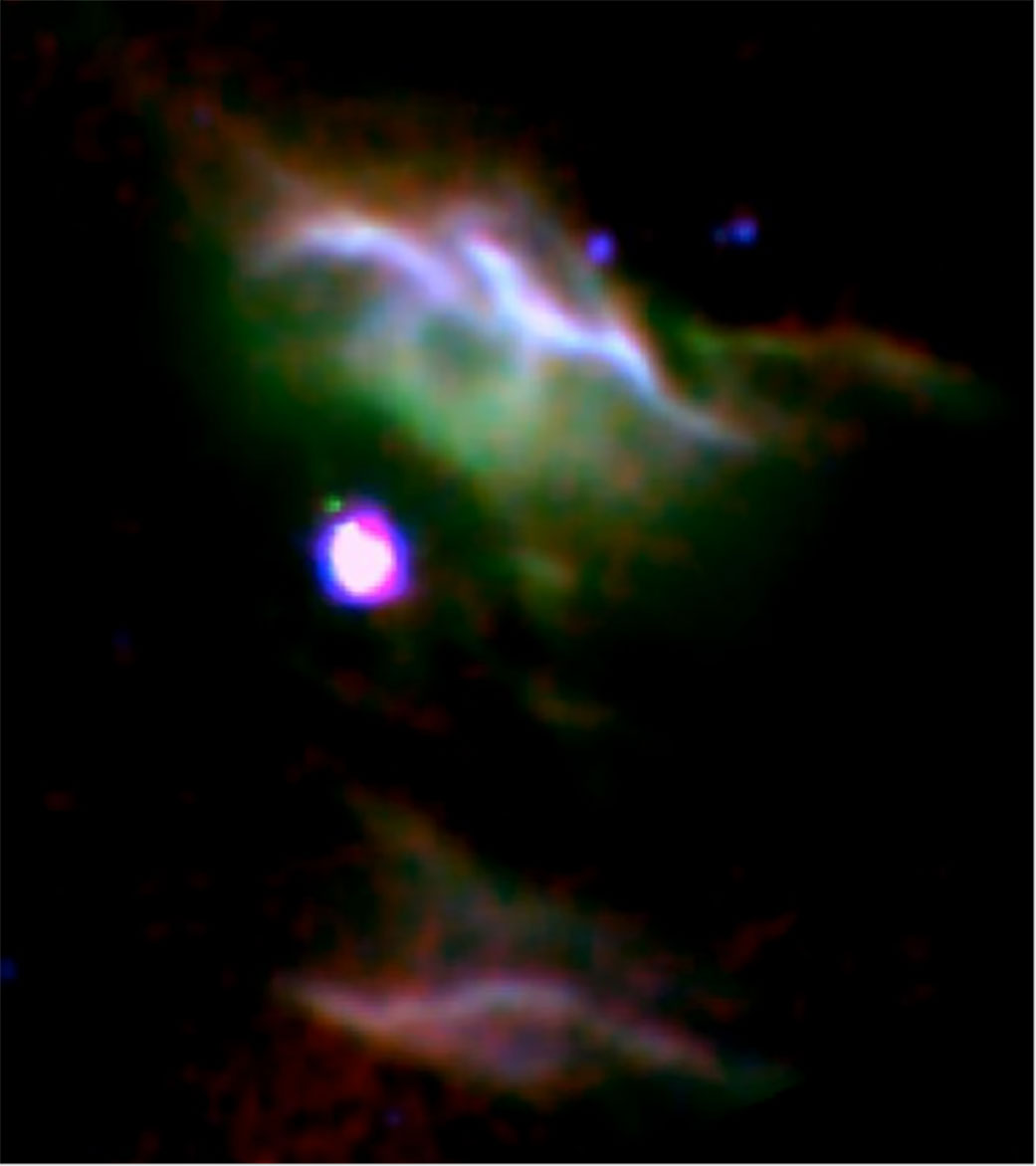
    A combination of three color images of NGC 7023 from SOFIA (red & green) and Spitzer (blue) show different populations of PAH molecules.

    Using data from NASA’s Stratospheric Observatory for Infrared Astronomy and other observatories, astronomers reveal how a particular type of organic molecules, the raw materials for life – could develop in space. This information could help scientists better understand how life could have developed on Earth.

    Bavo Croiset of Leiden University in the Netherlands and his collaborators focused on a type of molecule called polycyclic aromatic hydrocarbons (PAHs), which are flat molecules consisting of carbon atoms arranged in a honeycomb pattern, surrounded by hydrogen. PAHs make up about 10 percent of the carbon in the universe, and are found on the Earth where they are released upon the burning of organic material such as meat, sugarcane, wood, etc. Croiset’s team determined that when PAHs in the nebula NGC 7023, also known as the Iris Nebula, are hit by ultraviolet radiation from the nebula’s central star, they evolve into larger, more complex molecules. Scientists hypothesize that the growth of complex organic molecules like PAHs is one of the steps leading to the emergence of life.

    Some existing models predicted that the radiation from a newborn, nearby massive star would tend to break down large organic molecules into smaller ones, rather than build them up. To test these models, researchers wanted to estimate the size of the molecules at various locations relative to the central star.

    Croiset’s team used SOFIA to observe Nebula NGC 7023 with two instruments, the FLITECAM near-infrared camera, and the FORCAST mid-infrared camera. SOFIA’s instruments are sensitive to two wavelengths that are produced by these particular molecules, which can be used to estimate their size. The team analyzed the SOFIA images in combination with data previously obtained by the Spitzer Infrared Space Observatory, the Hubble Space Telescope, and the Canada-France-Hawaii Telescope on the Big Island of Hawaii.

    The analysis indicates that the size of the PAH molecules in this nebula varies by location in a clear pattern. The average size of the molecules in the nebula’s central cavity, surrounding the illuminating star, is larger than on the surface of the cloud at the outer edge of the cavity.

    In a paper published in Astronomy and Astrophysics, The team concluded that this molecular size variation is due both to some of the smallest molecules being destroyed by the harsh ultraviolet radiation field of the star, and to medium-sized molecules being irradiated so they combine into larger molecules. Researchers were surprised to find that the radiation resulted in net growth, rather than destruction.

    “The success of these observations depended on both SOFIA’s ability to observe wavelengths inaccessible from the ground, and the large size of its telescope, which provided a more detailed map than would have been possible with smaller telescopes,” said Olivier Berné at CNRS, the National Center for Scientific Research in Toulouse, France, one of the published paper’s co-authors.

    Reference: “Mapping PAH sizes in NGC 7023 with SOFIA” by B. A. Croiset, A. Candian, O. Berné and A. G. G. M. Tielens, 2 May 2016, Astronomy & Astrophysics.
    DOI: 10.1051/0004-6361/201527714
    arXiv:1603.02577

    Never miss a breakthrough: Join the SciTechDaily newsletter.
    Follow us on Google and Google News.

    Astronomy Astrophysics Cosmology PAHs Popular SOFIA
    Share. Facebook Twitter Pinterest LinkedIn Email Reddit

    Related Articles

    “Cannibal Stars” and Black Holes May Have Formed in the Universe’s First Second

    What If Einstein Was Only Half Right? NASA’s New Test for Dark Energy

    New Theory Suggests We’ve Been Looking for Dark Matter All Wrong

    Dark Matter and Dark Energy Don’t Exist, New Study Claims

    The Hunt for Dark Matter Has a New, Surprising Target

    Scientists Just Found a Way to Simulate the Universe on a Laptop

    New Measurements Show We May Live in a Giant “Cosmic Void”

    Webb’s Mysterious “Little Red Dots” May Be the Cradle of the First Black Holes

    Webb Telescope Spots Oldest Black Hole, Shattering Cosmic Records

    Leave A Reply Cancel Reply

    • Facebook
    • Twitter
    • Pinterest
    • YouTube

    Don't Miss a Discovery

    Subscribe for the Latest in Science & Tech!

    Trending News

    Just 10 Minutes a Day: Scientists Say This Ancient Chinese Practice Shows Powerful Blood Pressure Benefits

    Scientists Say This Popular Food Could Help Your Body Get Rid of Microplastics

    For the First Time, ChatGPT Has Solved an Unproven Math Problem in Geometry

    This Popular Supplement May Actually Slow Biological Aging, Scientists Reveal

    Can a Common Vitamin Fight the Most Aggressive Brain Cancer?

    Scientists Discover How to Stop Vision Loss Before It Starts

    The Mediterranean Isn’t Safe: Scientists Warn of Inevitable Tsunami

    Scientists Say Washing Dishes With a Sponge Has a Concerning Side Effect

    Follow SciTechDaily
    • Facebook
    • Twitter
    • YouTube
    • Pinterest
    • Newsletter
    • RSS
    SciTech News
    • Biology News
    • Chemistry News
    • Earth News
    • Health News
    • Physics News
    • Science News
    • Space News
    • Technology News
    Recent Posts
    • Widely Available Drug Found To Ease One of Long COVID’s Most Stubborn Symptoms
    • New Study Finds Internalized Stress May Accelerate Cognitive Decline
    • Stopping Weight-Loss Drugs Like Ozempic Can Quickly Erase Heart Benefits
    • A 500-Million-Year-Old Surprise Is Forcing Scientists to Rethink Spider Evolution
    • Ancient Carbon Is Flooding Arctic Rivers As Permafrost Melts Faster
    Copyright © 1998 - 2026 SciTechDaily. All Rights Reserved.
    • Science News
    • About
    • Contact
    • Editorial Board
    • Privacy Policy
    • Terms of Use

    Type above and press Enter to search. Press Esc to cancel.