
Scientists at UCLA have developed nanocapsules that battle cancer cells without harming healthy cells, providing researchers with a potentially new way to treat cancer.
A tiny capsule invented at a UCLA lab could go a long way toward improving cancer treatment.
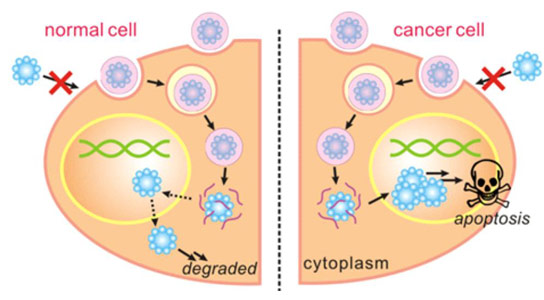
Devising a method for more precise and less invasive treatment of cancer tumors, a team led by researchers from the UCLA Henry Samueli School of Engineering and Applied Science has developed a degradable nanoscale shell to carry proteins to cancer cells and stunt the growth of tumors without damaging healthy cells.
In a new study, published online on February 1 in the peer-reviewed journal Nano, a group led by Yi Tang, a professor of chemical and biomolecular engineering and a member of the California NanoSystems Institute at UCLA, reports developing tiny shells composed of a water-soluble polymer that safely deliver a protein complex to the nucleus of cancer cells to induce their death. The shells, which at about 100 nanometers are roughly half the size of the smallest bacterium, degrade harmlessly in non-cancerous cells.
The process does not present the risk of genetic mutation posed by gene therapies for cancer, or the risk to healthy cells caused by chemotherapy, which does not effectively discriminate between healthy and cancerous cells, Tang said.
“This approach is potentially a new way to treat cancer,” said Tang. “It is a difficult problem to deliver the protein if we don’t use this vehicle. This is a unique way to treat cancer cells and leave healthy cells untouched.”
The cell-destroying material, apoptin, is a protein complex derived from an anemia virus in birds. This protein cargo accumulates in the nucleus of cancer cells and signals the cell to undergo programmed self-destruction.
The polymer shells are developed under mild physiological conditions so as not to alter the chemical structure of the proteins or cause them to clump, preserving their effectiveness on the cancer cells.
Tests done on human breast cancer cell lines in laboratory mice showed a significant reduction in tumor growth.
“Delivering a large protein complex such as apoptin to the innermost compartment of tumor cells was a challenge, but the reversible polymer encapsulation strategy was very effective in protecting and escorting the cargo in its functional form,” said Muxun Zhao, lead author of the research and a graduate student in chemical and biomolecular engineering at UCLA.
Tang’s group continues to research ways of more precisely targeting tumors, prolonging the circulation time of the capsules, and delivering other highly sought-after proteins to cancer cells.
Reference: “Degradable polymeric nanocapsule for efficient intracellular delivery of a high molecular weight tumor-selective protein complex” by Muxun Zhao, Biliang Hu, Zhen Gu, Kye-Il Joo, Pin Wang and Yi Tang, 1 February 2013, Nano.
DOI: 10.1016/j.nantod.2012.12.003
The research team also included former UCLA Engineering student Zhen Gu, now an assistant professor in the joint biomedical engineering department at the University of North Carolina at Chapel Hill and North Carolina State University, and University of Southern California researchers including graduate student Biliang Hu, postdoctoral scholar Kye-Il Joo and associate professor Pin Wang.
The Nano Today paper also will be published in a future print edition of the journal.
The research was funded by the David and Lucille Packard Foundation and a breast cancer research grant from the Congressionally Directed Medical Research Program.
Never miss a breakthrough: Join the SciTechDaily newsletter.
Follow us on Google and Google News.
1 Comment
dear sir this is very interesting to read, many in this world will leave hapily. And how shall i know if this capsule has come to sales .Can u please explain.or send mail to my mail