
Close Menu
    Facebook X (Twitter) Instagram
    SciTechDaily
    • Biology
    • Chemistry
    • Earth
    • Health
    • Physics
    • Science
    • Space
    • Technology
    Facebook X (Twitter) Pinterest YouTube RSS
    SciTechDaily
    Home»Space»NASA’s Solar Dynamics Observatory Witnesses a Double Eclipse
    Space

    NASA’s Solar Dynamics Observatory Witnesses a Double Eclipse

    By Lina Tran, NASA’s Goddard Space Flight CenterSeptember 6, 2016No Comments2 Mins Read
    Facebook Twitter Pinterest Telegram LinkedIn WhatsApp Email Reddit
    Share
    Facebook Twitter LinkedIn Pinterest Telegram Email Reddit

    NASA’s Solar Dynamics Observatory viewed both Earth and the moon crossing in front of the sun.

    SDO keeps a constant eye on the sun, but during SDO’s semiannual eclipse seasons, Earth briefly blocks SDO’s line of sight each day – a consequence of SDO’s geosynchronous orbit. On September 1, Earth completely eclipsed the sun from SDO’s perspective just as the moon began its journey across the face of the sun. The end of the Earth eclipse happened just in time for SDO to catch the final stages of the lunar transit.

    In the SDO data, you can tell Earth and the moon’s shadows apart by their edges: Earth’s is fuzzy, while the moon’s is sharp and distinct. This is because Earth’s atmosphere absorbs some of the sun’s light, creating an ill-defined edge. On the other hand, the moon has no atmosphere, producing a crisp horizon.
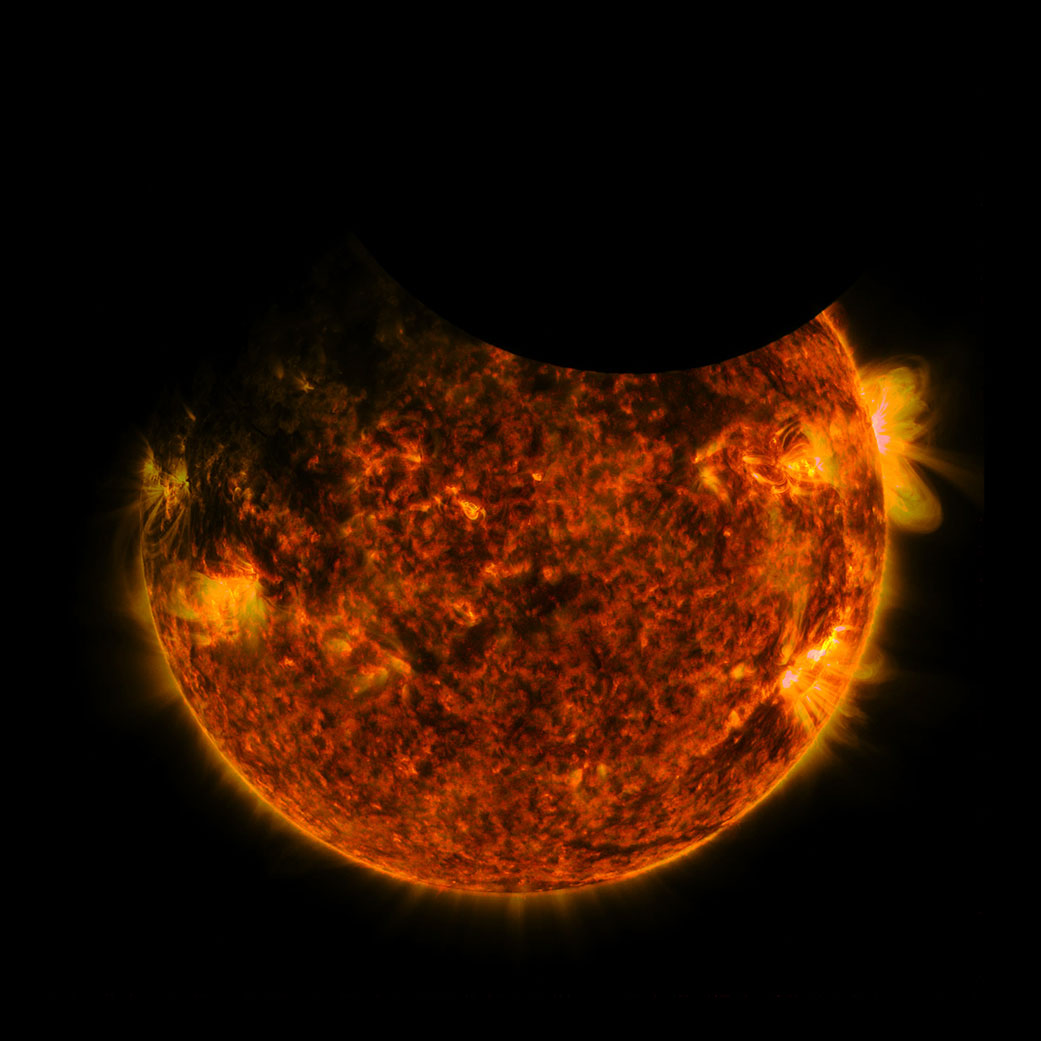
    NASA’s SDO Witnesses a Double Eclipse
    You can tell Earth and the moon’s shadows apart by their edges: Earth’s is fuzzy, while the moon’s is sharp and distinct. This is because Earth’s atmosphere absorbs some of the sun’s light, creating an ill-defined edge. On the other hand, the moon has no atmosphere, producing a crisp horizon.

    This particular geometry of Earth, the moon, and the sun had effects on viewing down on the ground as well: It resulted in a simultaneous eclipse visible from southern Africa. The eclipse was what’s known as a ring of fire, or annular, eclipse, which is similar to a total solar eclipse, except it happens when the moon is at a point in its orbit farther from Earth than average. The increased distance causes the moon’s apparent size to be smaller, so it doesn’t block the entire face of the sun. This leaves a bright, narrow ring of the solar surface visible, looking much like a ring of fire.

    Never miss a breakthrough: Join the SciTechDaily newsletter.
    Follow us on Google and Google News.

    Astronomy Cosmology NASA Solar Dynamics Observatory
    Share. Facebook Twitter Pinterest LinkedIn Email Reddit

    Related Articles

    SDO Views Coronal Hole in Our Sun

    NASA’s Solar Dynamics Observatory Views Two New Solar Flares

    Uniform Heavy Element Distribution Points to Early Cosmic ‘Seeding’

    Sun’s Magnetic Field Weaker Than a Normal Fridge Magnet

    NASA Data Suggests Black Holes Abundant Among the Earliest Stars

    Fermi’s Motion Captured by Vela Pulsar Video

    WISE Spots Massive Distant Galaxy Cluster

    ESA’s Euclid Mission Receives Final Approval

    The Bolshoi Simulation: Boxing the Universe

    Leave A Reply Cancel Reply

    • Facebook
    • Twitter
    • Pinterest
    • YouTube

    Don't Miss a Discovery

    Subscribe for the Latest in Science & Tech!

    Trending News

    Enormous Prehistoric Insects Puzzle Scientists

    Scientists Develop Bioengineered Chewing Gum That Could Help Fight Oral Cancer

    After 37 Years, the World’s Longest-Running Soil Warming Experiment Uncovers a Startling Climate Secret

    NASA Satellite Captures First-Ever High-Res View of Massive Pacific Tsunami

    ADHD Isn’t Just a Deficit: Study Reveals Powerful Hidden Strengths

    Scientists Discover Stem Cells That Could Regrow Teeth and Bone

    Early Cannabis Use May Stall Key Brain Skills in Teens

    Popular Vitamin D Supplement Has “Previously Unknown” Negative Effect, Study Finds

    Follow SciTechDaily
    • Facebook
    • Twitter
    • YouTube
    • Pinterest
    • Newsletter
    • RSS
    SciTech News
    • Biology News
    • Chemistry News
    • Earth News
    • Health News
    • Physics News
    • Science News
    • Space News
    • Technology News
    Recent Posts
    • Scientists Identify Two Simple Treatments for Cancer-Related Cognitive Impairment
    • Omega-3 Supplements Linked to Cognitive Decline in Surprising New Study
    • One in Five at Risk: Scientists Identify a Hidden Blood Particle Linked to Higher Risk of Stroke and Death
    • Darwin’s Islands Still Evolving: Giant Daisies Rewrite the Rules of Evolution
    • Ancient Document Confirms “Legendary” African King Actually Existed
    Copyright © 1998 - 2026 SciTechDaily. All Rights Reserved.
    • Science News
    • About
    • Contact
    • Editorial Board
    • Privacy Policy
    • Terms of Use

    Type above and press Enter to search. Press Esc to cancel.