
Close Menu
    Facebook X (Twitter) Instagram
    SciTechDaily
    • Biology
    • Chemistry
    • Earth
    • Health
    • Physics
    • Science
    • Space
    • Technology
    Facebook X (Twitter) Pinterest YouTube RSS
    SciTechDaily
    Home»Space»ALMA Telescope Reveals Planetary Influences on Young Stellar Disks
    Space

    ALMA Telescope Reveals Planetary Influences on Young Stellar Disks

    By Harvard-Smithsonian Center for AstrophysicsDecember 15, 2015No Comments3 Mins Read
    Facebook Twitter Pinterest Telegram LinkedIn WhatsApp Email Reddit
    Share
    Facebook Twitter LinkedIn Pinterest Telegram Email Reddit
    ALMA Reveals Planetary Influences on Young Stellar Disks
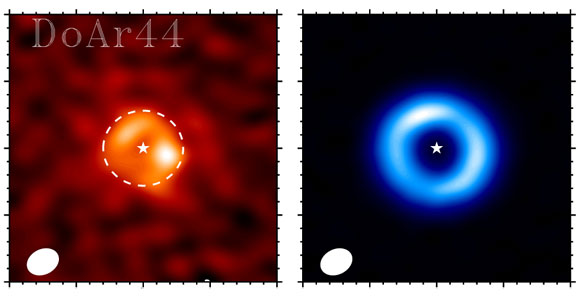
    False-color images of the gas (left) and dust (right) disks around the young stellar object DoAr44. The results show that the size of the gas ring is much smaller than the dust ring (dotted line), and support a picture in which orbiting planets have swept out the ring. Credit: ALMA: van der Marel et al.

    New research from the Harvard-Smithsonian Center for Astrophysics shows that the gas cavity in transition disks in four young stars was as much as three times smaller than the dust cavity, and that the gas density inside the cavity drops by at least a factor of one thousand compared to the surface density.

    A newborn star typically has a disk of gas and dust from which planets develop as the dust grains collide, stick together, and grow. Stars older than about five million years lack evidence for these disks, however, suggesting that by this age most of the disk material has either been converted into planets or smaller bodies, accreted onto the star, or dispersed from the system. Transition disks bridge this period in disk evolution: They have not yet been disbursed, and warmed by the star, can be detected at infrared or millimeter wavelengths. Their infrared colors can be used to characterize their properties. They often show inner dust cavities, which astronomers have sometimes interpreted as evidence of the presence of planets that have cleared out their orbits.

    The models of planet-disk interactions, however, indicate that dust cavities are only an indirect consequence of planet clearing. What actually seems to occur is that the planet creates a gap in the gas, and the gas distribution at its outer edges then traps the small dust grains and produces a dust ring that is frequently asymmetric. There is some uncertainty in this picture because other mechanisms could produce a dust cavity or dust ring, including selective evaporation of dust grains by starlight, or instabilities in the dust ring itself. Determining the gas density inside the cavity can help to distinguish between these mechanisms.

    CfA astronomer Sean Andrews and his colleagues used the ALMA millimeter-wavelength telescope array to study transition disks in four relatively nearby young stars. This powerful new facility can measure dimensions in these disks as small as twenty-four astronomical units (one AU is the average distance of the Earth from the Sun), and can do so for both the small dust grains and the warm gas. In all four disks the scientists were able to model the gas distribution. They found that the gas cavity was as much as three times smaller than the dust cavity, and that the gas density inside the cavity drops by at least a factor of one thousand compared to the surface density. The results strongly suggest that the cavities were indeed produced by orbiting planets.

    Reference: “Resolved gas cavities in transitional disks inferred from CO isotopologues with ALMA” by N. van der Marel, E. F. van Dishoeck, S. Bruderer, S. M. Andrews, K. M. Pontoppidan, G. J. Herczeg, T. van Kempen1 and A. Miotello1, 16 December 2015, Astronomy & Astrophysics.
    DOI: 10.1051/0004-6361/201526988
    arXiv:1511.07149

    Never miss a breakthrough: Join the SciTechDaily newsletter.
    Follow us on Google and Google News.

    ALMA Astronomy Astrophysics Cosmology Harvard-Smithsonian Center for Astrophysics Planetary Science
    Share. Facebook Twitter Pinterest LinkedIn Email Reddit

    Related Articles

    Harvard Astronomers Find Evidence of Shocked Gas in Galaxy Collisions

    ALMA Images the Planetesimal Belt around HR8799

    CEMP Stars Could Host Carbon Planets

    Astronomers Reveal a Planet Forming in an Earth-Like Orbit Around Young Star TW Hydrae

    Astronomers Show Magnetic Field is Critical for Life

    Preliminary Reference Earth Model Shows Earth-like Planets Have Earth-like Interiors

    Astronomers Discover a Giant Exoplanet and Four New Companion Stars

    Kepler Discovers a Planetary Object Being Vaporized by a White Dwarf

    ALMA Reveals First Ever Snow Line Seen Around a Distant Star

    Leave A Reply Cancel Reply

    • Facebook
    • Twitter
    • Pinterest
    • YouTube

    Don't Miss a Discovery

    Subscribe for the Latest in Science & Tech!

    Trending News

    Breakthrough Bowel Cancer Trial Leaves Patients Cancer-Free for Nearly 3 Years

    Natural Compound Shows Powerful Potential Against Rheumatoid Arthritis

    100,000-Year-Old Neanderthal Fossils in Poland Reveal Unexpected Genetic Connections

    Simple “Gut Reset” May Prevent Weight Gain After Ozempic or Wegovy

    2.8 Days to Disaster: Scientists Warn Low Earth Orbit Could Suddenly Collapse

    Common Food Compound Shows Surprising Power Against Superbugs

    5 Simple Ways To Remember More and Forget Less

    The Atomic Gap That Could Cost the Semiconductor Industry Billions

    Follow SciTechDaily
    • Facebook
    • Twitter
    • YouTube
    • Pinterest
    • Newsletter
    • RSS
    SciTech News
    • Biology News
    • Chemistry News
    • Earth News
    • Health News
    • Physics News
    • Science News
    • Space News
    • Technology News
    Recent Posts
    • After 37 Years, the World’s Longest-Running Soil Warming Experiment Uncovers a Startling Climate Secret
    • NASA Satellite Captures First-Ever High-Res View of Massive Pacific Tsunami
    • ADHD Isn’t Just a Deficit: Study Reveals Powerful Hidden Strengths
    • Scientists Uncover “Astonishing” Hidden Property of Light
    • Scientists Discover Stem Cells That Could Regrow Teeth and Bone
    Copyright © 1998 - 2026 SciTechDaily. All Rights Reserved.
    • Science News
    • About
    • Contact
    • Editorial Board
    • Privacy Policy
    • Terms of Use

    Type above and press Enter to search. Press Esc to cancel.