
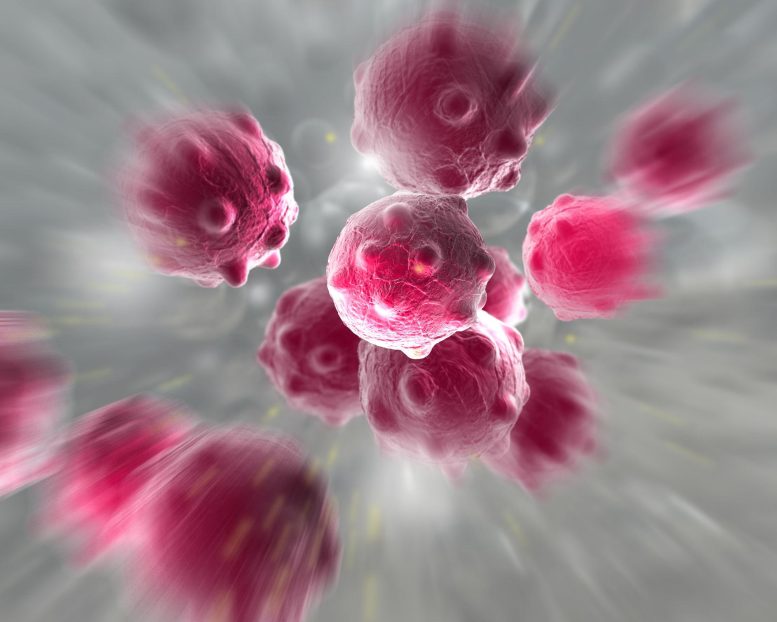
In a new study, a team of scientists have shown that a single antibody shrinks variety of human tumors transplanted into mice, finding that anti-CD47 antibodies can dramatically inhibit the growth of human solid tumors by blocking the ability of CD47 to transmit the ‘don’t-eat-me’ signal to macrophages.
Human tumors transplanted into laboratory mice disappeared or shrank when scientists treated the animals with a single antibody, according to a new study from the Stanford University School of Medicine. The antibody works by masking a protein flag on cancer cells that protects them from macrophages and other cells in the immune system. The scientists achieved the findings with human breast, ovarian, colon, bladder, brain, liver, and prostate cancer samples.
It is the first antibody treatment shown to be broadly effective against a variety of human solid tumors, and the dramatic response — including some overt cures in the laboratory animals — has the investigators eager to begin phase-1 and –2 human clinical trials within the next two years.
“Blocking this ‘don’t-eat-me’ signal inhibits the growth in mice of nearly every human cancer we tested, with minimal toxicity,” said professor of pathology Irving Weissman, MD, who directs Stanford’s Institute of Stem Cell Biology and Regenerative Medicine and the Ludwig Center for Cancer Stem Cell Research and Medicine at Stanford. “This shows conclusively that this protein, CD47, is a legitimate and promising target for human cancer therapy.”
The antibody treatment also significantly inhibited the ability of the tumors to metastasize throughout the animals’ bodies.
“This is exciting work and will surely trigger a worldwide wave of research designed to convert this strategy into useful therapies,” said Robert Weinberg, PhD, a professor of biology at the Whitehead Institute for Biomedical Research in Massachusetts who was not involved in the research. “Mobilizing the immune system to attack solid tumors has been a longstanding goal of many cancer researchers for decades.”
The research was published online on March 26 in the Proceedings of the National Academy of Sciences. Weissman, who is the Virginia & D.K. Ludwig Professor for Clinical Investigation in Cancer Research at Stanford and a member of the Stanford Cancer Institute, is the senior author of the research. Postdoctoral scholars Stephen Willingham, PhD, and Jens-Peter Volkmer, MD, are the co-first authors of the study.
Previous work in Weissman’s lab has shown that CD47 is normally expressed on the surfaces of circulating blood stem cells to protect them from immune cells called macrophages. Macrophages patrol the body looking for signs of trouble in the form of invaders or rogue cells, but they sometimes latch onto the wrong targets. CD47 prompts them to release cells they’ve grabbed by mistake.
Weissman and his colleagues also showed previously that some types of cancer cells — particularly those of blood cancers such as leukemia and lymphoma — have figured out a way to game the system and use this “don’t-eat-me signal” to their advantage by expressing CD47 on their own surfaces. In 2010, they found that blocking CD47 with a specific antibody (plus adding another to further stimulate the macrophages’ killing instinct) can cure some cases of human non-Hodgkin’s lymphoma in mice. But it wasn’t known until now how widespread or clinically important the phenomenon would be in human solid tumors.
In the current study, Willingham and Volkmer collected surgical samples of a variety of human tumors, including ovarian, breast, colon, bladder, brain, liver and prostate. To do so, they enlisted the help of clinical experts from across the School of Medicine, including those specializing in oncology, urology, obstetrics and gynecology, radiation oncology, neurosurgery, hematology, pathology, otolaryngology and hepatology.
They showed that nearly every human cancer cell they examined expressed CD47 — usually at higher levels (on average, about three times more) than did non-cancerous cells. Furthermore, people whose cancer cells express a lot of CD47 tend to have shorter life spans than people with similar cancers that express less CD47. This suggests that an analysis of the levels of CD47 expression in some types of tumors could be a valuable prognostic tool for patients and their doctors.
Willingham and Volkmer then implanted the different human tumor cells into matching locations in the bodies of mice — breast cancer tumors into the mammary fat pads, and ovarian cancer tumors into the abdomen, for example. Once the tumors were well-established (after two weeks or more), they treated the animals with the anti-CD47 antibody.
The researchers saw that most of the established tumors begin to shrink and even, in some cases, disappear within weeks of treatment with the antibody. In one case, antibody treatment cured five mice injected with the same human breast cancer cells. When the tumor was gone, the treatment was discontinued; the mice were monitored for four months with no signs of recurrence.
“These results indicate that anti-CD47 antibodies can dramatically inhibit the growth of human solid tumors by blocking the ability of CD47 to transmit the ‘don’t-eat-me’ signal to macrophages,” concluded the authors.
“If the tumor was highly aggressive,” said Weissman, “the antibody also blocked metastasis. It’s becoming very clear that, in order for a cancer to survive in the body, it has to find some way to evade the cells of the innate immune system.” The innate immune system is the body’s first line of defense against pathogens like bacteria and viruses. Unlike the adaptive immunity conferred by antibodies and T cells that recognize and battle specific molecules, cells of the innate immune system, like macrophages, respond non-specifically to a variety of threats.
The researchers’ approach didn’t work in every animal, though. A set of mice with breast cancer cells from one human patient experienced no benefit from antibody treatment. “There’s certainly more to learn,” said Weissman. “We need to learn more about the relationship between macrophages and tumor cells, and how to draw more macrophages to the tumors.” He suggested that reducing the size of a tumor with surgery or radiotherapy before antibody treatment could make the treatment more effective. Another option, he added, would be to use a second antibody in addition to CD47 that would further stimulate the ability of the macrophages or other immune cells to kill the cancer cells.
While treatment modifications may be beneficial, the findings about the effect of the single antibody are promising in their own right and set the stage for advancing the research. “We believe these results show that we should move forward quickly but cautiously into human clinical trials for many types of solid tumors,” Weissman said.
In addition to Willingham and Volkmer, other Stanford scientists involved in the research include postdoctoral scholars Andrew Gentles, PhD, Ferenc Scheeren, PhD, Anne Volkmer, MD, Chris Sun, PhD, Oihana Murillo, PhD, Maddalena Adorno, PhD, and Tal Raveh, PhD; graduate students Badreddin Edris, Pradeep Rajendran and Adriel Cha; medical or MSTP students Kipp Weiskopf, Chad Tang and Diane Tseng; life science research assistants Tejaswitha Naik, Theresa Storm, Humberto Contreras-Trujillo, Justin Cohen and Adriane Mosley; instructors Debashis Sahoo, PhD, and Piero Dalerba, MD; senior research scientists Siddhartha Mitra, PhD, and Mei-Sze Chua, PhD; clinical fellow Jian Wang, MD, PhD; CIRM research scholar Robin Martin; research and development engineer Patricia Lovelace; research associate Dongkyoon Kim, PhD; intern Mark Chao, MD, PhD; resident Siddhartha Jaiswal, MD, PhD; assistant professors Robert Chin, MD, PhD, Gordon Li, MD, Ravindra Majeti, MD, PhD, John Sunwoo, MD, and Ash Alizadeh, MD, PhD; associate professor Nelson Teng, MD, PhD; professors Samuel So, MD, Matt van de Rijn, MD, PhD, and Griffith Harsh, MD; associate director of the Stanford stem cell institute Michael Clarke, MD; and neurosurgery chair Gary Steinberg, MD, PhD.
This work was supported by the Joseph & Laurie Lacob Gynecologic/Ovarian Cancer Fund, the Jim & Carolyn Pride Fund, the Virginia & D.K. Ludwig Fund for Cancer Research, the Weston Havens Foundation, the National Cancer Institute, the Department of Defense, the California Institute for Regenerative Medicine and anonymous donors.
Reference: “The CD47-signal regulatory protein alpha (SIRPa) interaction is a therapeutic target for human solid tumors” by Stephen B. Willingham, Jens-Peter Volkmer, Andrew J. Gentles, Debashis Sahoo, Piero Dalerba, Siddhartha S. Mitra, Jian Wang, Humberto Contreras-Trujillo, Robin Martin, Justin D. Cohen, Patricia Lovelace, Ferenc A. Scheeren, Mark P. Chao, Kipp Weiskopf, Chad Tang, Anne Kathrin Volkmer, Tejaswitha J. Naik, Theresa A. Storm, Adriane R. Mosley, Badreddin Edris, Seraina M. Schmid, Chris K. Sun, Mei-Sze Chua, Oihana Murillo, Pradeep Rajendran, Adriel C. Cha, Robert K. Chin, Dongkyoon Kim, Maddalena Adorno, Tal Raveh, Diane Tseng, Siddhartha Jaiswal, Per Øyvind Enger, Gary K. Steinberg, Gordon Li, Samuel K. So, Ravindra Majeti, Griffith R. Harsh, Matt van de Rijn, Nelson N. H. Teng, John B. Sunwoo, Ash A. Alizadeh, Michael F. Clarke and Irving L. Weissman, 26 March 2012, Proceedings of the National Academy of Sciences.
DOI: 10.1073/pnas.1121623109
Never miss a breakthrough: Join the SciTechDaily newsletter.
Follow us on Google and Google News.
6 Comments
The line of treatment for cancer cells through our own immune system by attacking them is interesting. CD47 on the cell surface mostly on the walls of red cell cells give out a signal not to attack them by macrophages. This is only to protect them. But copying by cancer cells or tumour cells, the CD47 abundance make them free from attacks. The anti CD47 antibodies silences them and make them prone for attacks by our own macrophages and immune system. Thus this is a non-invasive treatment through anti-bodies. It is also interesting to note that cell metastasis also can be inhibited by another anti-body to boost the killing instinct of the macrophages to wash off any metastasis in the cancer cells migrating to other organs. I hail this research .Thank You.
God bless these scientists.
Wow! Exciting news!
So why doesn’t everyone know ow about this . It’s 2022 this article is from 2013 that’s 9 years ago . I’m sure they have a cure already. Put the chemo away and use the CD47 to cure the plague of man. I know one thing for sure Christ Jesus is the cure for Cancer. I know some people only believe in science but there are some things mans science just can’t explain. God is the divine scientist and creator of all things which includes disease. Some aren’t suppose to be cured and some are. Some aren’t supposed to live long and some are. If we honor our father and mother then we will live long healthy lives. If we follow the bible then we will receive God’s promises. Health and joy and peace in abundance to anyone reading this. Praise the beautiful name of Christ Jesus.
Bless your heart.
From ThermoFischer Scientific, retrieved 16July22. Put ’em in your cart today!:
“Antibodies that detect CD47 can be used in several scientific applications, including Flow Cytometry, Immunohistochemistry (Paraffin), Western Blot, Immunocytochemistry and Immunohistochemistry (Frozen). These antibodies target CD47 in Human, Mouse, Rat, Porcine and Non-human primate samples. Our CD47 monoclonal, polyclonal and recombinant monoclonal antibodies are developed in Mouse, Rabbit, Rat and Goat. These antibodies have been verified by Cell treatment to confirm specificity to CD47. Find the CD47 antibody that fits your needs. Choose from 1 of 105 CD47 antibodies, which have been validated in experiments with 122 publications …”