
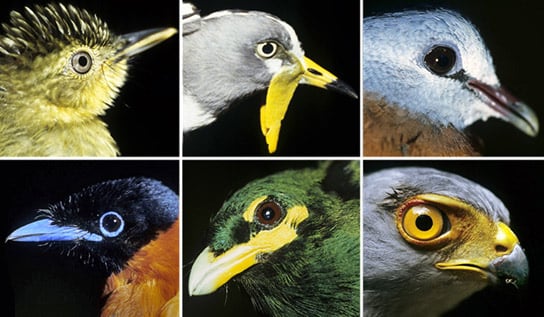
New research from Yale University projects how climate change will affect the functions performed by birds in ecosystems worldwide.
As changing climate reshapes the geographic range of thousands of bird species in the coming decades, ecosystems across wide swaths of the planet may be compromised, a new study warns.
Based on environmental projections for the rest of the century, the study predicts that some avian species will expand their ranges dramatically, while others will be unable to do so. The result is likely to cause widespread changes to the diverse array of functions these species fulfill in local ecosystems, most notably in tropical and sub-tropical regions, say the scientists. The research appears in the journal Global Change Biology.
Ecologists Walter Jetz of Yale University and Morgane Barbet-Massin of the National Museum of Natural History in Paris are co-authors of the paper. Looking specifically at avian populations, they gathered global breeding and residential data, extensive species trait information, and an array of climate projection data to conduct their analysis.
“Species fulfill critical ecological functions in a local ecosystem that may be altered substantially as climate change is causing them to shift in and out of their current location,” said Jetz, who is an associate professor of ecology and evolutionary biology and director of the Yale Program in Spatial Biodiversity Science & Conservation.
Jetz said many high-latitude regions, where bird ranges are likely to expand, will see smaller net losses in functional diversity than tropical and sub-tropical regions, where the functional change “could have severe consequences for ecosystem health.”
Several factors make the projection more precarious for places nearer to the equator. Bird species there tend to have smaller ranges and tend to be climatically more restricted. Also, those areas have more bird species, with a greater variety of roles in the local ecology. “Under projected climate change, the species there are expected to more often shrink than expand their range and even go extinct,” lead author Barbet-Massin said.
Extinctions of bird species groups, such as large-bodied fruit eaters or groups that feed on animals on the ground, would mean the loss of key ecological functions that control pests and aid in the dispersal of plants and trees, note the scientists.
In high-latitude parts of the world, the loss of species and their helpful activities would be counterbalanced by the addition of other species that expand their territories, according to the study. More small-bodied bird species and invertebrate feeders may make this move, for example.
The global scope of the study is necessary for a true perspective on the ecological effects of a changing climate, the researchers noted. “There is a tendency to think very locally when it comes to gauging the potential impacts of climate change on the functions and services offered by species communities,” Jetz said. “But species ranges and range shifts don’t stop at national borders, and species differ substantially in how much relative change their immigration or loss may cause in a local area. Our study provides a clear demonstration of these issues.”
Reference: “The effect of range changes on the functional turnover, structure and diversity of bird assemblages under future climate scenarios” by Morgane Barbet-Massin and Walter Jetz, 30 April 2015, Global Change Biology.
DOI: 10.1111/gcb.12905
Never miss a breakthrough: Join the SciTechDaily newsletter.
Follow us on Google and Google News.