
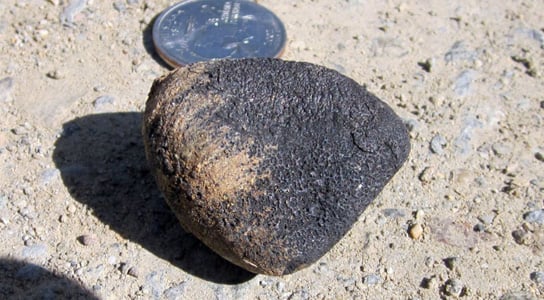
The Sutter’s Mill meteorite was seen by many eyewitnesses over the foothills of the Sierra Nevada range in California. A new, detailed study has traced the origins of this rock with unusual precision, and it has been revealed that it came down at record-breaking speed.
The scientists published their findings in the journal Science. Most of the 40,000 meteorites that have been recovered came from the asteroid belt, located between the orbits of Mars and Jupiter. However, in the case of the Sutter’s Mill meteorite, astronomers were able to find a more precise origin.
The scientists used records of the meteorite from weather data, which is commonly used to track rainfall in real time, and combined it with photographic and video images, as well as other data. The researchers then reconstructed the trajectory of the meteorite, and found it to be similar to comets from the outer reaches of the asteroid belt, near Jupiter’s orbit.
https://www.youtube.com/watch?v=nQiX8Dubg28
The meteorite entered Earth’s atmosphere at a speed of 28.6 kilometers (17.8 miles) per second, which makes it the fastest on record. A chemical and physical analysis of the meteorite revealed that it was a relatively rare carbonaceous chondrite meteorite, which is seen as a time capsule since they have barely altered since the formation of the Solar System, 4.5 billion years ago.
Carbonaceous chondrites are thought to be especially prevalent in the outer reaches of the asteroid belt, and the California rocks confirm that theory, being a rare case for which both the composition and the provenance are known. Usually, asteroids are seen through a telescope, which reveals location but gives only partial information on their composition, or the asteroid fragments that fall on Earth as meteorites are analyzed in great detail, but in most cases, we have no idea where in space they originated. The Sutter’s Mill meteorite is a rare case where we get to know the whole story.
Reference: “Radar-Enabled Recovery of the Sutter’s Mill Meteorite, a Carbonaceous Chondrite Regolith Breccia” by Peter Jenniskens, Marc D. Fries, Qing-Zhu Yin, Michael Zolensky, Alexander N. Krot, Scott A. Sandford, Derek Sears, Robert Beauford, Denton S. Ebel, Jon M. Friedrich, Kazuhide Nagashima, Josh Wimpenny, Akane Yamakawa, Kunihiko Nishiizumi, Yasunori Hamajima, Marc W. Caffee, Kees C. Welten, Matthias Laubenstein, Andrew M. Davis, Steven B. Simon, Philipp R. Heck, Edward D. Young, Issaku E. Kohl, Mark H. Thiemens, Morgan H. Nunn, Takashi Mikouchi, Kenji Hagiya, Kazumasa Ohsumi, Thomas A. Cahill, Jonathan A. Lawton, David Barnes, Andrew Steele, Pierre Rochette, Kenneth L. Verosub, Jérôme Gattacceca, George Cooper, Daniel P. Glavin, Aaron S. Burton, Jason P. Dworkin, Jamie E. Elsila, Sandra Pizzarello, Ryan Ogliore, Phillipe Schmitt-Kopplin, Mourad Harir, Norbert Hertkorn, Alexander Verchovsky, Monica Grady, Keisuke Nagao, Ryuji Okazaki, Hiroyuki Takechi, Takahiro Hiroi, Ken Smith, Elizabeth A. Silber, Peter G. Brown, Jim Albers, Doug Klotz, Mike Hankey, Robert Matson, Jeffrey A. Fries, Richard J. Walker, Igor Puchtel, Cin-Ty A. Lee, Monica E. Erdman, Gary R. Eppich, Sarah Roeske, Zelimir Gabelica, Michael Lerche, Michel Nuevo, Beverly Girten, Simon P. Worden and (the Sutter’s Mill Meteorite Consortium), 21 December 2012, Science.
DOI: 10.1126/science.1227163
Never miss a breakthrough: Join the SciTechDaily newsletter.
Follow us on Google and Google News.