
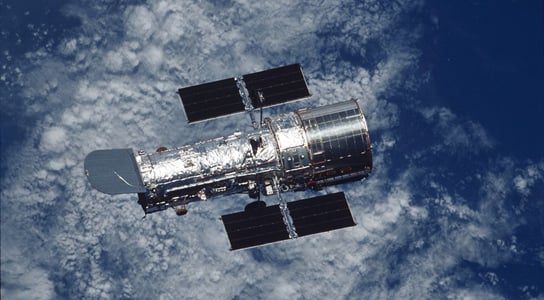
In the cavernous area of Building 1230, located at the ITT Exelis facility in Rochester, New York, there are two 2.4-meter (7.9-foot) telescopes, each as big as the Hubble Space Telescope and never flown, sitting on low pedestals.
These telescopes were commissioned by the US National Reconnaissance Office (NRO), a surveillance agency that needed the telescope to peer at Earth. The NRO bequeathed the telescopes to NASA because they were no longer needed. A science-definition team will embark to assess if these telescopes can be used in some fashion. They will announce their findings by April 2013 to the NASA administrator Charles Bolden.
The initial idea is to outfit them to study dark energy, the phenomenon thought to be accelerating the expansion of the Universe. The most likely first use of the NRO telescopes is as an alternative to the proposed Wide-Field Infrared Space Telescope (WFIRST), the top-ranked mission in the 2010 astronomy decadal survey. Before the gift was announced, astronomers were aiming for a wide-field 1.3 m (4.3 ft) survey telescope to search for the imprint of dark energy, search for exoplanets, and study star-forming regions in the Milky Way. WFIRST isn’t expected to fly until the mid-2020s; but with a telescope already in hand, the NRO version of WFIRST could conceivably be launched before the end of the decade.
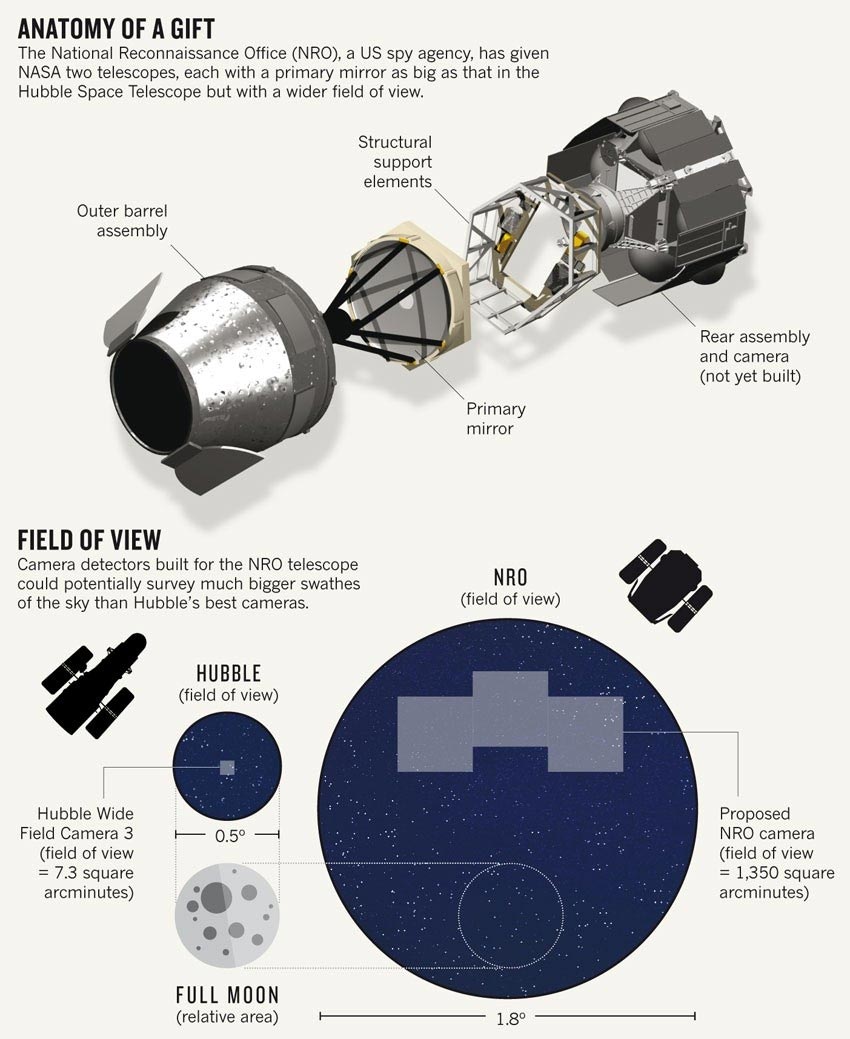
The NRO telescopes have a much wider field of view than Hubble, which is why they are suited for the WFIRST mission. They are perfect for spotting the thousands of supernovae and millions of galaxies needed to pin down the exact nature of dark energy. Newly released data also shows that the mirror is roughly as good as Hubble’s.
The supporting structure is made up of resin that can resist distortions caused by temperature changes and will keep the main mirror stable. Astronomers plan on using active control of the secondary mirror to adjust for any distortions due in the main mirror, further sharpening the telescope’s optics.
The telescope was produced to capture very stable images, which is crucial to “weak lensing,” a dark-energy technique that looks for subtle distortions in the shapes of the galaxies due to intervening matter.
The telescope won’t be ideal to study the most distant galaxies in the Universe, which are only visible in the infrared, since that would require a new system to cool the mirror. However, unlike the WFIRST instrument, the NRO is designed to work at room temperature and its larger mirror will have so much more light-gathering power that it will be able to spot many more faint objects nearer to hand.
Using the NRO telescopes, which are worth $250 million each, could be quite costly. A recent estimate put the total project cost at $1.75 billion, whereas the WFIRST mission was expected to cost $1.5 billion.
To take advantage of the extra light-gathering capability of the NRO telescope, some astronomers would like to add a coronagraph. This can block the light of a star while still revealing the dim glow of the orbiting planets and could help find exoplanets, but would add another $200 million to the overall cost.
Never miss a breakthrough: Join the SciTechDaily newsletter.
Follow us on Google and Google News.
2 Comments
I wonder if one of these could be fitted with a high pixel count wide field far infrared camera and be used to search for smaller near earth asteroids?
Telescope Optics demands high light gathering power and wide field lens. Pixels will help only if sufficient light is gathered to mark the seperation of dots. Just increasing the pixels of the camera without sufficient light will be of no avail. In electron microscope the ultra-short wavelength of electron , given by the wave nature of matter , is made use of. Either you should increase the brightness or light gathering power form the object or use shorter wavelength than optical light. NRO telescope lenses with high light gathering power were used to pin down weak gravitational lensing of Dark Matter bending distant light from far off galaxies and the pattern can be studied for arriving at the shape of Dark Matter in between.Thank You.