
Close Menu
    Facebook X (Twitter) Instagram
    SciTechDaily
    • Biology
    • Chemistry
    • Earth
    • Health
    • Physics
    • Science
    • Space
    • Technology
    Facebook X (Twitter) Pinterest YouTube RSS
    SciTechDaily
    Home»Space»Voyager 1 Reports a Rapid Increase in High-Energy Cosmic Ray Particles
    Space

    Voyager 1 Reports a Rapid Increase in High-Energy Cosmic Ray Particles

    By Jia-Rui Cook, Jet Propulsion LaboratoryAugust 3, 2012No Comments3 Mins Read
    Facebook Twitter Pinterest Telegram LinkedIn WhatsApp Email Reddit
    Share
    Facebook Twitter LinkedIn Pinterest Telegram Email Reddit
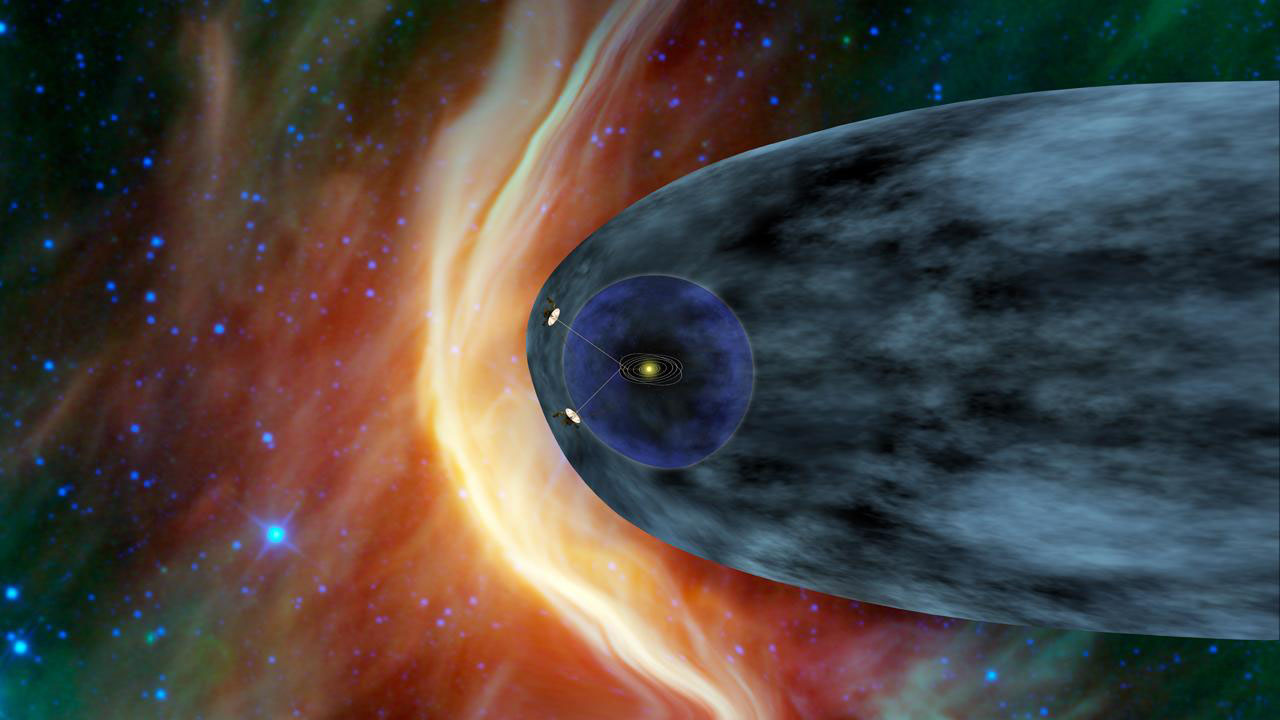
    artist's concept shows NASA's two Voyager spacecraft exploring a turbulent region of space known as the heliosheath
    This artist’s concept shows NASA’s two Voyager spacecraft exploring a turbulent region of space known as the heliosheath, the outer shell of the bubble of charged particles around our sun. Credit: NASA/JPL-Caltech

    On a mission to explore interstellar space, NASA’s Voyager 1 spacecraft showed a rapid increase in the levels of high-energy cosmic ray particles, jumping by five percent on July 28, which then fell to near their previous levels within three days.

    Two of three key signs of changes expected to occur at the boundary of interstellar space have changed faster than at any other time in the last seven years, according to new data from NASA’s Voyager 1 spacecraft.

    For the last seven years, Voyager 1 has been exploring the outer layer of the bubble of charged particles the sun blows around itself. In one day, on July 28, data from Voyager 1’s cosmic ray instrument showed the level of high-energy cosmic rays originating from outside our solar system jumped by five percent. During the last half of that same day, the level of lower-energy particles originating from inside our solar system dropped by half. However, in three days, the levels had recovered to near their previous levels.

    A third key sign is the direction of the magnetic field, and scientists are eagerly analyzing the data to see whether that has, indeed, changed direction. Scientists expect that all three of these signs will have changed when Voyager 1 has crossed into interstellar space. A preliminary analysis of the latest magnetic field data is expected to be available in the next month.

    “These are thrilling times for the Voyager team as we try to understand the quickening pace of changes as Voyager 1 approaches the edge of interstellar space,” said Edward Stone, the Voyager project scientist based at the California Institute of Technology (Caltech), Pasadena, California. “We are certainly in a new region at the edge of the solar system where things are changing rapidly. But we are not yet able to say that Voyager 1 has entered interstellar space.”

    The levels of high-energy cosmic ray particles have been increasing for years, but more slowly than they are now. The last jump — of five percent — took one week in May. The levels of lower-energy particles from inside our solar system have been slowly decreasing for the last two years. Scientists expect that the lower-energy particles will drop close to zero when Voyager 1 finally crosses into interstellar space.

    “The increase and the decrease are sharper than we’ve seen before, but that’s also what we said about the May data,” Stone said. “The data are changing in ways that we didn’t expect, but Voyager has always surprised us with new discoveries.”

    Voyager 1, which launched on September 5, 1977, is 11 billion miles (18 billion kilometers) from the sun. Voyager 2, which launched on August 20, 1977, is close behind, at 9.3 billion miles (15 billion kilometers) from the sun.

    “Our two veteran Voyager spacecraft are hale and healthy as they near the 35th anniversary of their launch,” said Suzanne Dodd, Voyager project manager based at NASA’s Jet Propulsion Laboratory, Pasadena. “We know they will cross into interstellar space. It’s just a question of when.”

    The Voyager spacecraft were built by JPL, which continues to operate both. JPL is a division of the California Institute of Technology. The Voyager missions are a part of the NASA Heliophysics System Observatory, sponsored by the Heliophysics Division of the Science Mission Directorate in Washington.

    Never miss a breakthrough: Join the SciTechDaily newsletter.
    Follow us on Google and Google News.

    Astronomy Astrophysics Heliophysics JPL NASA Voyager
    Share. Facebook Twitter Pinterest LinkedIn Email Reddit

    Related Articles

    NASA’s Voyager 1 Spacecraft Mystery: Engineers Investigating Telemetry Data

    Citizen Scientists Discover Dozens of Failed Stars Lurking in Our Cosmic Neighborhood

    NASA’s Spitzer Spies a Massive Star Factory – 2 Quadrillion Miles Across

    Runaway Star Might Explain Mysterious Black Hole Disappearing Act

    Voyager 2 Illuminates Boundary of Interstellar Space 11 Billion Miles From Earth

    It’s Official – Voyager 1 Has Entered Interstellar Space

    NASA’s Voyager 1 Explores the Outer Limits of Our Heliosphere

    Fly Along With the Voyager Spacecraft As They Head Towards Interstellar Space

    Voyager Spacecraft Poised to Make New Discoveries

    Leave A Reply Cancel Reply

    • Facebook
    • Twitter
    • Pinterest
    • YouTube

    Don't Miss a Discovery

    Subscribe for the Latest in Science & Tech!

    Trending News

    Scientists Discover Game-Changing New Way To Treat High Cholesterol

    This Small Change to Your Exercise Routine Could Be the Secret to Living Longer

    Scientists Discover 430,000-Year-Old Wooden Tools, Rewriting Human History

    AI Could Detect Early Signs of Alzheimer’s in Under a Minute – Far Before Traditional Tests

    What if Dark Matter Has Two Forms? Bold New Hypothesis Could Explain a Cosmic Mystery

    This Metal Melts in Your Hand – and Scientists Just Discovered Something Strange

    Beef vs. Chicken: Surprising Results From New Prediabetes Study

    Alzheimer’s Breakthrough: Scientists Discover Key Protein May Prevent Toxic Protein Clumps in the Brain

    Follow SciTechDaily
    • Facebook
    • Twitter
    • YouTube
    • Pinterest
    • Newsletter
    • RSS
    SciTech News
    • Biology News
    • Chemistry News
    • Earth News
    • Health News
    • Physics News
    • Science News
    • Space News
    • Technology News
    Recent Posts
    • Milk Nanoparticles Could Revolutionize Treatment for Deadly Bile Duct Cancer
    • Largest-Ever Study Finds Medicinal Cannabis Ineffective for Anxiety, Depression, PTSD
    • Scientists Reveal Why a Common Drug Causes Birth Defects and Autism
    • A Medieval Japanese Diary Just Helped Scientists Detect a Dangerous Solar Event
    • Humans Returned to Britain 500 Years Earlier Than Scientists Thought
    Copyright © 1998 - 2026 SciTechDaily. All Rights Reserved.
    • Science News
    • About
    • Contact
    • Editorial Board
    • Privacy Policy
    • Terms of Use

    Type above and press Enter to search. Press Esc to cancel.