
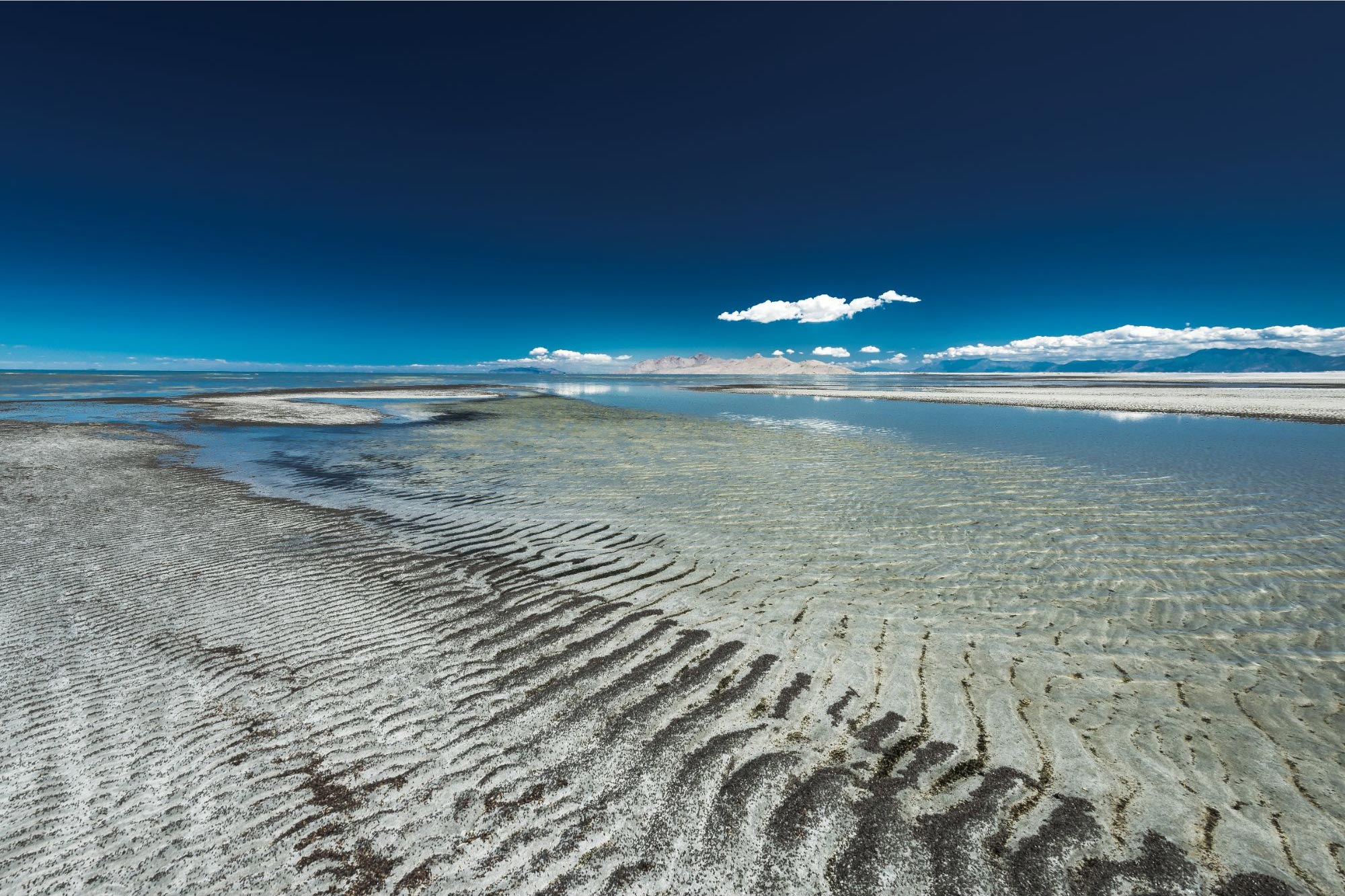
The Great Salt Lake hit record-low levels in 2022 due to reduced streamflows and increased evaporation driven by climate warming. The shrinking lake poses economic, ecological, and public health threats, including toxic dust exposure.
The Great Salt Lake, the largest saltwater lake in the Western Hemisphere, hit record-low levels in 2022, sparking serious economic, ecological, and public health concerns in Utah. New research from Portland State University, considered the first peer-reviewed study to quantify the factors driving these historic low water levels, provides valuable insights for predicting and managing future changes to the lake.
“The lake has a lot of social and economic relevance for the region and Utah,” said Siiri Bigalke, the lead author and a Ph.D. candidate in PSU’s Earth, Environment, and Society program who built on research she started while a master’s student at Utah State University. “It provides over $1.9 billion in annual economic revenue, serves as a vital feeding ground for millions of migratory birds, and enhances snowfall over the Wasatch Mountain Range” — home to 11 world-class ski resorts which are a big reason why the 2034 Winter Olympics are returning to Salt Lake City.
Bigalke and co-authors Paul Loikith, an associate professor of geography and director of PSU’s Climate Science Lab, and Nick Siler, an associate professor in the College of Earth, Ocean, and Atmospheric Sciences at Oregon State University, developed and applied a model that simulates lake volume change year over year from water inputs primarily from streamflow into the lake and precipitation onto the lake and output from water evaporating off the lake.
“We developed a model that created alternate scenarios where only one of the input or output variables changed as observed in order to isolate the relative contributions of streamflow, precipitation, and evaporation to the record low volume in 2022,” Bigalke said.
Drivers of Decline: Streamflow and Evaporation
The decline in lake levels leading up to 2022 has been widely attributed to low stream flows from the lake’s three major tributaries, likely due to some combination of drought, water diversions, and climate change. However, the present study found that lower streamflows only accounted for about two-thirds of the total decline in lake volume. The rest primarily came from an increase in lake evaporation due to warmer temperatures, which will only get worse as temperatures continue to rise.
“As the climate is warming, evaporation off the lake increases, so the contribution from warming to the evaporation is significant,” Loikith said. “Without the warming trend, 2022 wouldn’t have been record low. Even though streamflow is dominant, the increase in evaporation was necessary to reach the record low.”
The researchers said that the findings suggest that increased streamflow can lead to rapid volume recovery in the short term, but under continued warming, evaporation is expected to lead to additional long-term water loss.
In addition to ecological and economic loss, the shrinking lake also poses health risks as a source of toxic dust for the 1.2 million people in the Salt Lake City metro region.
“As the lake shrinks, it’s exposing this dry lakebed that could possibly increase dust events into the metropolitan area, affecting the air quality for nearby residents,” Bigalke said.
The authors suggest further research into determining the degree to which local increasing evaporation, precipitation changes, and/or human-caused diversions is affecting streamflow into the lake.
Reference: “Explaining the 2022 Record Low Great Salt Lake Volume” by Siiri Bigalke, Paul Loikith and Nicholas Siler, 21 January 2025, Geophysical Research Letters.
DOI: 10.1029/2024GL112154
The study was funded by the U.S. National Science Foundation.
Never miss a breakthrough: Join the SciTechDaily newsletter.
Follow us on Google and Google News.
5 Comments
“The Great Salt Lake hit record-low levels in 2022 due to reduced streamflows and increased evaporation driven by climate warming.”
It seems that the authors didn’t consider the cause of increased evaporation beyond the simplistic answer of “It has to be warming.” However, the Clausius-Clapeyron relationship tells us that the POTENTIAL for increased absolute humidity only increases about 7% for each degree Celsius increase in air temperature. The Global Average Temperature has increased about 1 deg C in the last hundred years, but the lake level has NOT been decreasing monotonically during that time. Therefore, it seems questionable that warming is the primary driver of the variance in evaporation, nor does it explain the abrupt increase in water level between about 1965 and 1990. In general, the US does not seem to be warming as rapidly as most of the rest of the Earth, particularly the Arctic, so warming does not seem to be highly correlated with the lake’s water level.
After the 1875 peak in water level, there were other peaks in the early-20th century, followed notably by a sharp peak about 1990 that re-set the trend to a sharp decline until the present day. That is, between 1990 and 2022, the lake level declined as much as it did between 1875 and 2022! What is going on here?
Among other things, it isn’t just temperature that is responsible for evaporation. Increased windiness can increase evaporation by removing the water-vapor saturated air layer in contact with the water surface, and adding some kinetic energy to the water molecules. The actual peer-reviewed article doesn’t mention wind, so I can only assume that they didn’t look at that, being content that they already ‘knew’ that increasing temperature was the culprit.
Increased evaporation could be the result of dryer air moving eastward over the Utah mountains, but warming is supposed to be responsible for Clausius-Clapeyron stimulation of evaporation of the water sources to the west, making the air more humid and potentially increasing precipitation. Although, that doesn’t seem to be happening.
There are yet other variables to consider, such as potentially reduced concentrations of the quantity or type of condensation nuclei that might have changed in the last 23 years, resulting in increased precipitation before the air masses move over Utah. We would need measures of cloudiness and condensation nuclei to resolve this. Again, a global search of the text of the paper does not show that condensation nuclei were were investigated.
Lastly, a little off the wall, but not impossible, the numerous earthquakes in the vicinity of Salt Lake City may have opened a conduit to a deep aquifer, allowing water to slowly drain out. That could probably be ruled out if the salinity of the lake was increasing, limiting the change to evaporation. These are pretty straight-forward calculations as to how the salinity would increase from water loss by evaporation alone. Unfortunately, a global search of the text does not find “salinity,” again leading me to conclude the possibility of a ‘leak’ was not ruled out.
As I mentioned yesterday, with respect to a link I provided ( https://www.mantleplumes.org/WebDocuments/Chamberlin1897.pdf ), there seems to be little acquaintance with the Method of Multiple Working Hypotheses (T. C. Chamberlain, 1897) in the current generation of researchers, particularly in climatology. As a consequence, society should be concerned about conclusions reached by researchers working in an echo chamber.
The Great Salt Lake is experiencing a decline in size mainly due to two key reasons: diminished streamflow and heightened evaporation. The decrease in streamflow is primarily caused by drought conditions, agricultural water diversions, and the impacts of climate change, all of which have led to a reduction in the water entering the lake. Furthermore, increasing temperatures have contributed to higher evaporation rates, exacerbating the drop in water levels. This interplay of factors has caused the lake to attain historically low levels, raising serious ecological, economic, and public health issues.
Speaking of an ‘echo chamber,’ you have just basically repeated what the article said, without adding anything new. You didn’t respond to any of the points I raised. Why should anyone believe your unsupported assertions? You could have saved yourself some time and trouble by just saying, “What they said!”
It sounds like an echo chamber because there’s deep scientific consensus on this topic. Much like the echo chamber of globe-earthers and the echo chamber of heliocentric model enthusiasts. As one NASA climate scientist once told me, no respected climate scientist argues about whether or not global warming is real. Even ordinary people can now see the evidence of rapid climate change.
At this point you need to get into the echo chamber and argue against these papers on your own. Write a rebuttal. You are doing no favors to anyone (except maybe your employer) by posting your brilliant bulls*** on a low level science site.
Of course, you could have saved yourself time and trouble by saying, “I lie because I’m a climate apologist in charge of posting misdirections on as many climate related posts as I can.”
“Of course, you could have saved yourself time and trouble by saying, “I lie because I’m a climate apologist in charge of posting misdirections on as many climate related posts as I can.”
Speaking of lying, you (and readers) KNOW you are lying by making such claim because, even if it were true, which it isn’t, logically there is NO way you could know if I were employed as you claim. It may make you feel better to accuse me of doing something that you couldn’t possibly know, but it demonstrates your desperation to be able to say anything, even if it is logically unsupportable.
I’m a retired Earth scientist, and therefore not in the employ of anyone (Whoever that might be. Do you subscribe to any other conspiracy theories?). I’m disappointed with the poor quality of research, supporting a paradigm that has many obvious flaws. That is my primary motivation. I try to walk a line between using the imprecise lawyer language found in many of these articles, and the jargon a specialist would use communicating with their peers. I may fail at times at doing that perfectly, and I apologize. However, today, with search engines that allow one to obtain the definition of a word without even getting up out of their computer chair and walking over to the bookcase, I don’t think I need to apologize too profusely.
You should be embarrassed to attack me instead of my arguments. It is commonly held that someone who resorts to ad hominem attacks does so because they don’t have a rebuttal with substance. Your actions are basically an acknowledgement that you have nothing to offer to support your beliefs.
Despite the concerns voiced by democrats about our current president being a threat to democracy, we still elect members of Congress. Therefore, I think it is important that the electorate hear both sides of the argument so that they can be an informed electorate, and not rely on trusting what ‘experts’ claim, as translated by the ‘news’ media. Writing exclusively in journals not read by layman would leave me trying to change the minds of those whose livelihood depends on them not changing their minds.
Lastly, I have never denied that the Earth has been warming for about the last 20,000 years. What I DO regularly question is what (and to what extent) is causing the warming.