
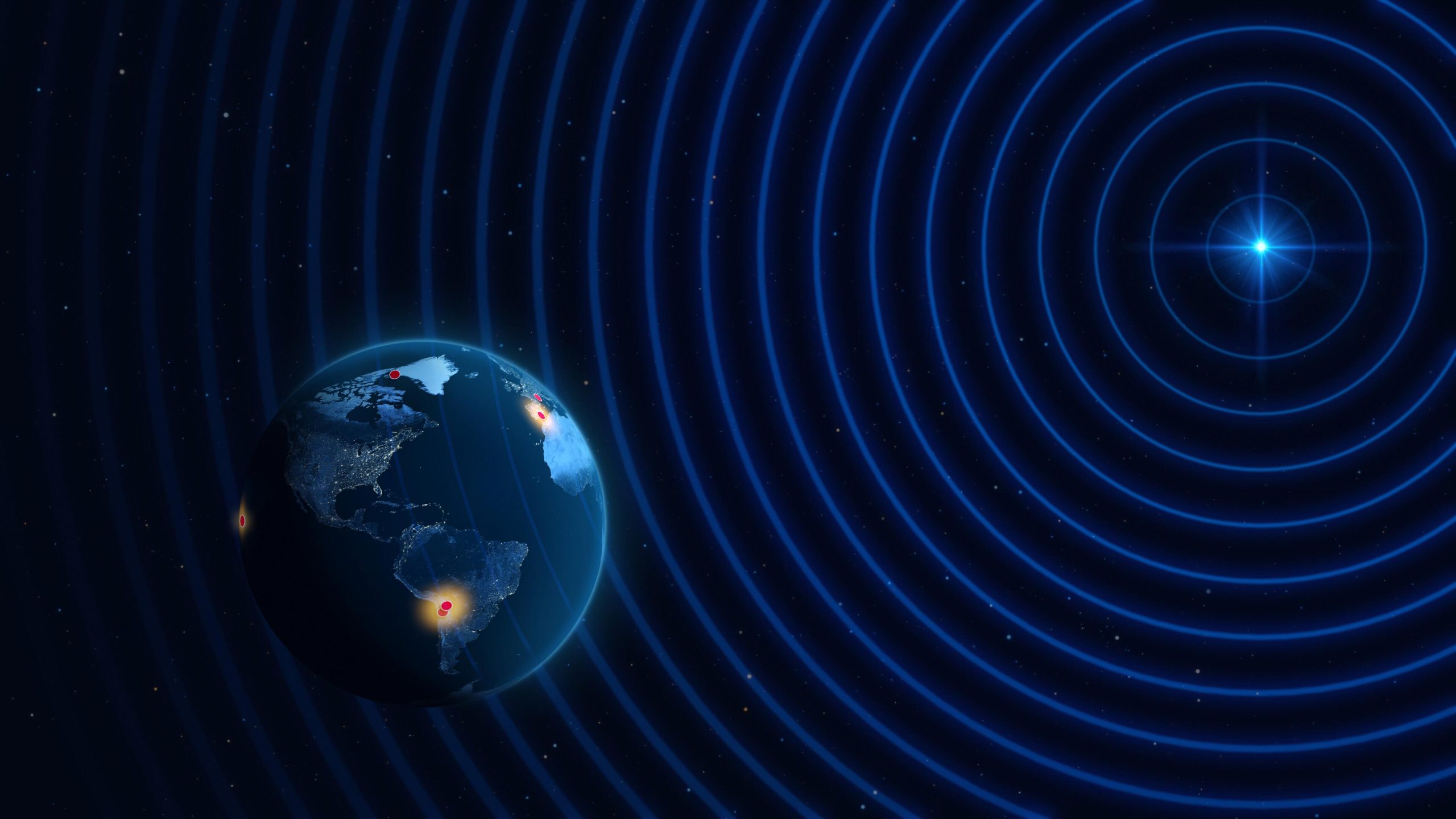
The Event Horizon Telescope (EHT) Collaboration has enhanced its observational capabilities, achieving unprecedented resolutions by detecting light at a 345 GHz frequency.
This breakthrough allows for detailed imaging of black holes, promising images 50% more detailed than previous ones and the potential to view more black holes than ever before.
Breakthrough in Black Hole Imaging
The Event Horizon Telescope (EHT) Collaboration has conducted test observations, using the Atacama Large Millimeter/submillimeter Array (ALMA) and other facilities, that achieved the highest resolution ever obtained from the surface of Earth.[1] They managed this feat by detecting light from distant galaxies at a frequency of around 345 GHz, equivalent to a wavelength of 0.87 mm.
The Collaboration estimates that in future they will be able to make black hole images that are 50% more detailed than was possible before, bringing the region immediately outside the boundary of nearby supermassive black holes into sharper focus. They will also be able to image more black holes than they have done so far. The new detections, part of a pilot experiment, were published today (August 27) in The Astronomical Journal.
In this episode of Chasing Starlight, ESO astronomer Suzanna Randall reveals how a pilot experiment using telescopes that are part of the EHT was able to obtain the highest-resolution observations ever made from the ground, and what that means for future black hole images. Credit: ESO
Advancements in Black Hole Visualization
The EHT Collaboration released images of M87*, the supermassive black hole at the center of the M87 galaxy, in 2019, and of Sgr A*, the black hole at the heart of our Milky Way galaxy, in 2022. These images were obtained by linking together multiple radio observatories across the planet, using a technique called very long baseline interferometry (VLBI), to form a single ‘Earth-sized’ virtual telescope.
To get higher-resolution images, astronomers typically rely on bigger telescopes — or a larger separation between observatories working as part of an interferometer. But since the EHT was already the size of Earth, increasing the resolution of their ground-based observations called for a different approach. Another way to increase the resolution of a telescope is to observe light of a shorter wavelength — and that’s what the EHT Collaboration has now done.
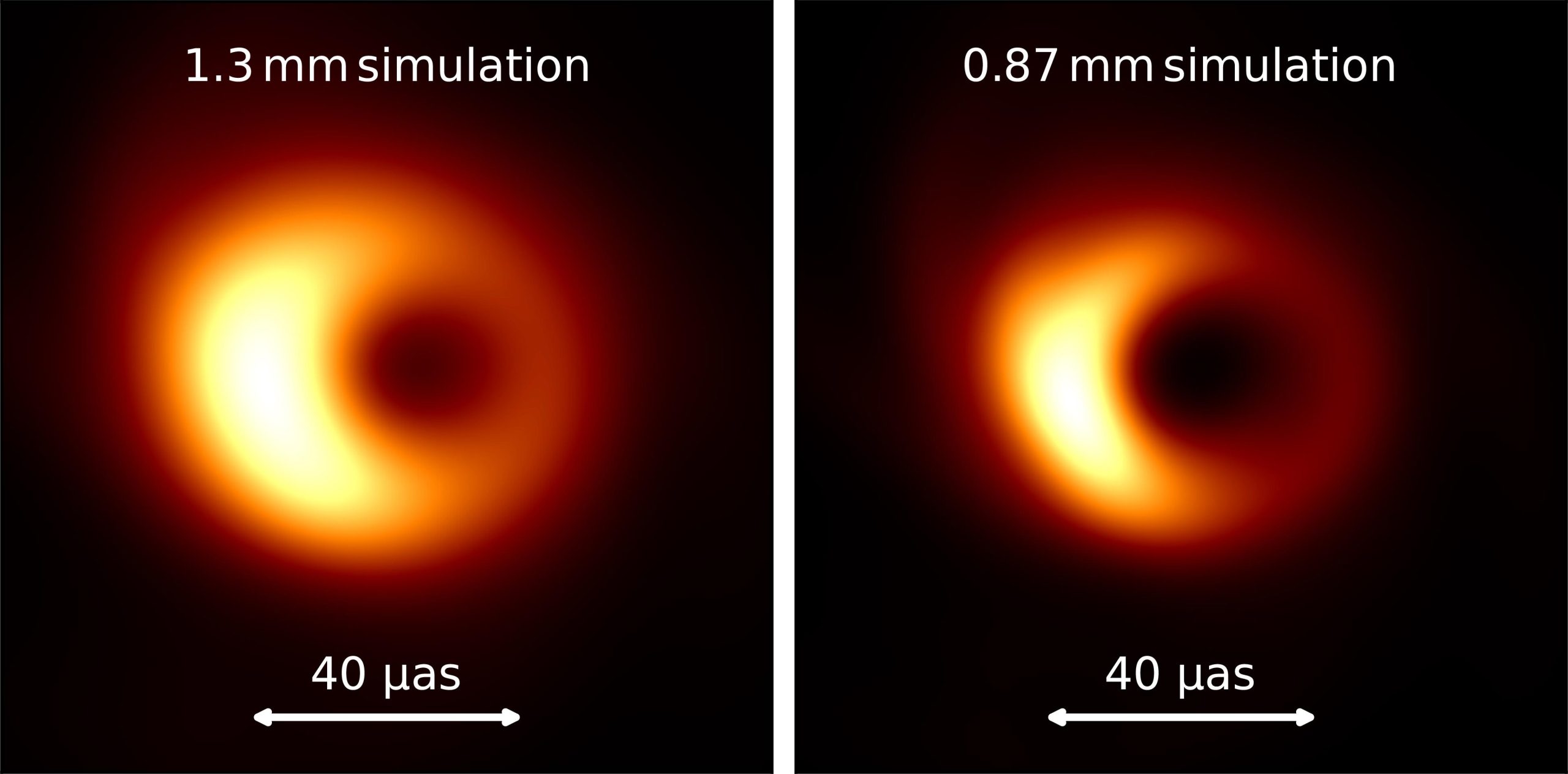
Credit: Christian M. Fromm, Julius-Maximilian University, Würzburg
“With the EHT, we saw the first images of black holes using the 1.3-mm wavelength observations, but the bright ring we saw, formed by light bending in the black hole’s gravity, still looked blurry because we were at the absolute limits of how sharp we could make the images,” said the study’s co-lead Alexander Raymond, previously a postdoctoral scholar at the Center for Astrophysics | Harvard & Smithsonian (CfA), and now at the Jet Propulsion Laboratory, both in the United States. “At 0.87 mm, our images will be sharper and more detailed, which in turn will likely reveal new properties, both those that were previously predicted and maybe some that weren’t.”
Pioneering New Observational Techniques
To show that they could make detections at 0.87 mm, the Collaboration conducted test observations of distant, bright galaxies at this wavelength.[2] Rather than using the full EHT array, they employed two smaller subarrays, both of which included ALMA and the Atacama Pathfinder EXperiment (APEX) in the Atacama Desert in Chile. The European Southern Observatory (ESO) is a partner in ALMA and co-hosts and co-operates APEX. Other facilities used include the IRAM 30-meter telescope in Spain and the NOrthern Extended Millimeter Array (NOEMA) in France, as well as the Greenland Telescope and the Submillimeter Array in Hawaiʻi.
In this pilot experiment, the Collaboration achieved observations with detail as fine as 19 microarcseconds, meaning they observed at the highest-ever resolution from the surface of Earth. They have not been able to obtain images yet, though: while they made robust detections of light from several distant galaxies, not enough antennas were used to be able to accurately reconstruct an image from the data.
This animation video shows the locations of the radio observatories which participated in a pilot experiment conducted by the Event Horizon Telescope (EHT) Collaboration that obtained the highest-resolution observations from the ground. Credit: ESO/M. Kornmesser
Exciting Prospects for Future Black Hole Research
This technical test has opened up a new window to study black holes. With the full array, the EHT could see details as small as 13 microarcseconds, equivalent to seeing a bottle cap on the Moon from Earth. This means that, at 0.87 mm, they will be able to get images with a resolution about 50% higher than that of previously released M87* and SgrA*[3] 1.3-mm images. In addition, there’s potential to observe more distant, smaller and fainter black holes than the two the Collaboration has imaged thus far.
EHT Founding Director Sheperd “Shep” Doeleman, an astrophysicist at the CfA and study co-lead, says: “Looking at changes in the surrounding gas at different wavelengths will help us solve the mystery of how black holes attract and accrete matter, and how they can launch powerful jets that stream over galactic distances.”
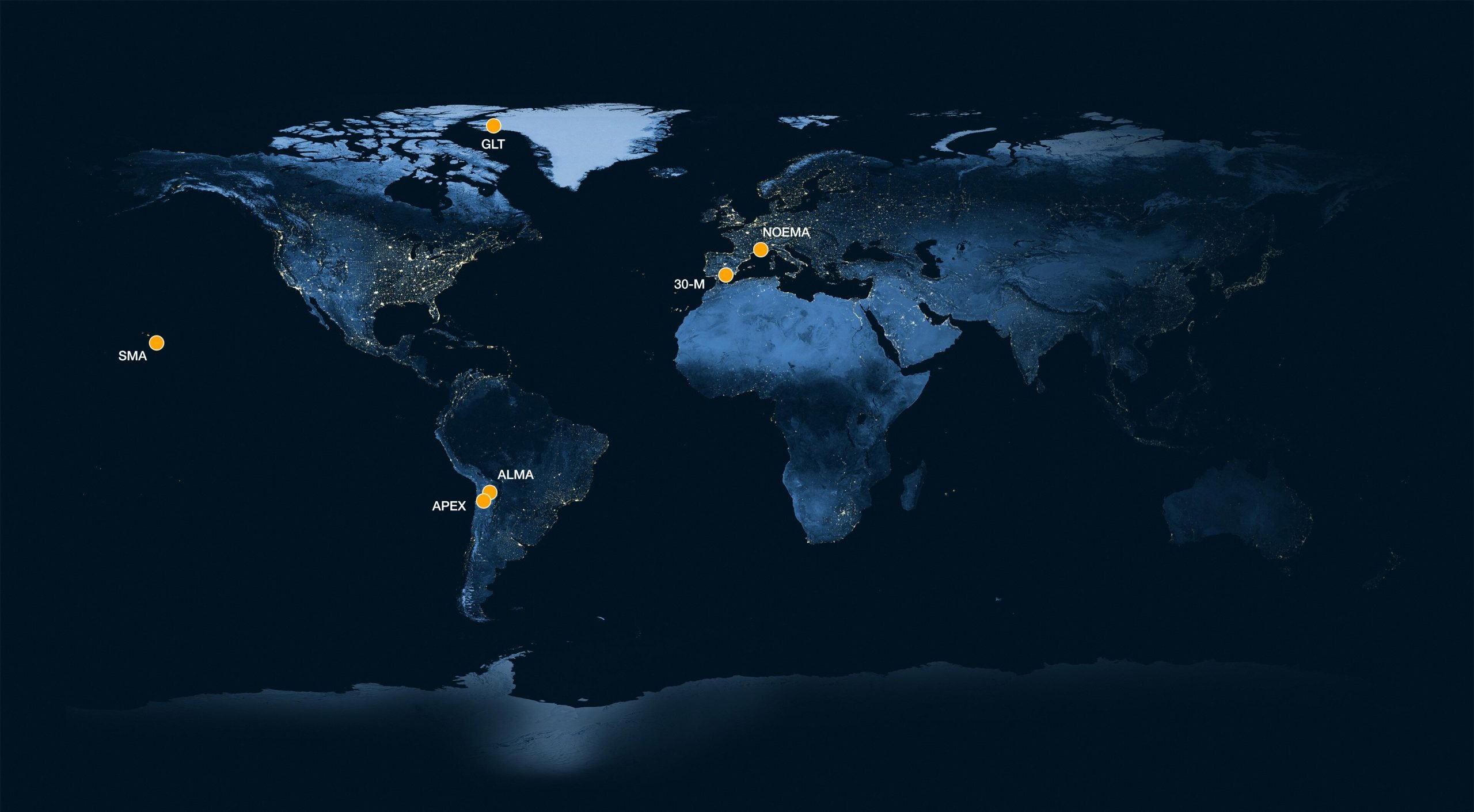
The facilities that participated were: the Atacama Large Millimeter/submillimeter Array (ALMA) and the Atacama Pathfinder EXperiment (APEX), in Chile, the IRAM 30-meter (30-M) telescope in Spain and the NOrthern Extended Millimeter Array (NOEMA) in France, as well as the Greenland Telescope (GLT) and the Submillimeter Array (SMA) in Hawaiʻi. ESO is a partner in ALMA and co-hosts and co-operates APEX.
Credit: ESO/M. Kornmesser
Implications for Astrophysical Studies
This is the first time that the VLBI technique has been successfully used at the 0.87 mm wavelength. While the ability to observe the night sky at 0.87 mm existed before the new detections, using the VLBI technique at this wavelength has always presented challenges that took time and technological advances to overcome. For example, water vapor in the atmosphere absorbs waves at 0.87 mm much more than it does at 1.3 mm, making it more difficult for radio telescopes to receive signals from black holes at the shorter wavelength. Combined with increasingly pronounced atmospheric turbulence and noise buildup at shorter wavelengths, and an inability to control global weather conditions during atmospherically sensitive observations, progress to shorter wavelengths for VLBI — especially those that cross the barrier into the submillimetre regime — has been slow. But with these new detections, that’s all changed.
“These VLBI signal detections at 0.87 mm are groundbreaking since they open a new observing window for the study of supermassive black holes”, states Thomas Krichbaum, a co-author of the study from the Max Planck Institute for Radio Astronomy in Germany, an institution that operates the APEX telescope together with ESO. He adds: “In the future, the combination of the IRAM telescopes in Spain (IRAM-30m) and France (NOEMA) with ALMA and APEX will enable imaging of even smaller and fainter emission than has been possible thus far at two wavelengths, 1.3 mm and 0.87 mm, simultaneously.”
Notes
- There have been astronomical observations with higher resolution, but these were obtained by combining signals from telescopes on the ground with a telescope in space: https://www.mpifr-bonn.mpg.de/pressreleases/2022/2. The new observations released today are the highest-resolution ones ever obtained using only ground-based telescopes.
- To test their observations, the EHT Collaboration pointed the antennas to very distant ‘active’ galaxies, which are powered by supermassive black holes at their cores and are very bright. These types of sources help to calibrate the observations before pointing the EHT to fainter sources, like nearby black holes.
- The GRAVITY instrument on ESO’s Very Large Telescope Interferometer has also obtained extremely detailed observations of Sgr A*, pinpointing the exact location of the black hole and the material orbiting it with an accuracy of a few tenths of microarcseconds.
Reference: “First Very Long Baseline Interferometry Detections at 870 μm” by Alexander W. Raymond, Sheperd S. Doeleman, Keiichi Asada, Lindy Blackburn, Geoffrey C. Bower, Michael Bremer, Dominique Broguiere, Ming-Tang Chen, Geoffrey B. Crew, Sven Dornbusch, Vincent L. Fish, Roberto García, Olivier Gentaz, Ciriaco Goddi, Chih-Chiang Han, Michael H. Hecht, Yau-De Huang, Michael Janssen, Garrett K. Keating, Jun Yi Koay, Thomas P. Krichbaum, Wen-Ping Lo, Satoki Matsushita, Lynn D. Matthews, James M. Moran, Timothy J. Norton, Nimesh Patel, Dominic W. Pesce, Venkatessh Ramakrishnan, Helge Rottmann, Alan L. Roy, Salvador Sánchez, Remo P. J. Tilanus, Michael Titus, Pablo Torne, Jan Wagner, Jonathan Weintroub, Maciek Wielgus, André Young, Kazunori Akiyama, Ezequiel Albentosa-Ruíz, Antxon Alberdi, Walter Alef, Juan Carlos Algaba, Richard Anantua, Rebecca Azulay, Uwe Bach, Anne-Kathrin Baczko, David Ball, Mislav Balokovic, Bidisha Bandyopadhyay, John Barrett, Michi Bauböck, Bradford A. Benson, Dan Bintley, Raymond Blundell, Katherine L. Bouman, Hope Boyce, Roger Brissenden, Silke Britzen, Avery E. Broderick, Thomas Bronzwaer, Sandra Bustamante, John E. Carlstrom, Andrew Chael, Chi-kwan Chan, Dominic O. Chang, Koushik Chatterjee, Shami Chatterjee, Yongjun Chen, Xiaopeng Cheng, Ilje Cho, Pierre Christian, Nicholas S. Conroy, John E. Conway, Thomas M. Crawford, Alejandro Cruz-Osorio, Yuzhu Cui, Rohan Dahale, Jordy Davelaar, Mariafelicia De Laurentis, Roger Deane, Jessica Dempsey, Gregory Desvignes, Jason Dexter, Vedant Dhruv, Indu K. Dihingia, Sergio A. Dzib, Ralph P. Eatough, Razieh Emami, Heino Falcke, Joseph Farah, Edward Fomalont, Anne-Laure Fontana, H. Alyson Ford, Marianna Foschi, Raquel Fraga-Encinas, … , Feryal Özel, Daniel C. M. Palumbo, Georgios Filippos Paraschos, Jongho Park, Harriet Parsons, Ue-Li Pen, Vincent Piétu, Aleksandar PopStefanija, Oliver Porth, Ben Prather, Giacomo Principe, Dimitrios Psaltis, Hung-Yi Pu, Philippe A. Raffin, Ramprasad Rao, Mark G. Rawlings, Angelo Ricarte, Bart Ripperda, Freek Roelofs, Cristina Romero-Cañizales, Eduardo Ros, Arash Roshanineshat, Ignacio Ruiz, Chet Ruszczyk, Kazi L. J. Rygl, David Sánchez-Argüelles, Miguel Sánchez-Portal, Mahito Sasada, Kaushik Satapathy, Tuomas Savolainen, F. Peter Schloerb, Jonathan Schonfeld, Karl-Friedrich Schuster, Lijing Shao, Zhiqiang Shen, Des Small, Bong Won Sohn, Jason SooHoo, León David Sosapanta Salas, Kamal Souccar, Joshua S. Stanway, He Sun, Fumie Tazaki, Alexandra J. Tetarenko, Paul Tiede, Kenji Toma, Teresa Toscano, Efthalia Traianou, Tyler Trent, Sascha Trippe, Matthew Turk, Ilse van Bemmel, Huib Jan van Langevelde, Daniel R. van Rossum, Jesse Vos, Derek Ward-Thompson, John Wardle, Jasmin E. Washington, Robert Wharton, Kaj Wiik, Gunther Witzel, Michael F. Wondrak, George N. Wong, Qingwen Wu, Nitika Yadlapalli, Paul Yamaguchi, Aristomenis Yfantis, Doosoo Yoon, Ziri Younsi, Wei Yu, Feng Yuan, Ye-Fei Yuan, J. Anton Zensus, Shuo Zhang, Guang-Yao Zhao and Shan-Shan Zhao, 27 August 2024, The Astronomical Journal.
DOI: 10.3847/1538-3881/ad5bdb
Never miss a breakthrough: Join the SciTechDaily newsletter.
Follow us on Google and Google News.