
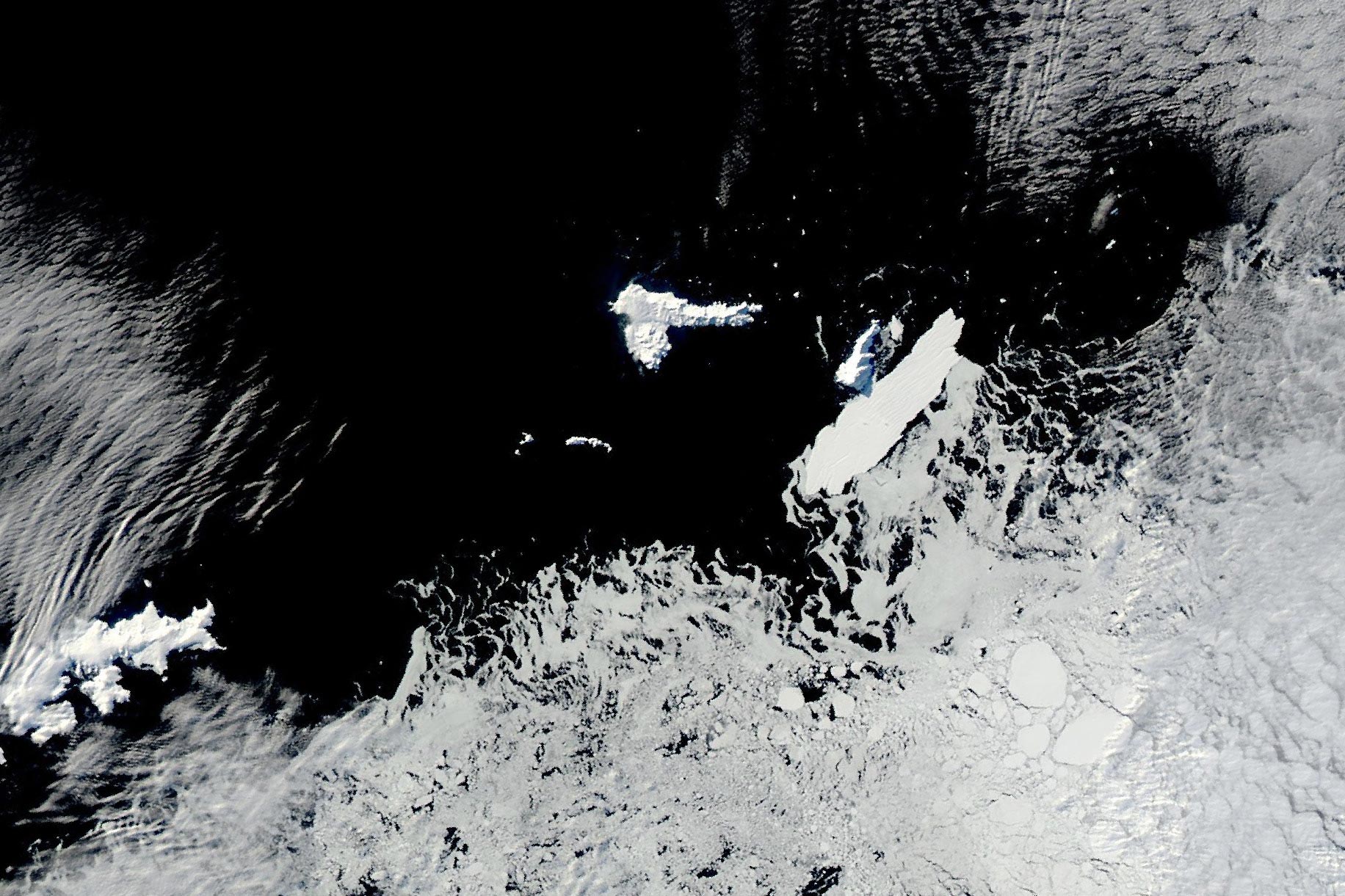
After passing the Antarctic Peninsula, Iceberg D-30A grazed the much smaller Clarence Island, spun around, and drifted north.
In June 2021, the U.S. National Ice Center reported that a collision between iceberg D-28 and the Borchgrevink Ice Shelf in the Queen Maud Land region of East Antarctica had formed a new tabular berg called D-30. Following the collision, the young berg immediately split again, forming D-30A.
After drifting for more than two years, this 39 nautical-mile-long and 11 nautical-mile-wide (72 kilometer-long and 20 kilometer-wide) berg—nearly the area of Rhode Island—grazed the much smaller Clarence Island in September 2023.
Satellite Imagery of D-30A
NASA’s Aqua satellite captured this image of D-30A at the edge of Clarence Island on September 6, 2023 using its MODIS (Moderate Resolution Imaging Spectroradiometer) sensor. Other MODIS imagery shows the berg approaching the island in late August, bumping into its southeast coast, and then rotating around the island in the first two weeks of September. By late September, the berg had moved away from the island and drifted north.
“It didn’t ‘stick’ quite likely because the eastern side of Clarence Island has a pretty sheer drop-off with deep enough water to allow the berg to sail right through,” said Christopher Shuman, a University of Maryland, Baltimore County, glaciologist based at NASA’s Goddard Space Flight Center.
Impact on Local Ecosystem
Still, the arrival of a large iceberg on the shores of a small island like this can trigger a cascade of effects—some positive, some negative—for local wildlife and ecosystems. For instance, iron-rich meltwater from icebergs can help fertilize ocean water and encourage beneficial phytoplankton blooms.
On the other hand, a large iceberg parked offshore a small island can disrupt penguins from foraging, and Clarence Island is home to more than 100,000 breeding pairs of chinstrap penguins. “But in this case, the timing was lucky because the chinstraps that breed there had not returned to the colony yet,” said Heather Lynch, a Stony Brook University ecologist. “If this had happened in December when they were breeding and the adults were trading off incubation daily, it might have been quite serious since even a few days of blocked access to the colony might mean a failed breeding year.”
Since the berg passed by Clarence Island relatively quickly without becoming grounded, the bigger impacts in this case may have involved a process called iceberg scouring, explained Roseanne Smith, a researcher with the British Antarctic Survey. “Scouring can have dramatic impact on the benthic flora and fauna, with single scouring events causing as much as 98 percent mortality of the local macrofauna and megafauna in shallow areas,” she said. “Luckily, because the seafloor drops away steeply on the east of the island, the scouring damage from the D-30A impact will have been localized.” There can also be an upside to scouring. Benthic biodiversity actually peaks when there is some, but not too much, iceberg scour because scour can open up space for species that are less competitively dominant but are more tolerant of iceberg scour, she added.
Previous Path and Future Directions
Before reaching Clarence Island, D-30A had drifted west along the Antarctic Coast with the Antarctic Coastal Current for several months in 2021, before Weddell Gyre ocean currents nudged the berg northwestward into the open waters of the East Weddell Sea. In November 2022, the berg made a sharp turn north, moving along the Antarctic Peninsula in an area known as “Iceberg Alley” on its approach to Clarence Island.
Exactly where D30-A heads next will depend on weather and ocean currents, but icebergs in this area are often pushed east by the powerful Antarctic Circumpolar Current funneling through the Drake Passage, the body of water between South America’s Cape Horn and the South Shetland Islands of Antarctica. From that point, icebergs often move north across the Southern Ocean towards the South Atlantic and quickly melt in the area’s warmer waters.
NASA Earth Observatory image by Wanmei Liang, using MODIS data from NASA EOSDIS LANCE and GIBS/Worldview.
Never miss a breakthrough: Join the SciTechDaily newsletter.
Follow us on Google and Google News.