
Close Menu
    Facebook X (Twitter) Instagram
    SciTechDaily
    • Biology
    • Chemistry
    • Earth
    • Health
    • Physics
    • Science
    • Space
    • Technology
    Facebook X (Twitter) Pinterest YouTube RSS
    SciTechDaily
    Home»Science»Giant Ambush-Predator Worms May Have Colonized the Seafloor Around 20 Million Years Ago
    Science

    Giant Ambush-Predator Worms May Have Colonized the Seafloor Around 20 Million Years Ago

    By Scientific ReportsJanuary 21, 2021No Comments2 Mins Read
    Facebook Twitter Pinterest Telegram LinkedIn WhatsApp Email Reddit
    Share
    Facebook Twitter LinkedIn Pinterest Telegram Email Reddit
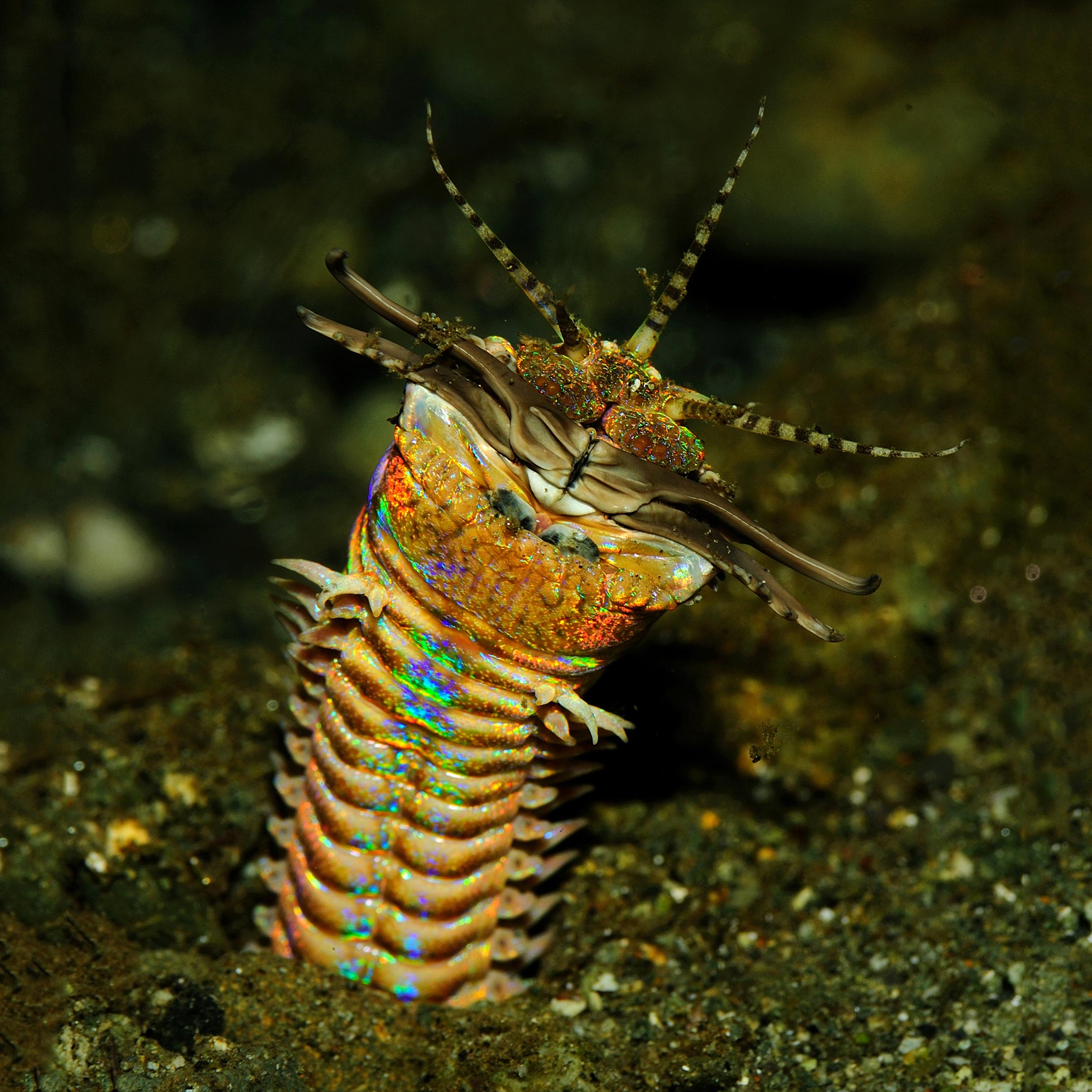
    Bobbit Worm
    Bobbit worm (Eunice aphroditois). Credit: Jenny – Flickr CC BY 2.0

    Fossil Burrows Point to Ancient Seafloor Colonization by Giant Marine Worms

    Giant ambush-predator worms, possible ancestors of the ‘bobbit worm’, may have colonized the seafloor of the Eurasian continent around 20 million years ago. The findings, based on the reconstruction of large, L-shaped burrows from layers of seafloor dating back to the Miocene (23 million to 5.3 million years ago) of northeast Taiwan, are reported in Scientific Reports this week.

    Ludvig Löwemark and colleagues reconstructed a new trace fossil, which they named Pennichnus formosae, using 319 specimens preserved within layers of seafloor formed during the Miocene era across northeast Taiwan. Trace fossils are geological features such as burrows, track marks, and plant root cavities preserved in rocks, which allow for conclusions to be drawn about the behavior of ancient organisms. The trace fossil consists of an L-shaped burrow, roughly 2 meters in length and 2-3 centimeters in diameter.

    Behavior Encoded in Burrows

    The morphology of Pennichnus suggests the burrows were likely inhabited by giant marine worms, such as the bobbit worm (Eunice aphroditois), which are still found today. Bobbit worms hide in long, narrow burrows within the seafloor and propel upwards to grab prey. The authors suggest that the retreat of an ancient worm and its prey into the sediment caused distinct feather-like collapse structures preserved in Pennichnus formosae, which are indicative of disturbance of the sediment surrounding the burrow. Further analysis revealed a high concentration of iron towards the top section of the burrow. The authors suggest this may indicate that the worm re-built its burrow by secreting mucus to strengthen the burrow wall, as bacteria that feed on mucus produced by marine invertebrates are known to create iron-rich environments.

    Although marine worms have existed since the early Palaeozoic, their bodies comprise mainly of soft tissue and are therefore rarely preserved. The trace fossil presented in the study is thought to be the first known fossil of this type produced by a sub-surface ambush predator. It provides a rare glimpse into these creatures’ behavior beneath the seafloor.

    Reference: “The 20-million-year old lair of an ambush-predatory worm preserved in northeast Taiwan” by Yu-Yen Pan, Masakazu Nara, Ludvig Löwemark, Olmo Miguez-Salas, Björn Gunnarson, Yoshiyuki Iizuka, Tzu-Tung Chen and Shahin E. Dashtgard, 21 January 2021, Scientific Reports.
    DOI: 10.1038/s41598-020-79311-0

    Never miss a breakthrough: Join the SciTechDaily newsletter.
    Follow us on Google and Google News.

    Evolution Fossils Marine Biology Paleontology Popular
    Share. Facebook Twitter Pinterest LinkedIn Email Reddit

    Related Articles

    520-Million-Year-Old Fossils Solve One of Evolution’s Biggest Mysteries

    Giant Ancient Shark Discovered in Australia Stuns Scientists

    Textbooks Were Wrong: 249-Million-Year-Old Fossil Discovery Upends Timeline of Evolution

    Incredible Vision in Ancient “Radiating Teeth” Deep Sea Creatures Drove an Evolutionary Arms Race

    Night of the Living Algae: To Survive Asteroid Impact, Algae Learned to Hunt

    Solved: Mystery That’s Been Puzzling Scientists Since 1852 – Bizarre Giraffe-Necked Reptile Hunted Underwater

    MIT’s New Evidence on Dinosaur Evolution

    “Enigmatic and Strange” – 300-Million-Year-Old Fish Resembles a Sturgeon, but With Key Differences

    Ancient Sea-Worm Mystery Solved by Student After 50 Years in “Wastebasket”

    Leave A Reply Cancel Reply

    • Facebook
    • Twitter
    • Pinterest
    • YouTube

    Don't Miss a Discovery

    Subscribe for the Latest in Science & Tech!

    Trending News

    A Woman Who Lived 30,000 Years Ago Is Changing What We Know About Ice Age Europe

    A Rare Radioactive Element Reveals a Hidden Secret About the Heaviest Atoms

    Breakthrough Cancer Treatment Wipes Out Deadly Brain Tumors in Every Mouse Tested

    Something Remarkable Is Happening to Dogs Living Near Chernobyl’s Nuclear Plant

    Hubble Uncovers a Mysterious 93-Billion-Mile Structure Hiding in a Nearby Star System

    Earth’s Oceans Were Slowly Suffocating Millions of Years Before a Devastating Mass Extinction

    Why Are Men Twice As Likely To Develop Parkinson’s? Scientists Discover a Hidden Clue in the Brain

    Scientists Finally Identify Mysterious Creature Nearly 90 Years After It Was First Found

    Follow SciTechDaily
    • Facebook
    • Twitter
    • YouTube
    • Pinterest
    • Newsletter
    • RSS
    SciTech News
    • Biology News
    • Chemistry News
    • Earth News
    • Health News
    • Physics News
    • Science News
    • Space News
    • Technology News
    Recent Posts
    • A New Era of Bionic Vision? AI Helps Scientists Unlock the Brain’s Visual Cortex
    • Scientists Spent 7 Years Studying Moth Wings and Discovered Something Unexpected
    • Scientists Discover Crows Make Decisions Twice As Fast as Humans
    • A Tiny, Jelly-Like Implant Could Change How We Treat High Blood Pressure
    • Less Sugar in Early Life Could Protect Your Mental Health Decades Later
    Copyright © 1998 - 2026 SciTechDaily. All Rights Reserved.
    • Science News
    • About
    • Contact
    • Editorial Board
    • Privacy Policy
    • Terms of Use

    Type above and press Enter to search. Press Esc to cancel.