

Close Menu
    Facebook X (Twitter) Instagram
    SciTechDaily
    • Biology
    • Chemistry
    • Earth
    • Health
    • Physics
    • Science
    • Space
    • Technology
    Facebook X (Twitter) Pinterest YouTube RSS
    SciTechDaily
    Home»Science»Neuroscientists Track How Bad Moods Develop and Persist in the Brain
    Science

    Neuroscientists Track How Bad Moods Develop and Persist in the Brain

    By Society for NeuroscienceMarch 22, 20211 Comment2 Mins Read
    Facebook Twitter Pinterest Telegram LinkedIn WhatsApp Email Reddit
    Share
    Facebook Twitter LinkedIn Pinterest Telegram Email Reddit
    Bad Mood Concept
    Study results suggest found amygdala activity plays a role in shaping a person’s day-to-day emotions, thereby influencing overall psychological wellbeing.

    Similar brain activity patterns to negative and subsequent neutral stimuli connected to increase in negative mood.

    How the amygdala responds to viewing negative and subsequent neutral stimuli may impact our daily mood, according to new research published in JNeurosci.

    The amygdala evaluates the environment to find potential threats. If a threat does appear, the amygdala can stay active and respond to new stimuli like they are threatening too. This is helpful when you are in a dangerous situation, but less so when spilling your coffee in the morning keeps you on edge for the rest of the day.

    In a recent study, Puccetti et al. examined data collected from the “Midlife in the US” longitudinal study. Participants completed a psychological wellbeing assessment and eight daily telephone interviews to assess their mood. They also came into the lab for an fMRI task: they viewed negative, positive, and neutral images with a picture of a neutral facial expression in between each image.
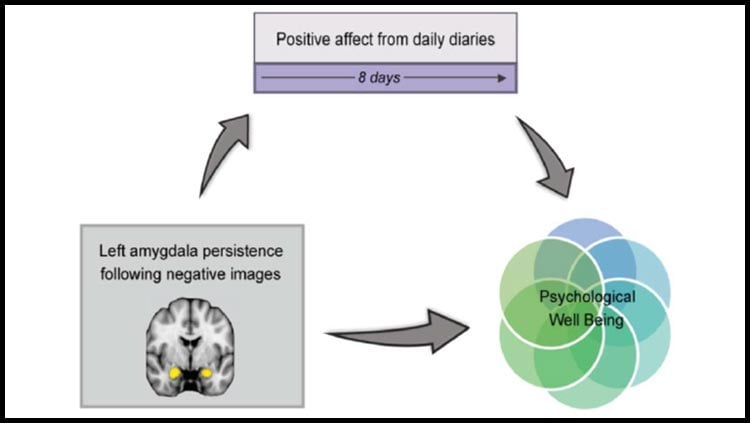
    Negative Mood Linked to Prolonged Amygdala Activity
    Left amygdala persistence following negative images predicts psychological well-being via daily positive affect. Credit: Puccetti et al., JNeurosci 2021

    When the amygdala activated in a similar pattern as the participants viewed negative images and the neutral faces that followed, this persistent activity predicted increases in negative daily mood and decreases in positive daily mood. In turn, participants who experienced increased positive mood displayed greater psychological wellbeing. These results suggest amygdala activity influences how a person feels day-to-day, which can impact overall psychological wellbeing.

    Reference: “Linking Amygdala Persistence To Real-World Emotional Experience and Psychological Well-Being” by Nikki A. Puccetti, Stacey M. Schaefer, Carien M. van Reekum, Anthony D. Ong, David M. Almeida, Carol D. Ryff, Richard J. Davidson and Aaron S. Heller, 22 March 2021, Journal of Neuroscience.
    DOI: 10.1523/JNEUROSCI.1637-20.2021

    Funding: MacArthur Foundation Research Network, National Institute on Aging

    Never miss a breakthrough: Join the SciTechDaily newsletter.
    Follow us on Google and Google News.

    Behavioral Science Brain Neuroscience Society for Neuroscience
    Share. Facebook Twitter Pinterest LinkedIn Email Reddit

    Related Articles

    New Research Reveals Why We Help Some People but Not Others

    A Mathematical Equation Can Uncover Your Preferences via Brain Activity and Mood

    Brain Activity Reveals When White Lies Are Selfish

    Musicians Have Brains With Stronger Connections Than Non-musicians

    Infant Brain Circuitry Shaped by Language Exposure

    “Area 32” – How the Brain Balances Emotion and Reason

    Why Time Sometimes Flies or Drags: How the Brain Creates the Experience of Time

    Scientists Can See the Bias in Your Brain – Even Before You Make Your Decision

    The Science of a Hit Song – Unlocking the Secrets of Musical Pleasure

    1 Comment

    1. Sameer Ali Khan on March 22, 2021 11:18 pm

      Energy Healing Also Helped in loneliness and control the bad Mood.

      Spirituality Awakening

      Reply
    Leave A Reply Cancel Reply

    • Facebook
    • Twitter
    • Pinterest
    • YouTube

    Don't Miss a Discovery

    Subscribe for the Latest in Science & Tech!

    Trending News

    Invisible Black Holes Could Be Triggering Supernovae

    Scientists Discover the First Contagious Cancer in a Freshwater Animal

    THC-CBD Treatment Dramatically Reduces Agitation in Dementia Trial

    Scientists Say Love Follows Mathematical Patterns

    “Zombie Cells” Reveal a Hidden Weakness That Could Help Fight Aging

    Alien Signals May Be Hiding in a Radio Band SETI Has Barely Explored

    Earth’s Hidden Thermostat Has Regulated Climate for 60 Million Years

    This 518-Million-Year-Old Creature Reveals How Spiders Got Their Bite

    Follow SciTechDaily
    • Facebook
    • Twitter
    • YouTube
    • Pinterest
    • Newsletter
    • RSS
    SciTech News
    • Biology News
    • Chemistry News
    • Earth News
    • Health News
    • Physics News
    • Science News
    • Space News
    • Technology News
    Recent Posts
    • What It Takes To Make a White Blood Cell Could Unlock New Cancer Treatments
    • Scientists Turn Gut Bacteria Into Pancreatic Cancer Fighters
    • Scientists Link Heavy TV Watching to Brain Changes Decades Later
    • This Smart Ring Tracks Glucose, Alcohol, and More Through Your Sweat
    • Underwater Cave Bones Reveal Hidden Clues About Ancient Fossils
    Copyright © 1998 - 2026 SciTechDaily. All Rights Reserved.
    • Science News
    • About
    • Contact
    • Editorial Board
    • Privacy Policy
    • Terms of Use

    Type above and press Enter to search. Press Esc to cancel.