
Close Menu
    Facebook X (Twitter) Instagram
    SciTechDaily
    • Biology
    • Chemistry
    • Earth
    • Health
    • Physics
    • Science
    • Space
    • Technology
    Facebook X (Twitter) Pinterest YouTube RSS
    SciTechDaily
    Home»Space»Hubble Space Telescope’s View of Planetary Nebula Reveals Complex Structure
    Space

    Hubble Space Telescope’s View of Planetary Nebula Reveals Complex Structure

    By NASA's Goddard Space Flight CenterDecember 4, 20212 Comments2 Mins Read
    Facebook Twitter Pinterest Telegram LinkedIn WhatsApp Email Reddit
    Share
    Facebook Twitter LinkedIn Pinterest Telegram Email Reddit
    NGC 6891
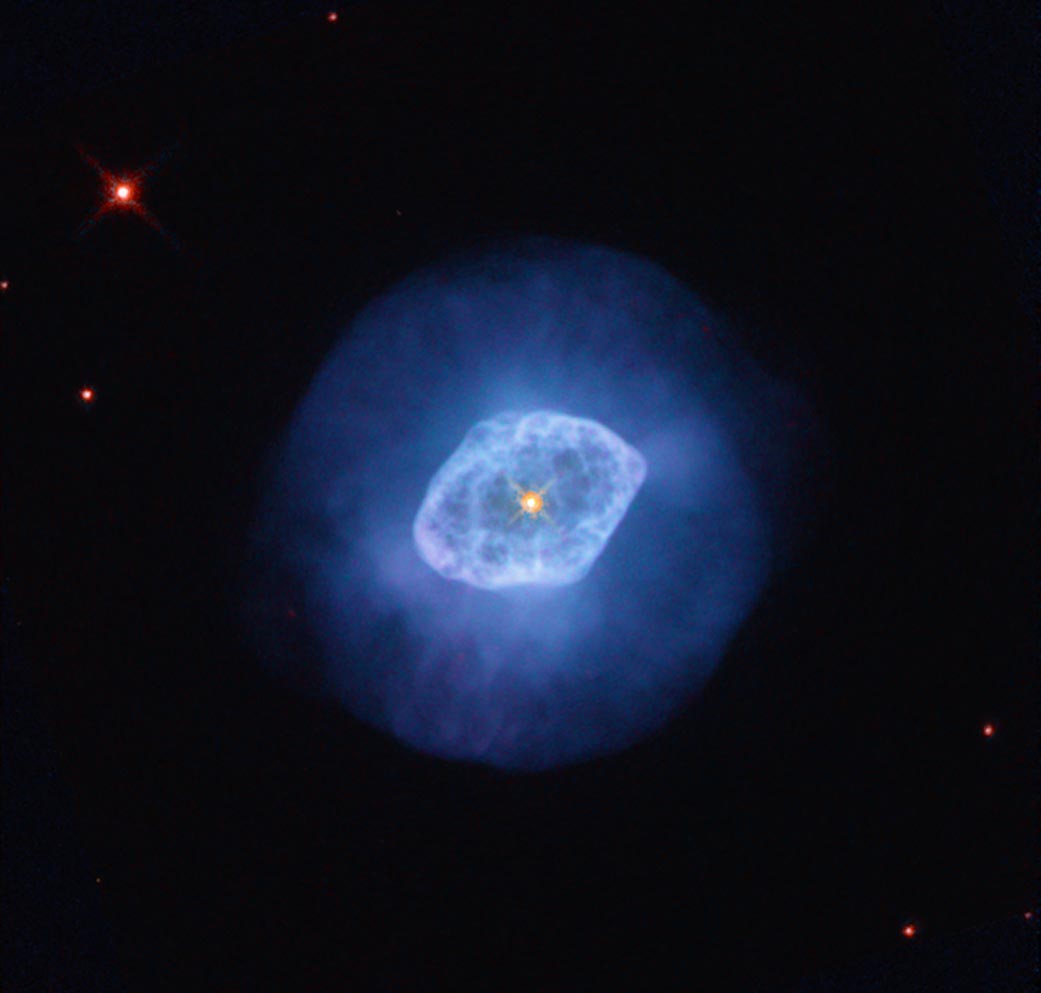
    Hubble Space Telescope image of NGC 6891. Credit: NASA, ESA, A. Hajian (University of Waterloo), H. Bond (Pennsylvania State University), and B. Balick (University of Washington); Processing: Gladys Kober (NASA/Catholic University of America)

    Hubble captured NGC 6891’s layered shells and glowing gas, evidence of repeated stellar eruptions thousands of years apart. Its light arises from hydrogen atoms ionized by the central white dwarf.

    NGC 6891 is a bright, asymmetrical planetary nebula in the constellation Delphinus, the Dolphin. This Hubble image reveals a wealth of structure, including a spherical outer halo that is expanding faster than the inner nebula, and at least two ellipsoidal shells that are orientated differently. The image also reveals filaments and knots in the nebula’s interior, surrounding the central white dwarf star. From their motions, astronomers estimate that one of the shells is 4,800 years old while the outer halo is some 28,000 years old, indicating a series of outbursts from the dying star at different times.

    Hubble studied NGC 6891 as part of efforts to gauge the distances to nebulae, and to learn more about how their structures formed and evolved. NGC 6891 is made up of gas that’s been ionized by the central white dwarf star, which stripped electrons from the nebula’s hydrogen atoms. As the energized electrons revert from their higher-energy state to a lower-energy state by recombining with the hydrogen nuclei, they emit energy in the form of light, causing the nebula’s gas to glow.

    Never miss a breakthrough: Join the SciTechDaily newsletter.
    Follow us on Google and Google News.

    Astronomy Hubble Space Telescope NASA NASA Goddard Space Flight Center
    Share. Facebook Twitter Pinterest LinkedIn Email Reddit

    Related Articles

    Astronomers Finally Solve Betelgeuse’s Biggest Mystery

    The Andromeda Mystery: Hubble Discovers Strange Galactic Behavior

    3.7 Billion Miles Away: Hubble Uncovers a Hidden Trio That Could Rewrite Kuiper Belt History

    Historic Discovery: Twin Titans Clash As NASA Unveils Closest Supermassive Black Hole Duo

    The Great Escape: NASA’s Hubble and MAVEN Help Solve Mystery of Mars’ Vanishing Water

    Into the Rosy Depths: Hubble’s Journey Through Andromeda

    Hubble Observes a Lonely Beacon in the Cosmic Dark

    What Lies Within? Hubble’s Deep Dive Into the Structured Chaos of Leo A

    Hubble Spots Billowing Bubbles of Stellar Floss Across 1,000 Light-Year Expanse

    2 Comments

    1. Edward Lobb on December 5, 2021 1:34 am

      Bosons could be an initial source material for continuous accretion of matter, thus intensifying the gravitational field surrounding black holes.

      Reply
    2. Cynthia Binder on December 6, 2021 6:15 am

      Its pretty 🔍🔎

      Reply
    Leave A Reply Cancel Reply

    • Facebook
    • Twitter
    • Pinterest
    • YouTube

    Don't Miss a Discovery

    Subscribe for the Latest in Science & Tech!

    Trending News

    Scientists Finally Uncover How a “Forever Chemical” Causes Birth Defects

    Scientists Uncover the Earliest Brain Changes That May Predict Alzheimer’s Decades Before Symptoms

    Surprising New Study Challenges a Century-Old Theory of Habit Formation

    Scientists Turn Seawater Into Drinking Water Without Toxic Brine

    Vitamin D Drug Shows Surprising Promise Against One of the Deadliest Cancers

    NASA’s X-59 Sonic Boom Killer Is Ready for Its Biggest Test Yet

    The Best Exercise Combination for Longevity, According to a 30-Year Study

    Popular Weight-Loss Drug Found To Slow Biological Aging in Landmark Human Trial

    Follow SciTechDaily
    • Facebook
    • Twitter
    • YouTube
    • Pinterest
    • Newsletter
    • RSS
    SciTech News
    • Biology News
    • Chemistry News
    • Earth News
    • Health News
    • Physics News
    • Science News
    • Space News
    • Technology News
    Recent Posts
    • According to Scientists, This Simple Dietary Change Is Linked to Lower Depression Scores
    • Researchers Discover a Hidden Vitamin D Problem That Persists Year-Round
    • Scientists Are Building Electronics That Stretch Like Human Skin and Learn Like a Brain
    • Ancient Romans Were Obsessed With This Remarkable Herb – Then It Vanished Forever
    • AI Reveals Simple Ways To Make Your Meals Healthier and Cheaper
    Copyright © 1998 - 2026 SciTechDaily. All Rights Reserved.
    • Science News
    • About
    • Contact
    • Editorial Board
    • Privacy Policy
    • Terms of Use

    Type above and press Enter to search. Press Esc to cancel.