
Close Menu
    Facebook X (Twitter) Instagram
    SciTechDaily
    • Biology
    • Chemistry
    • Earth
    • Health
    • Physics
    • Science
    • Space
    • Technology
    Facebook X (Twitter) Pinterest YouTube RSS
    SciTechDaily
    Home»Space»Don’t Miss: A Planetary Breakup, Hercules Star Cluster, and the Harp Constellation
    Space

    Don’t Miss: A Planetary Breakup, Hercules Star Cluster, and the Harp Constellation

    By Preston Dyches, NASA's Jet Propulsion LaboratoryJune 6, 2022No Comments6 Mins Read
    Facebook Twitter Pinterest Telegram LinkedIn WhatsApp Email Reddit
    Share
    Facebook Twitter LinkedIn Pinterest Telegram Email Reddit
    Planetary Breakup Hercules Star Cluster Ring Nebula
    Skywatchers in June will want to see the planets Saturn, Mars, Jupiter, and Venus, the Hercules Cluster, and the constellation Lyra.

    What’s Up for June? A planetary breakup, prime viewing for a well-known star cluster, and the constellation Lyra.

    Skywatching highlights for June 2022 include the gathering of four naked-eye planets (Saturn, Mars, Jupiter, and Venus) in the morning sky. Check these out, before they break up. There is also the Hercules Cluster, one of the most well-known globular clusters, which you’ll be able to see with just binoculars if you don’t have access to a telescope. Enjoy a nice view of the constellation Lyra, which is easy to locate by looking for Vega, one of the brightest stars in the sky.

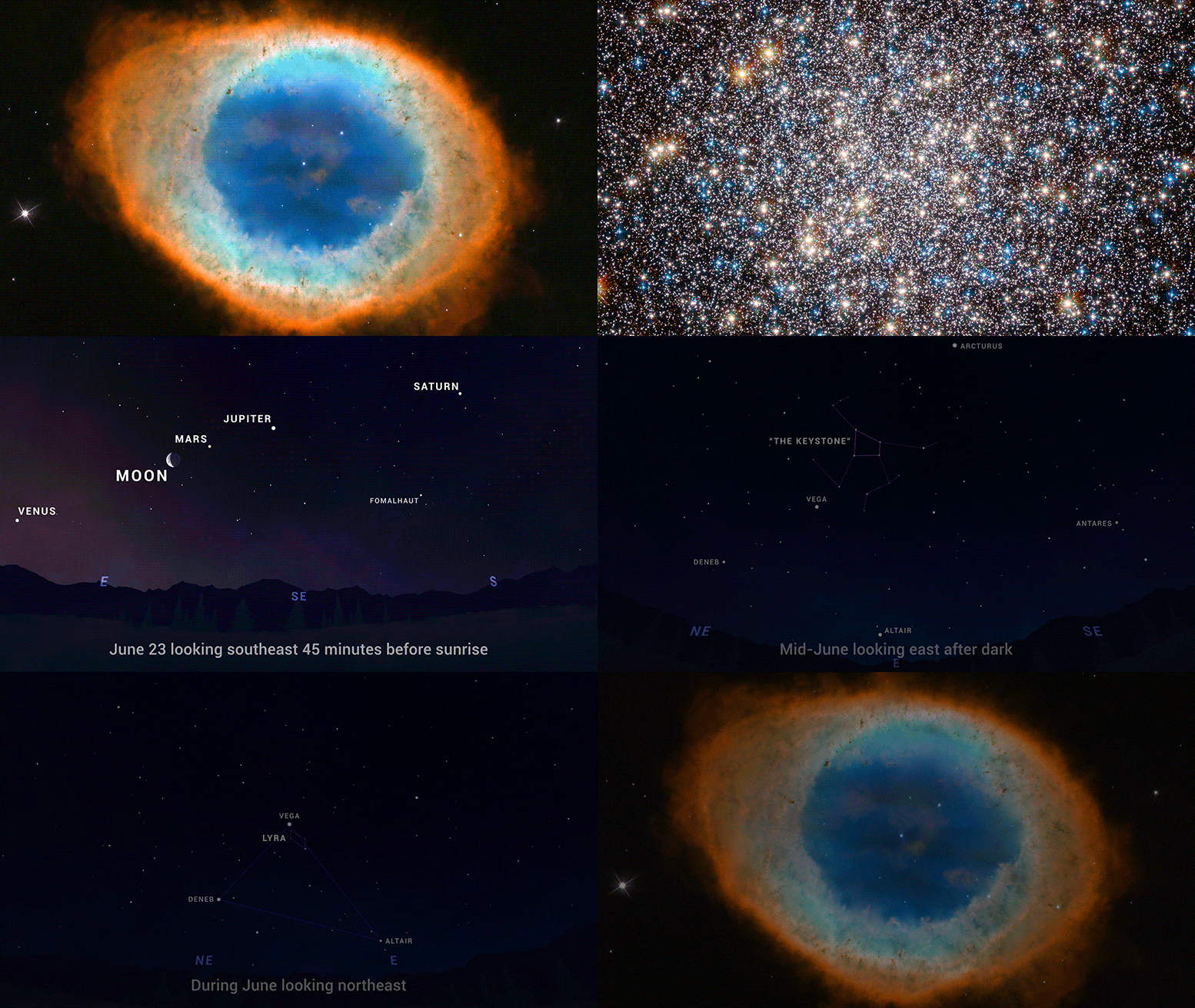
    The gathering of four naked-eye planets we’ve been enjoying in the morning sky for the past few months – including several close conjunctions, is beginning to break up. Over the next few months, Saturn, Mars, Jupiter, and Venus will appear increasingly spread out across the morning sky – so much so that Venus and Saturn will make their exits as morning objects for most observers by September.

    Look for this increasingly spaced out planetary precession in June, and note that the crescent moon jumps into the lineup on the morning of the 23rd.

    Skywatching June 23, 2022
    Planets continue to make a show in the morning before sunrise in June, with the Moon joining the lineup on the 23rd. Credit: NASA/JPL-Caltech

    June is an excellent time to observe one of the best-known globular star clusters – M13, also known as the Hercules Cluster. Globular clusters are spherical collections of stars, tightly packed together in their centers. M13 itself contains several hundred thousand stars.

    Globular clusters are also extremely old. The stars in M13 are thought to be around 12 billion years old, which is approaching the age of the universe itself. Our home galaxy, the Milky Way, is known to have about 150 globular clusters. They orbit outside the galaxy’s disk, traveling tens of thousands of light-years above and below its spiral arms and most of its stars.
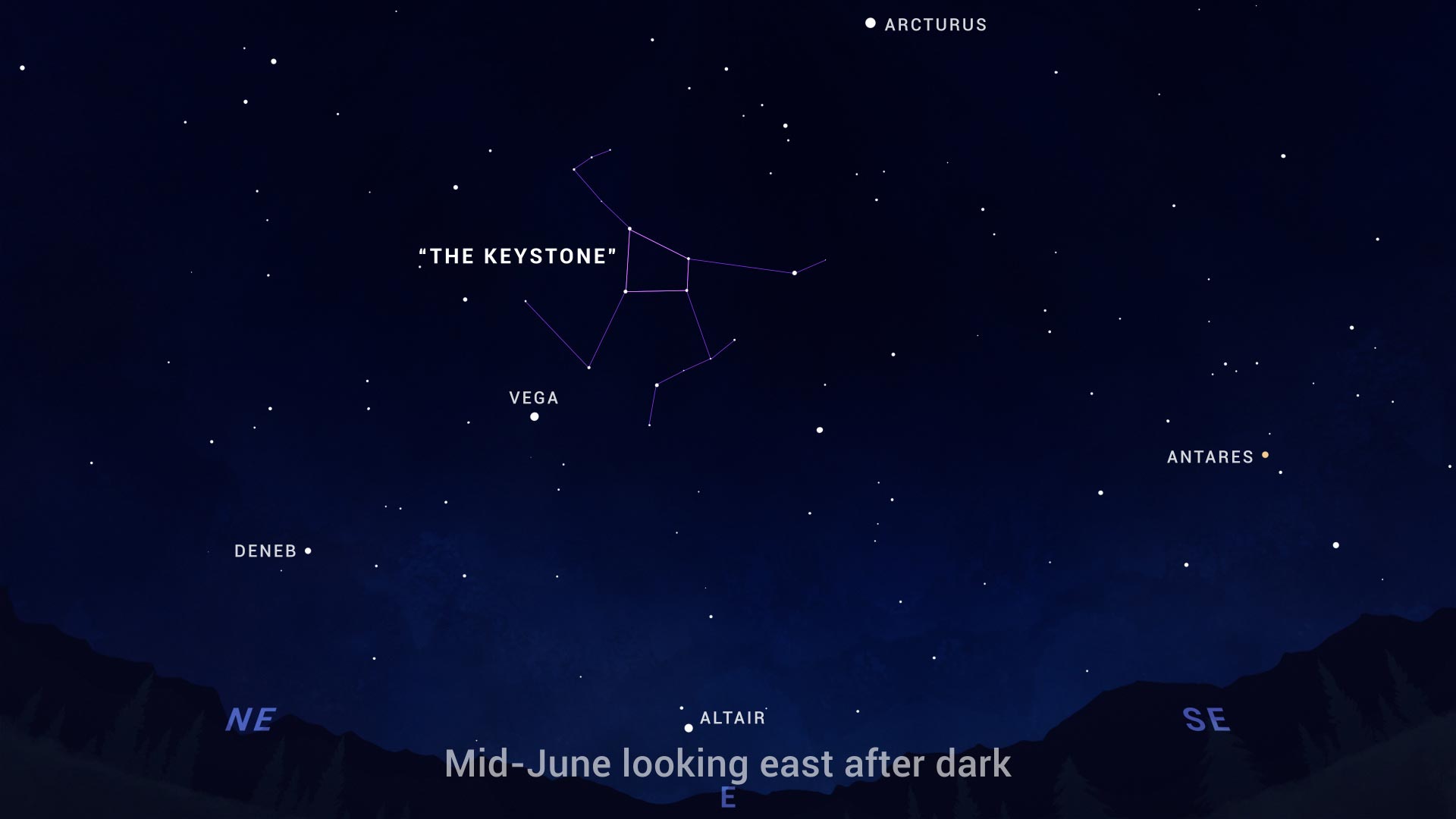
    Skywatching Mid-June 2022
    Find M13 in Hercules by first locating the stars that form the Keystone, about a third of the way between bright stars Vega and Arcturus. Credit: NASA/JPL-Caltech

    Now, the Hercules Cluster is best observed with a telescope, and larger telescopes will allow you to see more of the cluster’s stars. But you can also find it with a pair of binoculars, where it’ll look like a hazy little spot.

    Find M13 in the constellation Hercules, which is high in the east in the first couple of hours after dark in June.
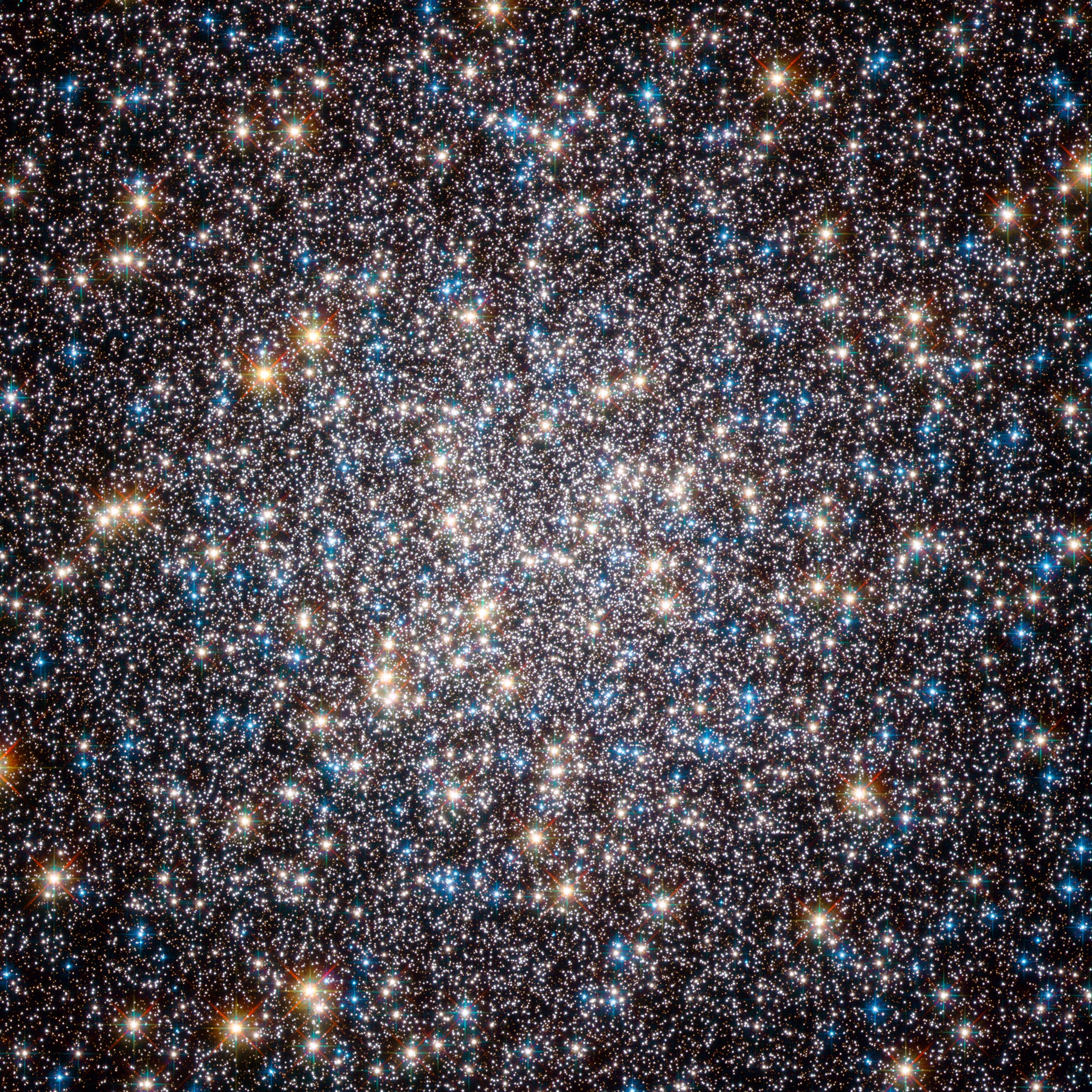
    Heart of M13 Hercules Globular Cluster
    This image, taken by the Advanced Camera for Surveys on the Hubble Space Telescope, shows the core of the great globular cluster Messier 13 and provides an extraordinarily clear view of the hundreds of thousands of stars in the cluster, one of the brightest and best known in the sky. Just 25,000 light-years away and about 145 light-years in diameter, Messier 13 has drawn the eye since its discovery by Edmund Halley, the noted British astronomer, in 1714. The cluster lies in the constellation of Hercules and is so bright that under the right conditions it is even visible to the unaided eye. Credit: ESA/Hubble and NASA

    First look for the bright stars Vega and Arcturus.

    Then find the four stars that comprise “the Keystone,” which is the pattern making up the central part of Hercules.

    You’ll find M13 about a third of the way between the two stars on the western, or leading, side of the Keystone.

    So check out the Great Globular Cluster in Hercules, M13, in June, and find yourself staring at an ancient gathering of stars that soars high above the Milky Way.
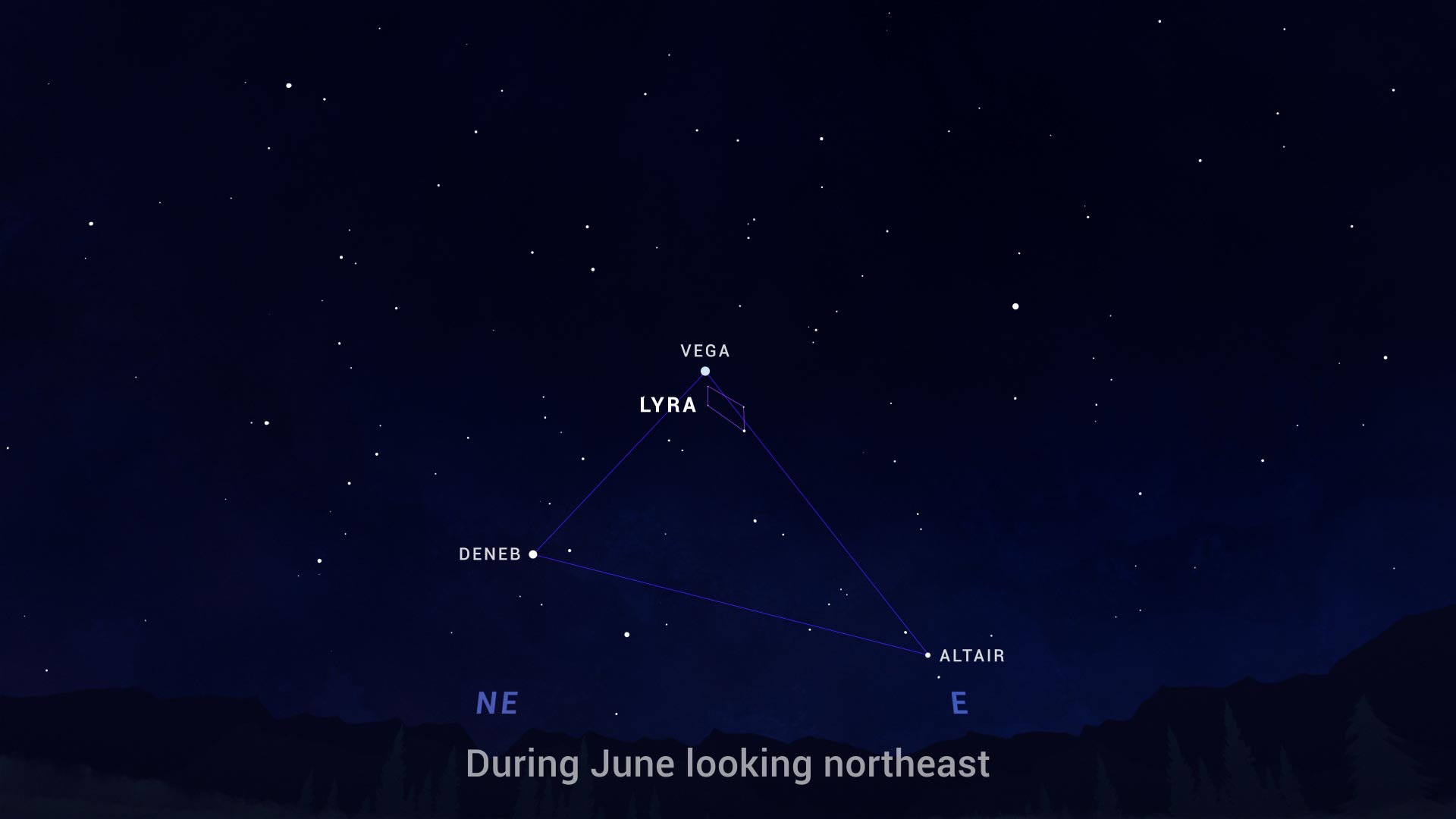
    Skywatching June 2022
    Lyra is easy to locate in the sky, thanks to the brightness of Vega, which is part of the Summer Triangle asterism. Credit: NASA/JPL-Caltech

    Finally in June, a quick introduction to one of the smaller constellations that’s home to one of the brightest stars.

    That’s the constellation Lyra.

    It represents a lyre, or harp, played by the musician Orpheus in Greek mythology.

    In Arab cultures, as well as ancient Egypt and India, Lyra was seen as an eagle.

    And the Inca of South America saw it as a llama.

    Find Lyra by looking for Vega, which is the westernmost of the three bright stars in the Summer Triangle.
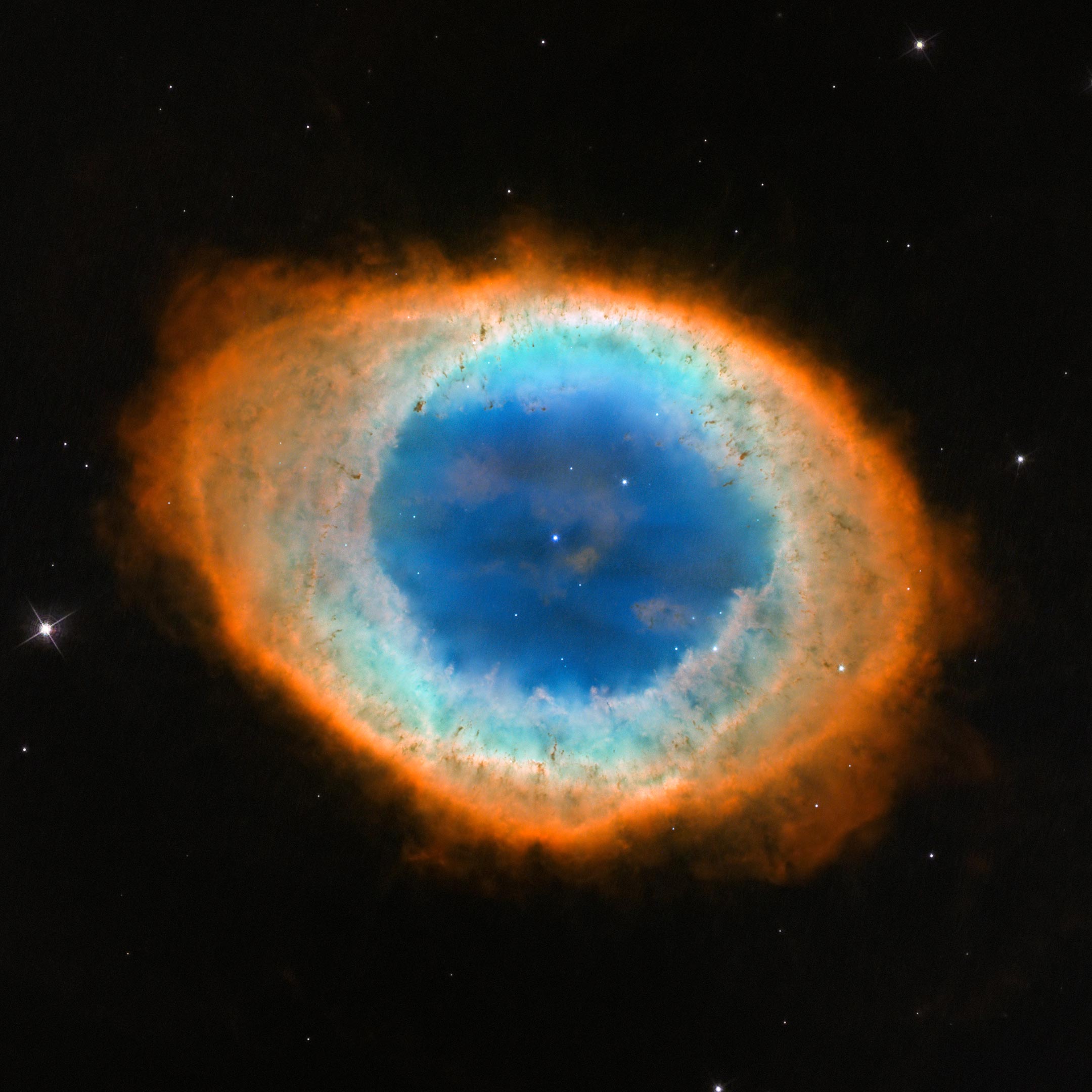
    Hubble Ring Nebula (Messier 57)
    This image shows the dramatic shape and color of the Ring Nebula, otherwise known as Messier 57. From Earth’s perspective, the nebula looks like a simple elliptical shape with a shaggy boundary. However, observations combining existing ground-based data with new NASA/ESA Hubble Space Telescope data show that the nebula is shaped like a distorted doughnut. This doughnut has a rugby-ball-shaped region of lower-density material slotted into its central “gap,” stretching towards and away from us. It is located about 2,500 light years from Earth in the Lyra Constellation. Credit: NASA, ESA, and C. Robert O’Dell (Vanderbilt University)

    In the Northern Hemisphere, you’ll find it halfway up the eastern sky in the first couple of hours after dark in June.

    Vega is by far the brightest star in Lyra.

    It’s the fifth brightest star in the sky and the second brightest in the Northern Hemisphere, after Sirius.

    A pair of binoculars will help you see the others stars in Lyra, which form a sort of parallelogram hanging beneath it.

    It’s sometimes described as looking a bit like a diamond ring, with Vega as the diamond.

    And that’s not the only ring in Lyra. It’s also home to the famous Ring Nebula, where a star has blown off most of its outer layers, leaving behind a remnant star known as a white dwarf.

    So let the bright star Vega lead you to Lyra, the harp constellation, in the June sky. And if you see it as an eagle, or a diamond ring, or a llama, well that’s perfectly okay too…

    Never miss a breakthrough: Join the SciTechDaily newsletter.
    Follow us on Google and Google News.

    Astronomy JPL NASA Popular
    Share. Facebook Twitter Pinterest LinkedIn Email Reddit

    Related Articles

    Don’t Miss: Total Solar Eclipse, Mars and Saturn Rising, Slim Lunar Crescent, Comet 12P

    Webb’s Ethanol Discovery Fuels Search for Alien Life

    Don’t Miss: Jupiter Plows Through the Pleiades

    NASA’s Next-Gen Exoplanet-Imaging Technology Advances Search for Extraterrestrial Life

    NASA Telescopes Are Unlocking the Secrets Behind Mysterious Deep Space Signals

    Catch the Quadrantid Fireballs: A January Sky Spectacle With Moon and Planet Pairings

    From IRAS to Webb: The Incredible Evolution of NASA’s Infrared Telescopes

    End of an Era: NASA’s NEOWISE 10-Year Mission Ending Due to Solar Activity

    Don’t Miss: Geminid Meteor Shower and Asteroid Vesta

    Leave A Reply Cancel Reply

    • Facebook
    • Twitter
    • Pinterest
    • YouTube

    Don't Miss a Discovery

    Subscribe for the Latest in Science & Tech!

    Trending News

    Mezcal “Worm” in a Bottle Mystery: DNA Testing Reveals a Surprise

    New Research Reveals That Your Morning Coffee Activates an Ancient Longevity Switch

    This Is What Makes You Irresistible to Mosquitoes

    Shockingly Powerful Giant Octopuses Ruled the Seas 100 Million Years Ago

    Scientists Stunned by New Organic Molecules Found on Mars

    Rewriting Dinosaur Evolution: Scientists Unearth Remarkable 150-Million-Year-Old Stegosaur Skull

    Omega-3 Supplements Linked to Cognitive Decline in Surprising New Study

    First-of-Its-Kind Discovery: Homer’s Iliad Found Embedded in a 1,600-Year-Old Egyptian Mummy

    Follow SciTechDaily
    • Facebook
    • Twitter
    • YouTube
    • Pinterest
    • Newsletter
    • RSS
    SciTech News
    • Biology News
    • Chemistry News
    • Earth News
    • Health News
    • Physics News
    • Science News
    • Space News
    • Technology News
    Recent Posts
    • This Tiny World in the Outer Solar System Should Be Airless, but It Has an Atmosphere
    • NASA’s Webb Space Telescope Reveals a Dark Airless Super-Earth That Looks Like Mercury
    • These Simple Daily Habits Can Quickly Improve Blood Pressure and Heart Risk Factors
    • A Common Nutrient May Play a Surprising Role in Anxiety
    • Doing This After 9 p.m. Could Double Your Risk of Gut Issues
    Copyright © 1998 - 2026 SciTechDaily. All Rights Reserved.
    • Science News
    • About
    • Contact
    • Editorial Board
    • Privacy Policy
    • Terms of Use

    Type above and press Enter to search. Press Esc to cancel.