
Humans or Seals? Who Has the Best Underwater Hearing?
All mammals lived on land millions of years ago, but eventually, certain species abandoned the land and adapted to life in the sea: take seals and whales, which both can now live underwater.
The remainder of the species that persisted on land has similarly adapted to a life on land. That is why it shouldn’t be a surprise that a group of experts came to the conclusion that people today hear better on land than underwater in a recent study. However, the research also offers unexpected information on human hearing.
A specialist in animal hearing, Jakob Christensen-Dalsgaard devotes his time and energy to studying the hearing of creatures including cormorants, geckos, frogs, and crocodiles, as well as people, in his laboratory at the University of Southern Denmark. This time, he is working alongside Ph.D. candidate Kenneth Sørensen and biologist Magnus Wahlberg, who is an expert on animal underwater hearing and also attends the University of Southern Denmark.
Decades of Hearing Tests
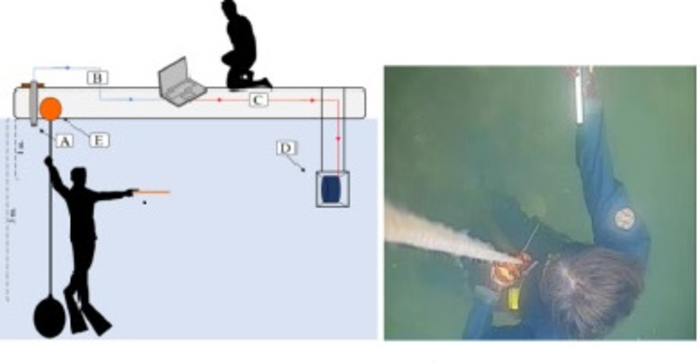
Since the 1950s, several different attempts have been made to measure human hearing underwater. The US military, for example, has had an interest in understanding how divers are affected by underwater explosions, and in general, the hearing tests have been very different.
Some subjects have been tested with diving equipment on, others with neoprene caps, and still others with air-filled diving masks — all of which can affect the test subjects’ hearing.
However, the authors state that one thing in common with all of these scientific studies is that they all find hearing thresholds that are higher than the thresholds we have found in their new study.
We Hear As Well as Seals Underwater
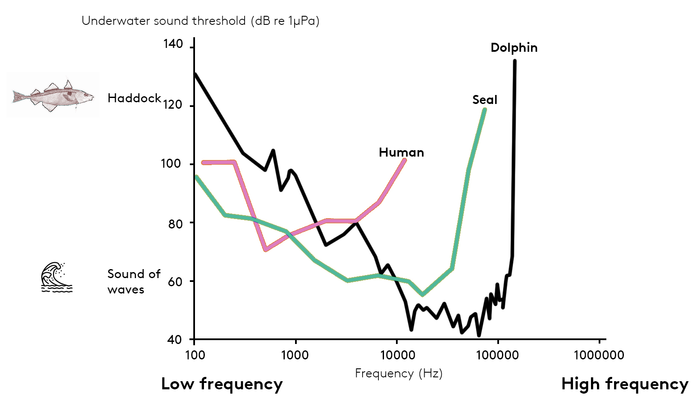
In the new study, in which 7 people participated, the average hearing threshold of 71 dB (3.5 mPa) is at 500 Hz. Hearing threshold is the sound level below which a person’s ear cannot hear anything.
“It is 26 dB lower than hypothesized in previous studies, so we must conclude that humans hear significantly better underwater than previously reported by science. In fact, the threshold at 500 Hz is in line with how well animals such as cormorants and seals hear underwater,” says Jakob Christensen-Dalsgaard.
Worth noting in this context is, that e.g., seals and dolphins – unlike us — can hear very loud sounds underwater – also sounds that humans cannot hear.
The previous studies hypothesized that the human ear underwater works by so-called bone conduction; that is, the sound waves vibrate the skull. That hypothesis would fit the high hearing thresholds found in previous studies.
“But we believe that resonance in the enclosed air in the middle ear amplifies the sound and makes the ear more sensitive. We have also shown this in previous studies of cormorants, turtles, and frogs,” explains Jakob Christensen-Dalsgaard
“You should not expect to be able to jump into the sea and orient yourself perfectly using only your sense of hearing,” says Jakob Christensen-Dalsgaard, “Sense of hearing is not just about being able to pick up a sound. It is also about determining the direction of the sound — and this is very difficult for a person underwater.”
“In the air, we can determine the sound direction within a few degrees, but in water, there is an up to 90 degrees error margin. This is not so strange, because we are trained to react to the small time differences between the ears, which are due to the speed of sound in air. In water, the speed of sound is four times greater, and the time differences are much smaller,” Jakob Christensen-Dalsgaard explains, concluding, “The results tell us that humans have a reduced ability to determine the direction of sounds underwater, thus confirming that human hearing is not adapted to work well underwater.”
Reference: “Is human underwater hearing mediated by bone conduction?” by K.Sørensen, J.Christensen-Dalsgaard and M. Wahlberg, 19 March 2022, Hearing Research.
DOI: 10.1016/j.heares.2022.108484
Never miss a breakthrough: Join the SciTechDaily newsletter.
Follow us on Google and Google News.