
Close Menu
    Facebook X (Twitter) Instagram
    SciTechDaily
    • Biology
    • Chemistry
    • Earth
    • Health
    • Physics
    • Science
    • Space
    • Technology
    Facebook X (Twitter) Pinterest YouTube RSS
    SciTechDaily
    Home»Space»Scientists Reveal Saturn’s Youthful Appearance Is the Result of Layered Convection
    Space

    Scientists Reveal Saturn’s Youthful Appearance Is the Result of Layered Convection

    By University of ExeterMay 1, 2013No Comments3 Mins Read
    Facebook Twitter Pinterest Telegram LinkedIn WhatsApp Email Reddit
    Share
    Facebook Twitter LinkedIn Pinterest Telegram Email Reddit
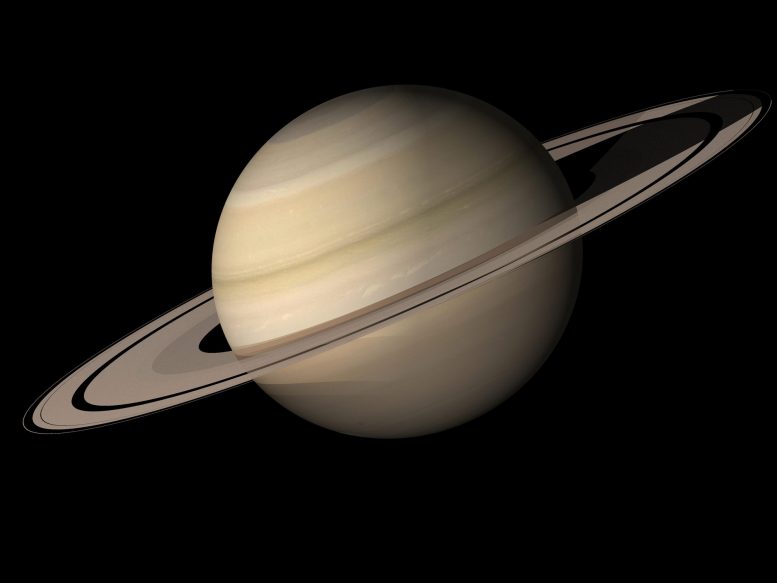
    Saturns Appearance Explained
    Saturn is much brighter than expected for a planet of its age.

    In a new study, scientists from the University of Exeter and the Ecole Normale Supérieure de Lyon reveal that Saturn’s youthful appearance is due to its inability to cool down, suggesting that the interior structure, composition, and thermal evolution of giant planets may be more complex than the conventional approximation of giant planets as homogeneous adiabatic bodies.

    As planets age, they become darker and cooler. Saturn however is much brighter than expected for a planet of its age – a question that has puzzled scientists since the late sixties.

    New research published in the journal Nature Geoscience has revealed how Saturn keeps itself looking young and hot.

    Researchers from the University of Exeter and the Ecole Normale Supérieure de Lyon found that layers of gas, generated by physical instability deep within the giant planet, prevent heat from escaping and have resulted in Saturn failing to cool down at the expected rate.

    Professor Gilles Chabrier from Physics & Astronomy at the University of Exeter said: “Scientists have been wondering for years if Saturn was using an additional source of energy to look so bright but instead our calculations show that Saturn appears young because it can’t cool down. Instead of heat being transported throughout the planet by large-scale (convective) motions, as previously thought, it must be partly transferred by diffusion across different layers of gas inside Saturn. These separate layers effectively insulate the planet and prevent heat from radiating out efficiently. This keeps Saturn warm and bright.”

    Characterized by its distinctive rings, Saturn is one of the largest planets in our Solar System, second only in size to massive Jupiter. It is primarily made of hydrogen and helium and its excessive brightness has previously been attributed to helium rains, the result of helium failing to mix with Saturn’s hydrogen-rich atmosphere.

    Layered convection, like that recently discovered in Saturn, has been observed in the Earth’s oceans where warm, salty water lies beneath cool and less salty water. The denser, salty water prevents vertical currents from forming between the different layers so heat cannot be transported efficiently upwards.

    These findings suggest that the interior structure, composition, and thermal evolution of giant planets in our Solar System, and beyond, may be much more complex than previously thought.

    Reference: “Layered convection as the origin of Saturn’s luminosity anomaly” by Jérémy Leconte and Gilles Chabrier, 21 April 2013, Nature Geoscience.
    DOI: 10.1038/ngeo1791

    This work was funded by the European Research Council.

    Never miss a breakthrough: Join the SciTechDaily newsletter.
    Follow us on Google and Google News.

    Astronomy Geoscience Planetary Science University of Exeter
    Share. Facebook Twitter Pinterest LinkedIn Email Reddit

    Related Articles

    New Study Resolves a Decades-Old Paradox between Thermal History Models and Estimates of Mercury’s Contraction

    Orbiter Examines Clues to Possible Water Flows on Mars

    Scientists Find Evidence for Granite on Mars

    Hubble Reveals the Puzzling Properties of Hot Jupiter Atmospheres

    Pre-existing Mineral Deposits on the Moon Can Survive Lunar Impacts

    Number of Potentially Habitable Planets Is Greater Than Previously Thought

    Presence of Water in the Primary Crust Indicates That the Early Moon Was Wet

    An Updated Model for Identifying Habitable Zones Around Stars

    Diogenites Provide Clues of the Earliest Days of Our Solar System

    Leave A Reply Cancel Reply

    • Facebook
    • Twitter
    • Pinterest
    • YouTube

    Don't Miss a Discovery

    Subscribe for the Latest in Science & Tech!

    Trending News

    NASA Finds Earth Microbes Could Hide in the Moon’s Deep Shadows

    New Study: Intermittent Fasting Lowers Blood Sugar in Type 1 Diabetes

    Alzheimer’s Brain Changes May Begin 7 Years Earlier Than Scientists Thought

    This New Molecule Could Transform How We Recover Gold From Electronic Waste

    A Billion Years Before the Grand Canyon, a Giant Cliff May Have Stretched Across America

    The Immune Systems of 110-Year-Olds Are Hiding a Remarkable Secret

    Common Osteoarthritis Treatment Fails a Major Test

    Dark Stars May Have Left a Gravitational-Wave Signal We Can Detect Today

    Follow SciTechDaily
    • Facebook
    • Twitter
    • YouTube
    • Pinterest
    • Newsletter
    • RSS
    SciTech News
    • Biology News
    • Chemistry News
    • Earth News
    • Health News
    • Physics News
    • Science News
    • Space News
    • Technology News
    Recent Posts
    • Naked Comet Photobombs Public Telescope Image
    • JWST Finds Giant Planets Face a Cosmic Race Against Time
    • Brain Cells Once Thought Protective May Actually Drive Cognitive Decline With Age
    • Magnetic Bacterium Extends Lifespan by 43% in Surprising Anti-Aging Study
    • 80,000-Year-Old Arrowheads Could Rewrite the Story of How Humans Reached Europe
    Copyright © 1998 - 2026 SciTechDaily. All Rights Reserved.
    • Science News
    • About
    • Contact
    • Editorial Board
    • Privacy Policy
    • Terms of Use

    Type above and press Enter to search. Press Esc to cancel.