
Close Menu
    Facebook X (Twitter) Instagram
    SciTechDaily
    • Biology
    • Chemistry
    • Earth
    • Health
    • Physics
    • Science
    • Space
    • Technology
    Facebook X (Twitter) Pinterest YouTube RSS
    SciTechDaily
    Home»Space»Galactic Mistake? Astronomers May Have Solved the Mystery of the Runaway Supermassive Black Hole
    Space

    Galactic Mistake? Astronomers May Have Solved the Mystery of the Runaway Supermassive Black Hole

    By Instituto de Astrofísica de Canarias (IAC)May 10, 20237 Comments4 Mins Read
    Facebook Twitter Pinterest Telegram LinkedIn WhatsApp Email Reddit
    Share
    Facebook Twitter LinkedIn Pinterest Telegram Email Reddit
    Runaway Supermassive Black Hole Illustration
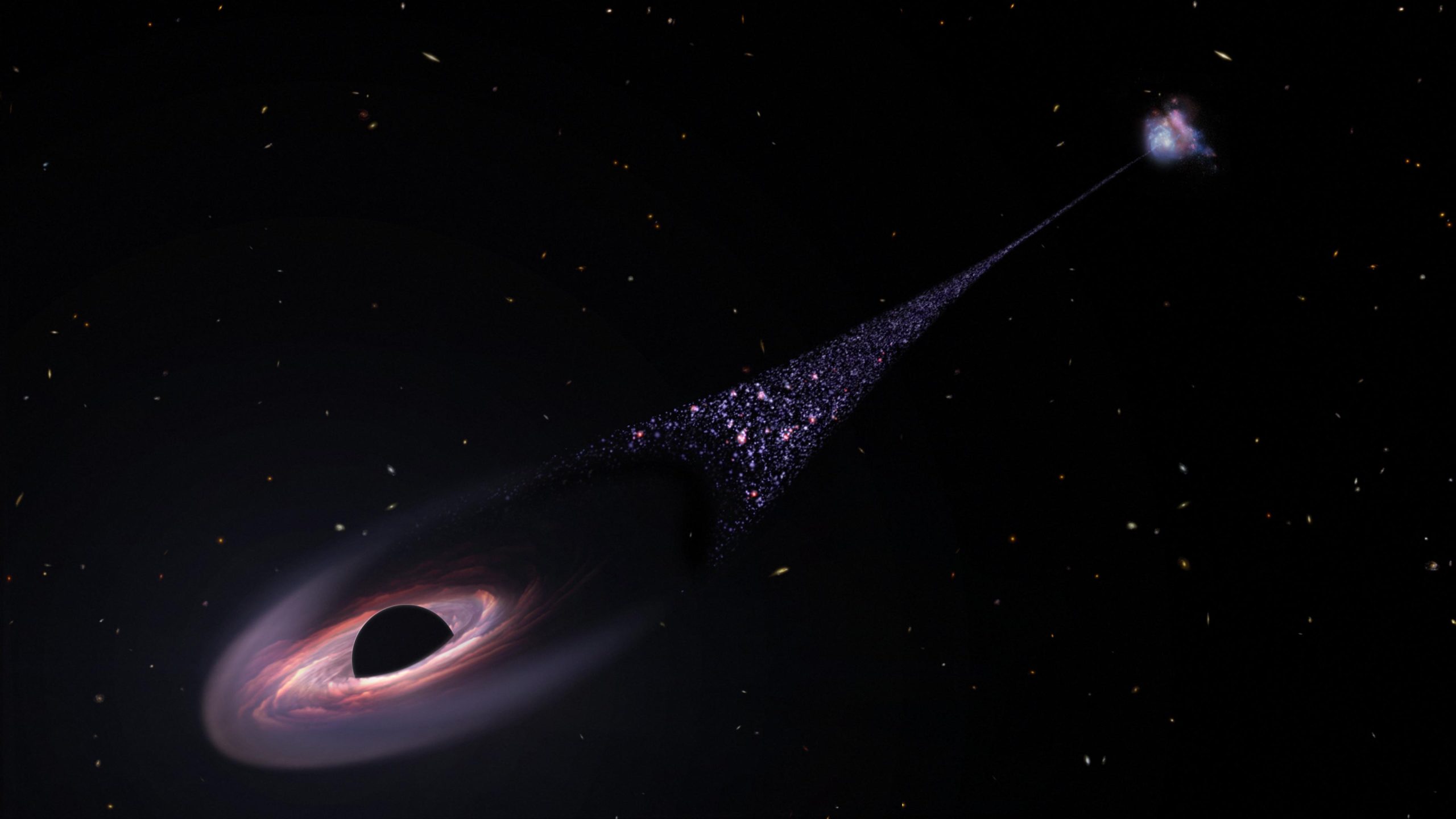
    Researchers at the IAC have discovered that an unusual thin structure of stars might actually be a galaxy seen edge-on, rather than a trail left by a fleeing supermassive black hole, as shown in this artist’s impression of a runaway supermassive black hole. Credit: NASA, ESA, Leah Hustak (STScI)

    A study carried out by a team of researchers at the Instituto de Astrofísica de Canarias (IAC) has shown that an unusually thin structure of stars, recently discovered by the Hubble Space Telescope, could be a galaxy seen edge-on. This finding goes against the original interpretation in which a fleeing supermassive black hole was leaving a trail of stars in its wake. The new interpretation is published in the journal Astronomy and Astrophysics Letters.

    A mysterious trail of stars formed eight billion years ago and recently discovered by the Hubble Space Telescope has been a challenge to a number of research groups. Its size is similar to that of the Milky Way, and this very long narrow structure has given rise to several explanations of its origin.
    Runaway Supermassive Black Hole or Galaxy
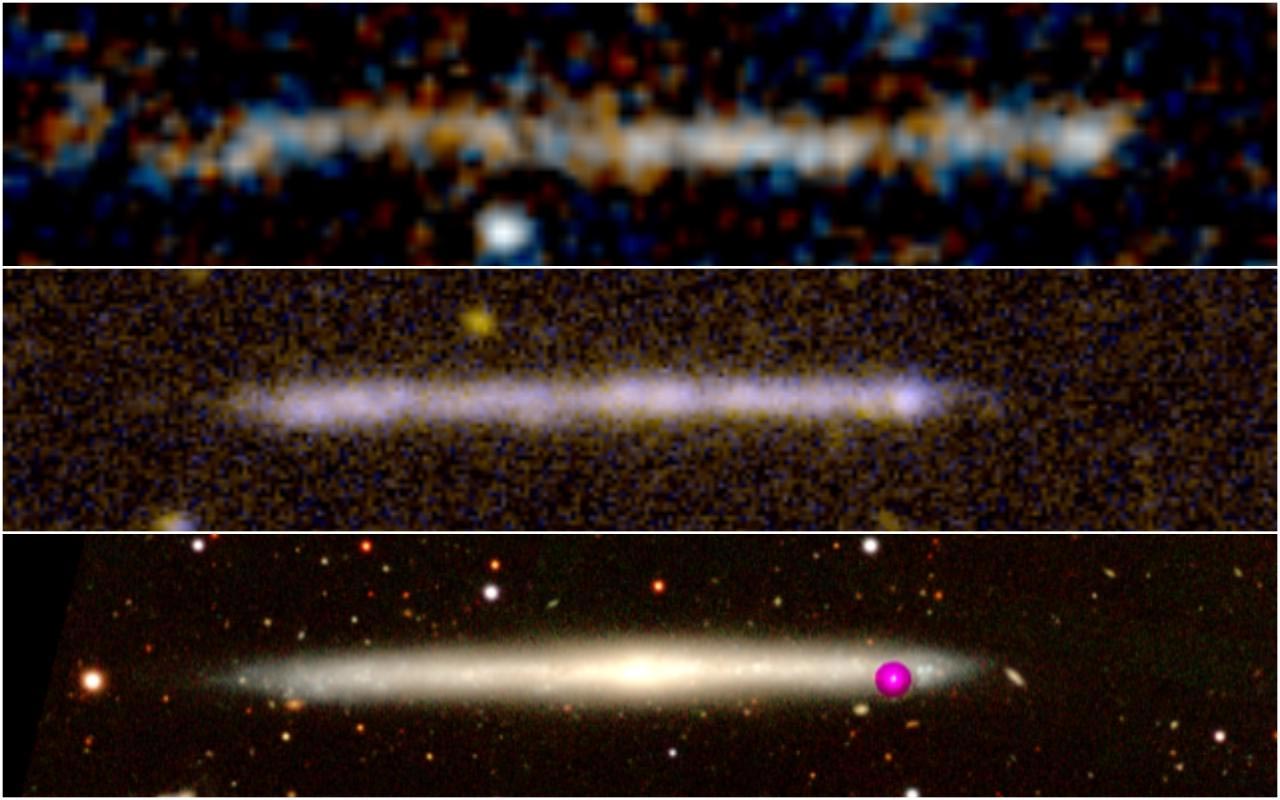
    Above: Image of the object observed with the Hubble Space Telescope. It shows the emission in the ultraviolet part of the spectrum. Middle: Ultraviolet image of a local galaxy without a bulge and observed edge-on (IC 5249). The similarities are obvious. Bottom: The same galaxy IC 5249 observed in the visible part of the spectrum. The spatial scales of the three images are identical. Credit: HST

    According to a controversial initial hypothesis, this trail of stars could be the result of the passage of a supermassive black hole through a huge cloud of gas. This idea quickly fired the imagination of the astronomical community, because it needs a large set of complex exceptional circumstances. For this reason, several scientific teams have continued to explore different, and less exotic scenarios which can explain the observations.

    In a recent study, researchers at the IAC have reached the conclusion that this unusual structure of stars could be interpreted as a galaxy without a bulge seen edge-on. This type of galaxies, also called thin, or flat galaxies, are relatively common. “The motions, the size, and the quantity of stars fits what has been seen in galaxies within the local universe” explains Jorge Sanchez Almeida, an IAC researcher who is the first author of the article. “It’s a relief to have found the solution to this mystery, the new proposed scenario is much simpler. In one sense it is also a pity, because the existence of fleeing black holes is expected, and this could have been the first one to be observed.”
    Comparison Runaway Supermassive Black Hole Galaxy
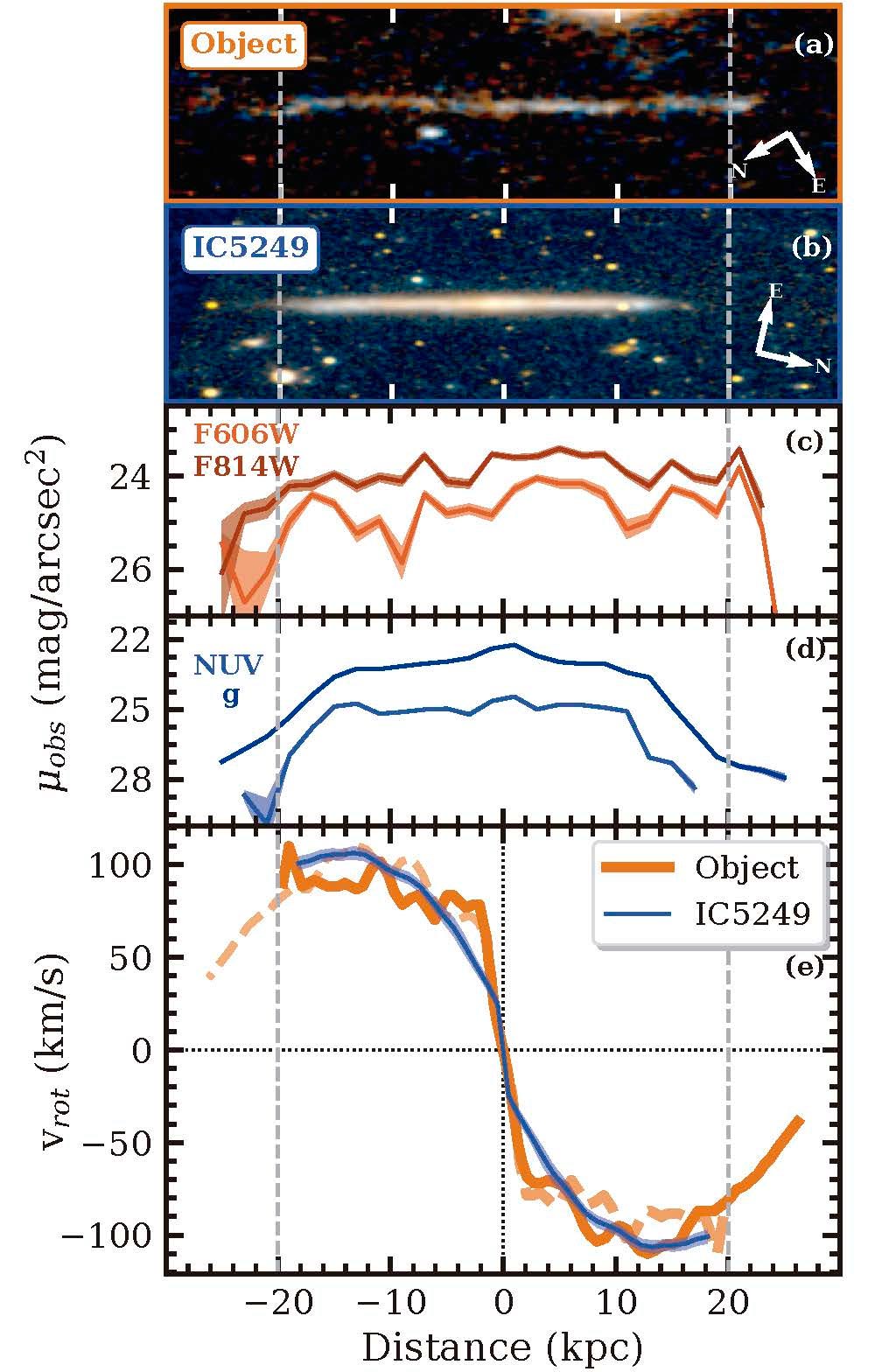
    Comparison between this “object” and an edge-on galaxy in the local Universe (IC5249): images (a and b) the intensity along the track (c and d) and its rotational velocity (e). This object and IC5249 turn out to be extremely similar in all their physical parameters, which supports the idea that the “object” is really an edge-on galaxy. Credit: IAC

    To support the hypothesis of the interpretation in terms of a galaxy, the team compared the mysterious structure with a well-known local galaxy without a bulge, IC5249, which has a similar mass of stars, and found surprising agreement. In the words of Mireia Montes, an IAC researcher who is a co-author of the article, “When we analyzed the velocities of this distant structure of stars we realized that they were very similar to those obtained from the rotation of galaxies, so we decided to compare a much closer galaxy, and found that they are extraordinarily similar.”
    Relation Between the Rotation Velocity of a Galaxy and Its Stellar Mass
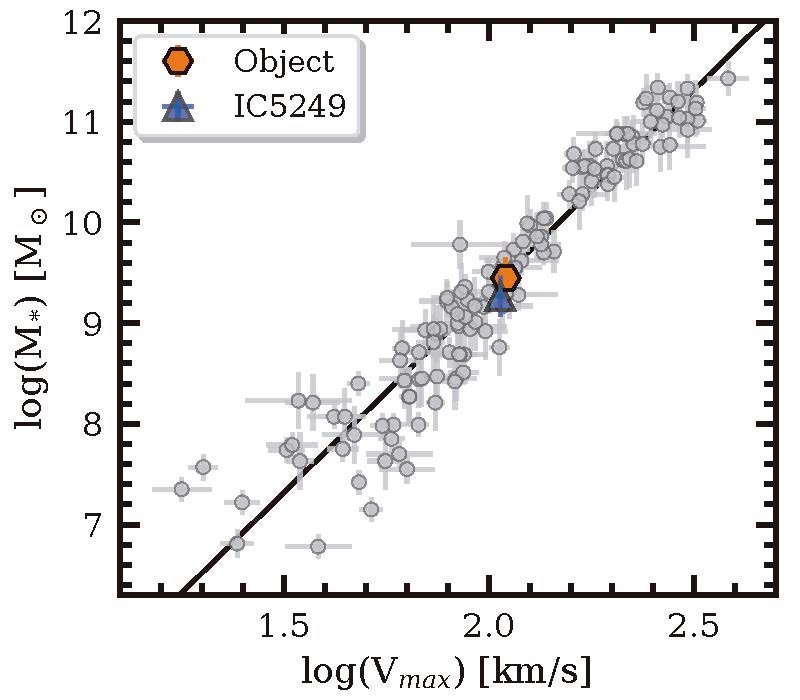
    Relation between the rotation velocity of a galaxy and its stellar mass (grey dots). This is the well known Tully Fisher relation, which characterizes galaxies, (which is basic for measuring the distances to galaxies from their observed rotation velocities and apparent luminosities). The object lies just on the relation, as would be expected for any disc galaxy. Credit: IAC

    “We also looked at the relation between the mass of the assumed galaxy and its máximum velocity of rotation, and discovered that indeed it is a galaxy which behaves like a galaxy,” states Ignacio Trujillo, an IAC researcher who has taken part in the study. “It is an interesting object, because it is quite a large galaxy at a very large distance from Earth, where the majority of the galaxies are smaller,” he adds.

    Upcoming observations will allow the study of this object in greater detail.

    Reference: “Supermassive black hole wake or bulgeless edge-on galaxy?” by Jorge Sánchez Almeida, Mireia Montes and Ignacio Trujillo, 12 May 2023, Astronomy and Astrophysics Letters.
    DOI: 10.1051/0004-6361/202346430

    Never miss a breakthrough: Join the SciTechDaily newsletter.
    Follow us on Google and Google News.

    Astronomy Astrophysics Black Hole Instituto De Astrofísica De Canarias Popular
    Share. Facebook Twitter Pinterest LinkedIn Email Reddit

    Related Articles

    Astronomers Discover How to Feed a Supermassive Black Hole

    Einstein’s Theory of General Relativity Verified by New Measurements of the Solar Spectrum

    Ripples in the Fabric of Space and Time Offer New Clues to the Shape of Black Holes

    “Echo Mapping” Light Bursts From Supermassive Black Holes in Faraway Galaxies to Measure Vast Cosmic Distances

    Einstein’s Theory of General Relativity Tested Using Black Hole Shadow

    Galaxies Trapped in the Web of a Supermassive Black Hole – Cosmic “Spider’s Web” of Gas Extends Over 300 Times the Size of the Milky Way

    Astronomers Find Extreme Galaxy With Intense Ultraviolet Luminosity Comparable to a Quasar

    Event Horizon Telescope Reveals Turbulent Black Hole Evolution: Wobbling Shadow of the M87 Black Hole

    Cosmic X-Rays Reveal a Distinctive Signature of Black Hole Event Horizons

    7 Comments

    1. JmjUSA on May 10, 2023 4:20 am

      So much for the “settled science” gaggle of the likes of Bill neigh,the unscientific guy (but he does sleep at an intergalactic motel 666), Neil eat the grass (who actually thinks that zer sounds like james earl Jones from Arby’s),etc….

      Reply
      • Jason on May 10, 2023 5:49 am

        Confirmation bias is the easiest, yet laziest method for judging what is true.

        Science evolves, try it.

        Reply
    2. D Aspinall on May 10, 2023 5:11 am

      Human knowledge of the Universe is slightly above ZERO……

      Reply
    3. Fixed gravity for you. on May 10, 2023 8:12 am

      I can understand how Dark Matter experts could miss a bulge-free very thin galaxy. Probably too busy mapping their favorite cold gravity-concealing centralized halo concoctions and random hot-looking disorganized galaxies, when they aren’t silently thanking MOND experts for making them appear relatively intelligent by “modifying gravity” without having the slightest understanding of it. Emergent retro-reflection in quantum-scale gravitational effect information flows from cooling matter.

      Reply
      • Fixed gravity for you. on May 10, 2023 8:56 am

        Another thing gravity experts seem clueless about is entanglement, particularly in California (ER=EPR). Is the galaxy flat and bulge-free due to something about wormholes, or is it due to emerged quantum-scale focus in cooled galactic gravity flows?

        Reply
    4. Bonehead McGee on May 10, 2023 9:23 am

      WHY would you say “Eight thousand million years”?? Why wouldn’t you just say 8 billion years??? What you said is a hundred times more complicated and difficult to understand than just using the ACTUAL number would be…

      Reply
      • Mike O'Neill on May 11, 2023 9:00 am

        Thanks for the feedback, this has been updated.

        Reply
    Leave A Reply Cancel Reply

    • Facebook
    • Twitter
    • Pinterest
    • YouTube

    Don't Miss a Discovery

    Subscribe for the Latest in Science & Tech!

    Trending News

    Scientists Warn That This Common Pet Fish Can Wreck Entire Ecosystems

    Scientists Make Breakthrough in Turning Plastic Trash Into Clean Fuel Using Sunlight

    This Popular Supplement May Interfere With Cancer Treatment, Scientists Warn

    Scientists Finally Solved One of Water’s Biggest Mysteries

    Could This New Weight-Loss Pill Disrupt the Entire Market? Here’s What You Should Know About Orforglipron

    Earth’s Crust Is Tearing Open in Africa, and It Could Form a New Ocean

    Breakthrough Bowel Cancer Trial Leaves Patients Cancer-Free for Nearly 3 Years

    Natural Compound Shows Powerful Potential Against Rheumatoid Arthritis

    Follow SciTechDaily
    • Facebook
    • Twitter
    • YouTube
    • Pinterest
    • Newsletter
    • RSS
    SciTech News
    • Biology News
    • Chemistry News
    • Earth News
    • Health News
    • Physics News
    • Science News
    • Space News
    • Technology News
    Recent Posts
    • Enormous Prehistoric Insects Puzzle Scientists
    • College Student Identifies Bizarre New Carnivorous Dinosaur Three Times Older Than T. rex
    • The Most Effective Knee Arthritis Treatments Aren’t What You Expect
    • Scientists Develop Bioengineered Chewing Gum That Could Help Fight Oral Cancer
    • Popular Weight-Loss Drugs Found To Cut Heart Attack and Stroke Risk
    Copyright © 1998 - 2026 SciTechDaily. All Rights Reserved.
    • Science News
    • About
    • Contact
    • Editorial Board
    • Privacy Policy
    • Terms of Use

    Type above and press Enter to search. Press Esc to cancel.