

Close Menu
    Facebook X (Twitter) Instagram
    SciTechDaily
    • Biology
    • Chemistry
    • Earth
    • Health
    • Physics
    • Science
    • Space
    • Technology
    Facebook X (Twitter) Pinterest YouTube RSS
    SciTechDaily
    Home»Biology»Molecular Time Bomb: How RIPK1 Deficiency Sparks the Aging Inflammatory Response
    Biology

    Molecular Time Bomb: How RIPK1 Deficiency Sparks the Aging Inflammatory Response

    By RIKENJuly 8, 2023No Comments4 Mins Read
    Facebook Twitter Pinterest Telegram LinkedIn WhatsApp Email Reddit
    Share
    Facebook Twitter LinkedIn Pinterest Telegram Email Reddit
    Overactive Immune System Concept
    RIKEN researchers discovered that a lack of a key signaling molecule, RIPK1, in mice T cells caused premature aging symptoms and inflammation known as “inflammaging.” This lack prompts compounds caspase-8 and RIPK3 to overactivate cell-growth regulator mTORC1, inducing T cell senescence. Additionally, senescent T cells can revert to normal in a different environment, suggesting the possibility of new treatment strategies for age-related diseases.

    By engineering mice lacking a key signaling molecule, researchers have shed light on how the immune system causes problems in elderly people.

    The lack of a key signaling molecule in certain immune cells can induce various age-related diseases in young mice, RIKEN researchers have shown. This finding eventually could help to develop new treatments for age-related diseases.

    Aging isn’t kind to our immune systems, causing over-activation of the system, so that inflammation occurs even when there are no pathogens in sight. Dubbed inflammaging, this chronic, low-grade inflammation damages tissue, making elderly people more susceptible to infection and a wide range of diseases, including cancer, type 2 diabetes and heart disease.

    Inflammaging causes T cells—immune cells that recognize, respond to, and remember specific pathogens—to go into overdrive, producing inflammation-causing compounds such as cytokines and chemokines. This is known as the senescence state of T cells.

    “People often have the impression that aging makes cells less active,” says Takashi Saito of the RIKEN Center for Integrative Medical Sciences. “However, some aged immune cells enter an activated phase, and the resulting inflammaging can give rise to various age-dependent diseases.”
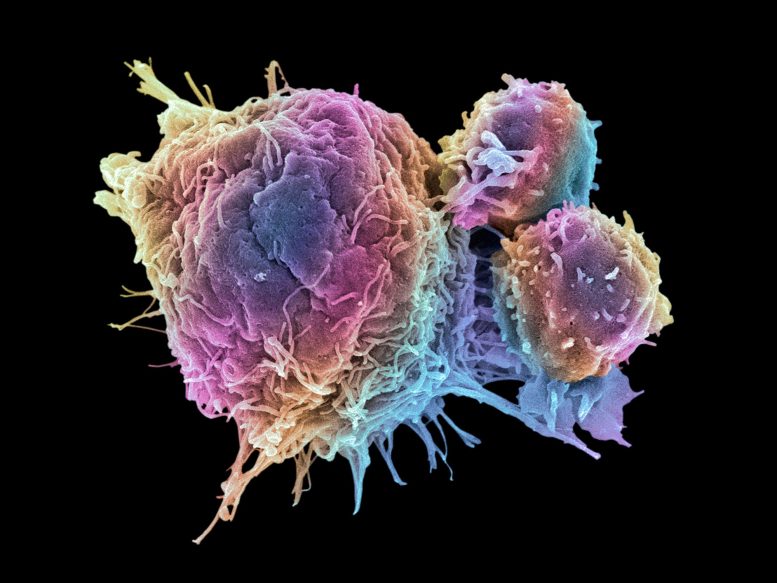
    T Lymphocytes and Cancer Cell
    A colored scanning electron micrograph of T lymphocyte and cancer cell. T cells are a type of white blood cell and components of the body’s immune system. By engineering mice lacking RIPK1 in their T cells, RIKEN researchers have shed light on RIPK1’s role in inflammaging.

    A signaling molecule called receptor-interacting protein kinase 1 (RIPK1) controls cell death through two different paths, depending on which compounds it combines with. Recent studies had found that people with a RIPK1 deficiency are more susceptible to inflammatory disorders.

    The Consequences of RIPK1 Deficiency

    Now, Saito and co-workers have engineered mice that lack RIPK1 just in their T cells. They found that these mice developed inflammatory diseases at a young age and died much earlier than normal mice. Interestingly, the T cells lacking RIPK1 behaved similarly to T cells in aged mice.

    The team uncovered how this premature inflammaging occurs. When RIPK1 is not present, two compounds, caspase-8 and RIPK3, cause a cell-growth regulator known as mTORC1 to be excessively activated. This in turn promotes T cell senescence by inducing the expression of senescence-related genes, resulting in the production of various cytokines and chemokines.

    This mechanism was unexpected. “Caspase-8 and RIPK3 are well known to induce cell death,” says Saito. “But we’ve shown that they also help to activate mTORC1 and induce inflammaging in cellular senescence.”

    New Insights Into Treating Age-Related Diseases

    This discovery opens up the possibility of finding new ways to treat inflammaging. “We could target caspase-8 and RIPK3 to counteract inflammaging induced by T cell senescence,” says Saito.

    A further surprise was that when the team put the senescent T cells into normal mice, they reverted to normal, non-senescent T cells, indicating that environmental factors play an important role in regulating T cell senescence.

    The team is now investigating what happens before activation of RIPK3 and caspase-8. They also want to explore what environmental factors allow senescent T cells to revert to normal T cells.

    Reference: “RIPK1 blocks T cell senescence mediated by RIPK3 and caspase-8” by Takayuki Imanishi, Midori Unno, Natsumi Yoneda, Yasutaka Motomura, Miho Mochizuki, Takaharu Sasaki, Manolis Pasparakis and Takashi Saito, 25 January 2023, Science.
    DOI: 10.1126/sciadv.add6097

    Never miss a breakthrough: Join the SciTechDaily newsletter.
    Follow us on Google and Google News.

    Aging Gerontology Immunology Popular RIKEN
    Share. Facebook Twitter Pinterest LinkedIn Email Reddit

    Related Articles

    Scientists Uncover Immune Cells That Could Hold the Secret to Slowing Aging

    Parts of the Brain Defy Aging and Even Improve Over Time

    Can We Slow Down Aging? New Biomarker Shows Promise

    USC Scientists Uncover Secret to a Youthful Immune System

    Selective Destruction – Scientists Propose New Theory of Aging

    Stress Accelerates Aging of the Immune System

    Microbes Turn Back the Clock: New Research Discovers Their Potential To Reverse Aging in the Brain

    New Discovery Helps Explain How COVID-19 Overpowers the Immune System

    New Research Shows How to Boost Muscle Regeneration and Rebuild Tissue

    Leave A Reply Cancel Reply

    • Facebook
    • Twitter
    • Pinterest
    • YouTube

    Don't Miss a Discovery

    Subscribe for the Latest in Science & Tech!

    Trending News

    Scientists Warn That This Common Pet Fish Can Wreck Entire Ecosystems

    Scientists Make Breakthrough in Turning Plastic Trash Into Clean Fuel Using Sunlight

    This Popular Supplement May Interfere With Cancer Treatment, Scientists Warn

    Scientists Finally Solved One of Water’s Biggest Mysteries

    Could This New Weight-Loss Pill Disrupt the Entire Market? Here’s What You Should Know About Orforglipron

    Earth’s Crust Is Tearing Open in Africa, and It Could Form a New Ocean

    Breakthrough Bowel Cancer Trial Leaves Patients Cancer-Free for Nearly 3 Years

    Natural Compound Shows Powerful Potential Against Rheumatoid Arthritis

    Follow SciTechDaily
    • Facebook
    • Twitter
    • YouTube
    • Pinterest
    • Newsletter
    • RSS
    SciTech News
    • Biology News
    • Chemistry News
    • Earth News
    • Health News
    • Physics News
    • Science News
    • Space News
    • Technology News
    Recent Posts
    • Kratom Use Explodes in the US, With Life-Changing Consequences
    • Scientists Uncover Fatal Weakness in “Zombie Cells” Linked to Cancer
    • World-First Study Reveals Human Hearts Can Regenerate After a Heart Attack
    • Why Your Dreams Feel So Real Sometimes and So Strange Other Times
    • Scientists Debunk 100-Year-Old Belief About Brain Cells, Rewriting Textbooks
    Copyright © 1998 - 2026 SciTechDaily. All Rights Reserved.
    • Science News
    • About
    • Contact
    • Editorial Board
    • Privacy Policy
    • Terms of Use

    Type above and press Enter to search. Press Esc to cancel.