
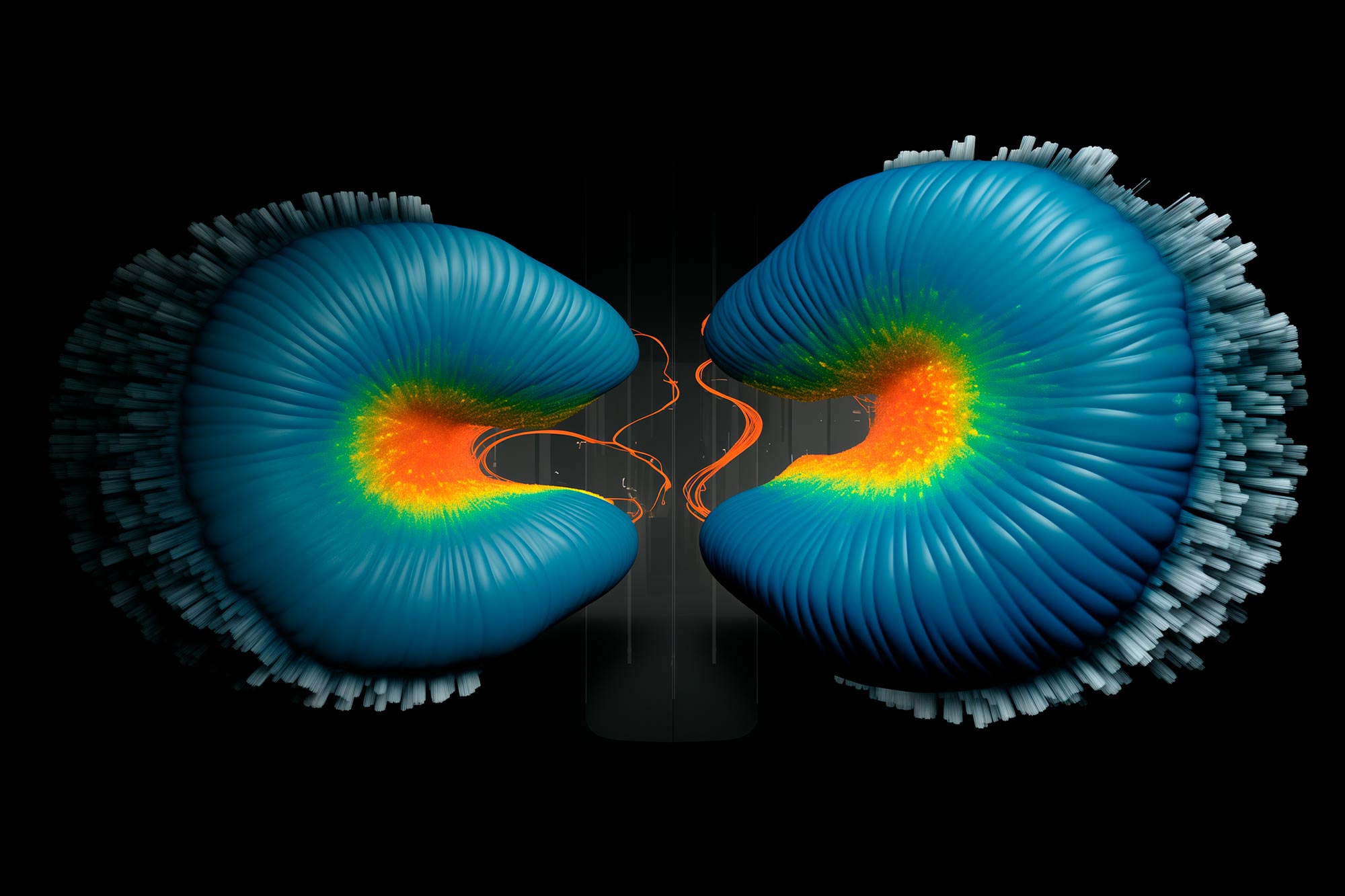
Open-source supercomputer algorithm predicts patterning and dynamics of living materials and enables studying their behavior in space and time.
Biological materials are made of individual components, including tiny motors that convert fuel into motion. This creates patterns of movement, and the material shapes itself with coherent flows by constant consumption of energy. Such continuously driven materials are called “active matter.” The mechanics of cells and tissues can be described by active matter theory, a scientific framework to understand shape, flows, and form of living materials. The active matter theory consists of many challenging mathematical equations.
Scientists from the Max Planck Institute of Molecular Cell Biology and Genetics (MPI-CBG) in Dresden, the Center for Systems Biology Dresden (CSBD), and the TU Dresden have now developed an algorithm, implemented in an open-source supercomputer code, that can for the first time solve the equations of active matter theory in realistic scenarios. These solutions bring us a big step closer to solving the century-old riddle of how cells and tissues attain their shape and to designing artificial biological machines.
The Complexity of Biological Behaviors and Theories
Biological processes and behaviors are often very complex. Physical theories provide a precise and quantitative framework for understanding them. The active matter theory offers a framework to understand and describe the behavior of active matter – materials composed of individual components capable of converting a chemical fuel (“food”) into mechanical forces. Several scientists from Dresden were key in developing this theory, among others Frank Jülicher, director at the Max Planck Institute for the Physics of Complex Systems, and Stephan Grill, director at the MPI-CBG.
With these principles of physics, the dynamics of active living matter can be described and predicted by mathematical equations. However, these equations are extremely complex and hard to solve. Therefore, scientists require the power of supercomputers to comprehend and analyze living materials. There are different ways to predict the behavior of active matter, with some focusing on the tiny individual particles, others studying active matter at the molecular level, and yet others studying active fluids on a large scale. These studies help scientists see how active matter behaves at different scales in space and over time.
Solving Complex Mathematical Equations
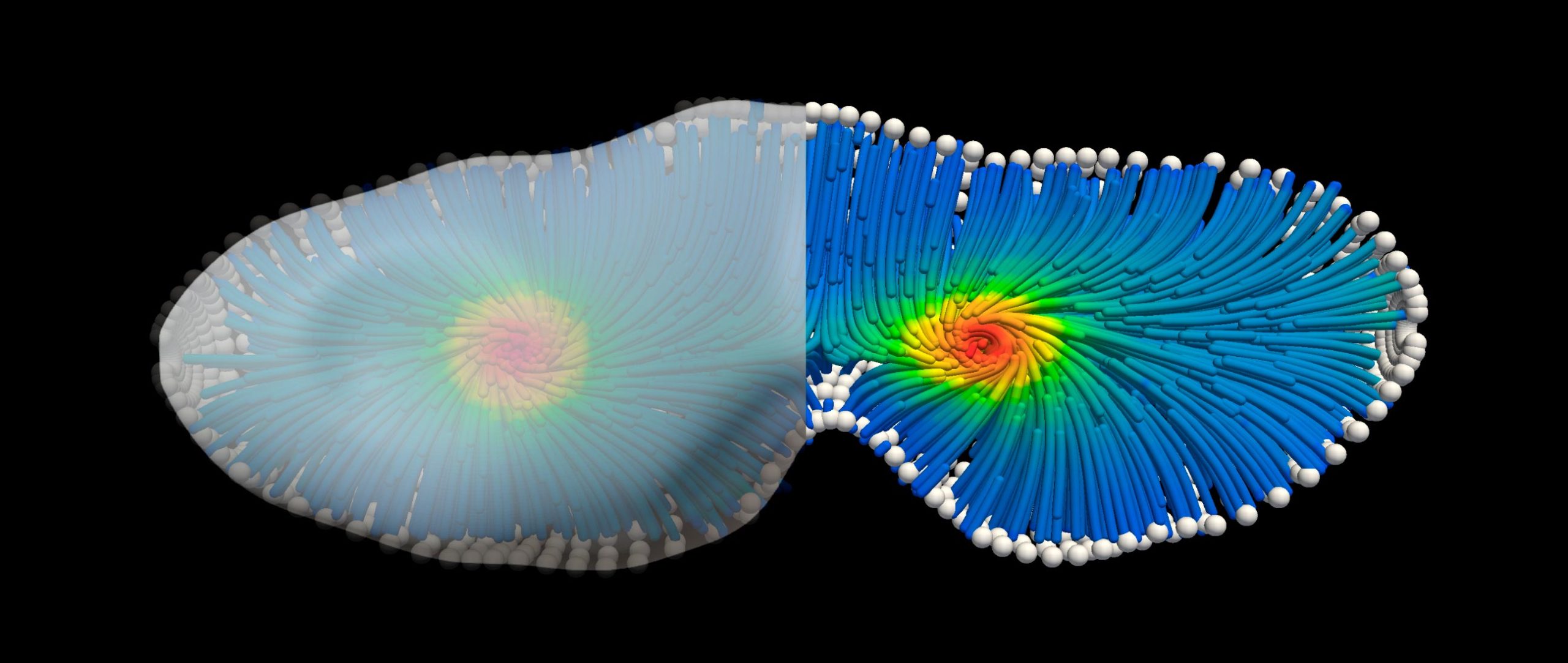
Scientists from the research group of Ivo Sbalzarini, TU Dresden Professor at the Center for Systems Biology Dresden (CSBD), research group leader at the Max Planck Institute of Molecular Cell Biology and Genetics (MPI-CBG), and Dean of the Faculty of Computer Science at TU Dresden, have now developed a computer algorithm to solve the equations of active matter. Their work was published in the journal “Physics of Fluids” and was featured on the cover. They present an algorithm that can solve the complex equations of active matter in three dimensions and in complex-shaped spaces
“Our approach can handle different shapes in three dimensions over time,” says one of the first authors of the study, Abhinav Singh, a studied mathematician. He continues, “Even when the data points are not regularly distributed, our algorithm employs a novel numerical approach that works seamlessly for complex biologically realistic scenarios to accurately solve the theory’s equations. Using our approach, we can finally understand the long-term behavior of active materials in both moving and non-moving scenarios for predicting their dynamics. Further, the theory and simulations could be used to program biological materials or create engines at the nano-scale to extract useful work.”
The other first author, Philipp Suhrcke, a graduate of TU Dresden’s Computational Modeling and Simulation M.Sc. program, adds, “thanks to our work, scientists can now, for example, predict the shape of a tissue or when a biological material is going to become unstable or dysregulated, with far-reaching implications in understanding the mechanisms of growth and disease.”
A Powerful Code for Everyone To Use
The scientists implemented their software using the open-source library OpenFPM, meaning that it is freely available for others to use. OpenFPM is developed by the Sbalzarini group for democratizing large-scale scientific computing. The authors first developed a custom computer language that allows computational scientists to write supercomputer codes by specifying the equations in mathematical notation and letting the computer do the work to create a correct program code. As a result, they do not have to start from scratch every time they write a code, effectively reducing code development times in scientific research from months or years to days or weeks, providing enormous productivity gains.
Due to the tremendous computational demands of studying three-dimensional active materials, the new code is scalable on shared and distributed-memory multi-processor parallel supercomputers, thanks to the use of OpenFPM. Although the application is designed to run on powerful supercomputers, it can also run on regular office computers for studying two-dimensional materials.
The Principal Investigator of the study, Ivo Sbalzarini, summarizes: “Ten years of our research went into creating this simulation framework and enhancing the productivity of computational science. This now all comes together in a tool for understanding the three-dimensional behavior of living materials. Open-source, scalable, and capable of handling complex scenarios, our code opens new avenues for modeling active materials. This may finally lead us to understand how cells and tissues attain their shape, addressing the fundamental question of morphogenesis that has puzzled scientist for centuries. But it may also help us design artificial biological machines with minimal numbers of components.”
Reference: “A numerical solver for active hydrodynamics in three dimensions and its application to active turbulence” by Abhinav Singh, Philipp H. Suhrcke, Pietro Incardona and Ivo F. Sbalzarini, 30 October 2023, Physics of Fluids.
DOI: 10.1063/5.0169546
Never miss a breakthrough: Join the SciTechDaily newsletter.
Follow us on Google and Google News.
1 Comment
Great advancement (active matter theory ) the algorithm has my attention the framework of the algorithm and how the manipulation can be achieved and implementation sot, can be formed by the algorithm the method has great value in other sciences. collaboration