
Uncovering the missing precursors of hydrogen-poor supernovae.
Supernovae–stellar explosions as bright as an entire galaxy–have fascinated us since time immemorial. Yet, there are more hydrogen-poor supernovae than astrophysicists can explain. Now, a new Assistant Professor at the Institute of Science and Technology Austria (ISTA) has played a pivotal role in identifying the missing precursor star population. The results, now published in Science, go back to a conversation the involved professors had many years ago as junior scientists.
The Enigma of Hydrogen-Poor Supernovae
Some stars do not simply die down, but explode in a stellar blast that could outshine entire galaxies. These cosmic phenomena, called supernovae, spread light, elements, energy, and radiation in space and send galactic shock waves that could compress gas clouds and generate new stars. In other words, supernovae shape our universe. Among these, hydrogen-poor supernovae from exploding massive stars have long puzzled astrophysicists. The reason: scientists have not been able to put their finger on their precursor stars. It is almost as if these supernovae appeared out of nowhere.
“There are many more hydrogen-poor supernovae than our current models can explain. Either we can’t detect the stars that mature on this path, or we must revise all our models,” says ISTA Assistant Professor Ylva Götberg. She pioneered this work together with Maria Drout, an Associated Faculty Member of the Dunlap Institute for Astronomy & Astrophysics, University of Toronto, Canada.
“Single stars would typically explode as hydrogen-rich supernovae. Being hydrogen-poor indicates that the precursor star must have lost its thick hydrogen-rich envelope. This happens naturally in a third of all massive stars through envelope stripping by a binary companion star,” says Götberg.
Now, Götberg and Drout combined their areas of expertise in theoretical modeling and observation to hunt down the missing stars. Their quest is successful: they document a first-of-its-kind star population that finally bridges a large knowledge gap and sheds light on the origin of hydrogen-poor supernovae.
Binary Stars and Envelope Stripping
The stars that Götberg and Drout search for go in pairs: interlocked in a binary star system. Some binary systems are well-known to us Earthlings: these include the brightest star in our night sky, Sirius A, and its faint companion star Sirius B. The Sirius binary system is located only 8.6 light-years away from Earth–a stone’s throw in cosmic terms. This explains Sirius A’s observed brightness in our night sky.
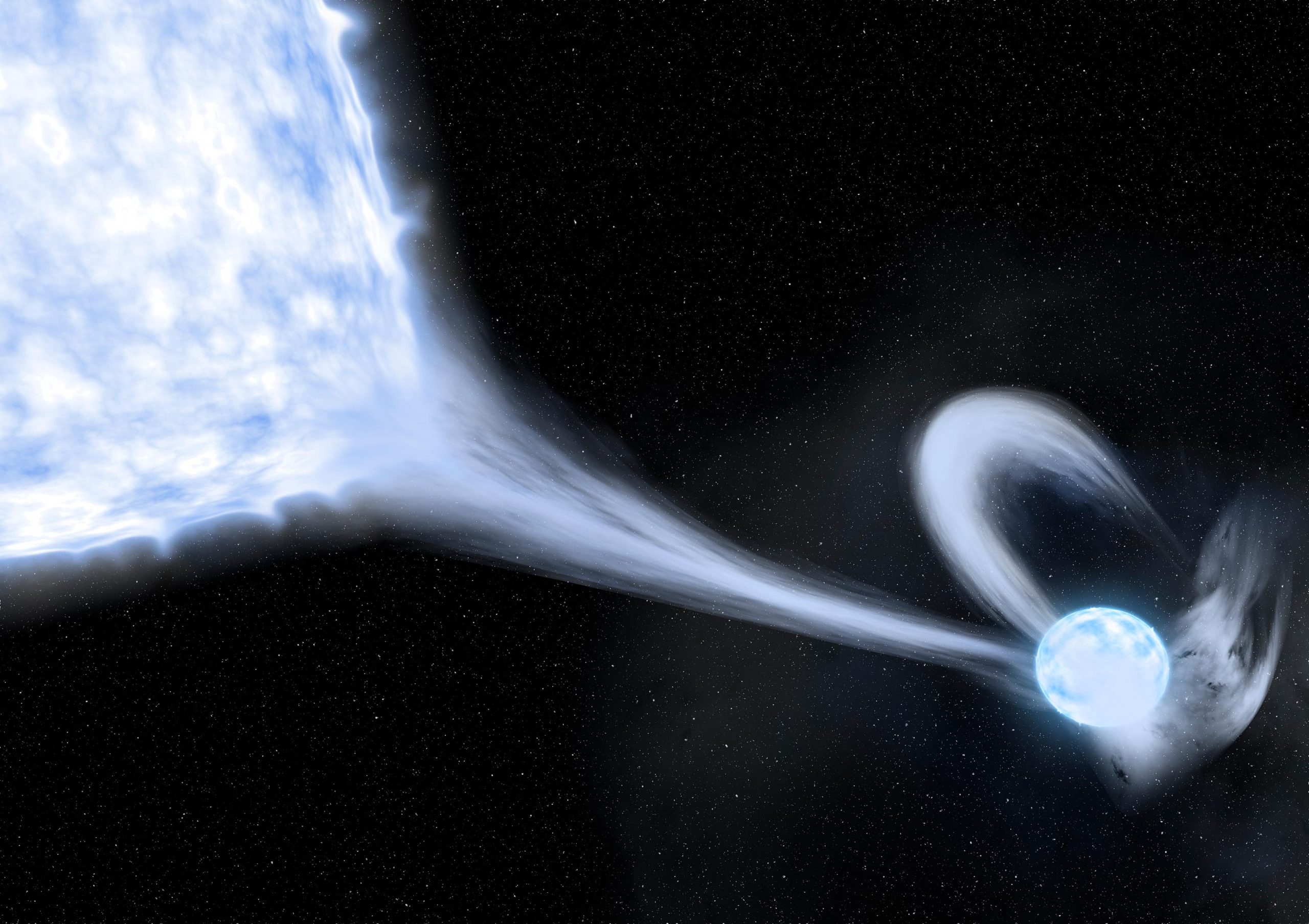
Astrophysicists expect the missing stars to be initially formed from massive binary systems. In a binary system, the stars would orbit around one another until the more massive star’s thick, hydrogen-rich envelope expands. Eventually, the expanding envelope experiences a stronger gravitational pull to the companion star than to its own core.
This causes a transfer of mass to begin, which eventually leads the entire hydrogen-rich envelope to be stripped off, leaving the hot and compact helium core exposed–more than 10 times hotter than the Sun’s surface. This is precisely the type of stars that Götberg and Drout are looking for.
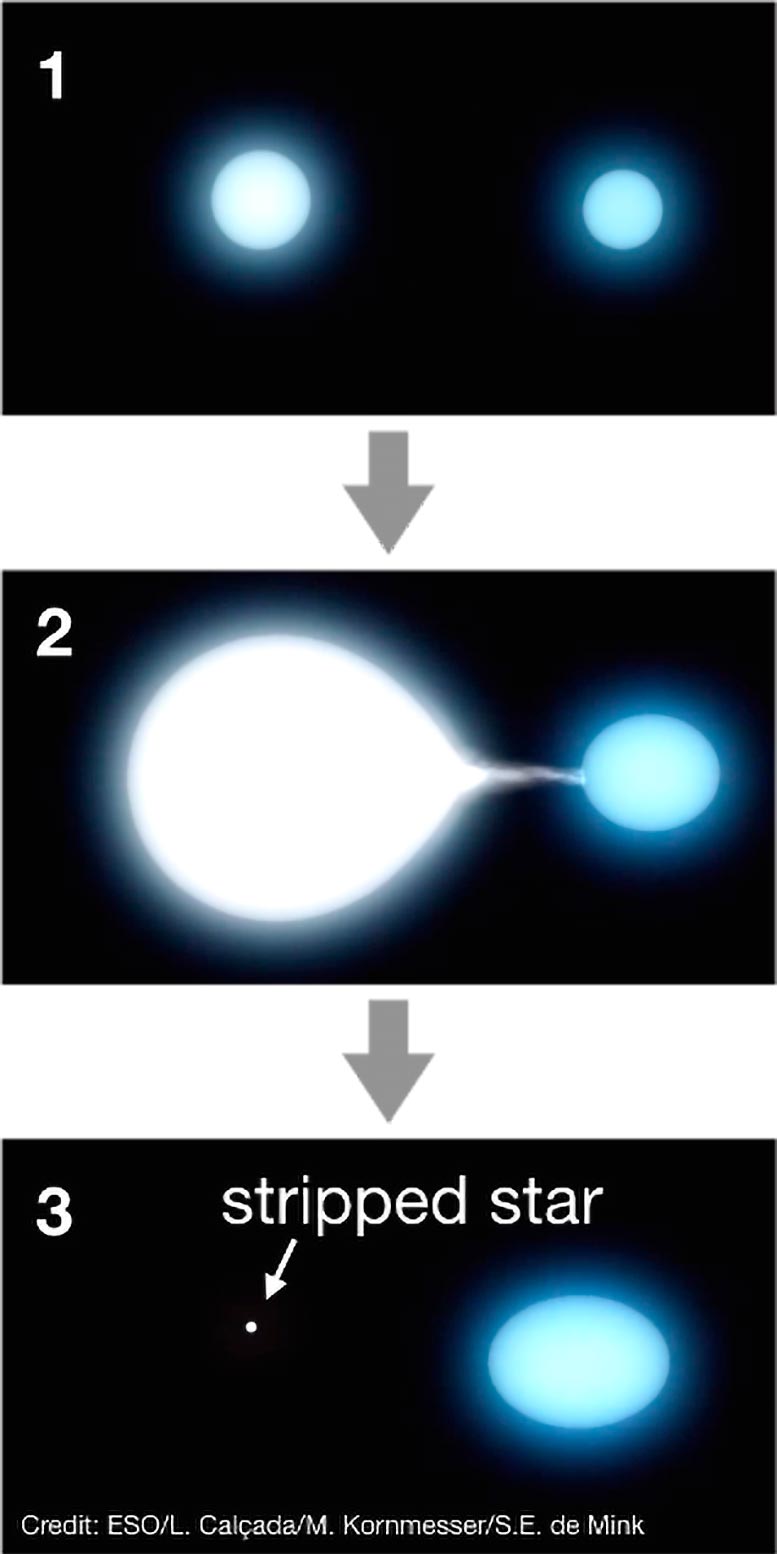
“Intermediate mass helium stars stripped through binary interaction are predicted to play important roles in astrophysics. Yet, they were not observed until now,” says Götberg.
In fact, there is an important mass gap between the known classes of helium stars: the more massive Wolf-Rayet (WR) stars have more than 10 times the Sun’s mass, and the low-mass subdwarf stars could have around half the Sun’s mass. However, models have predicted the precursors of hydrogen-poor supernovae to lie between 2 and 8 solar masses following stripping.
Not Just a Needle in the Haystack
Before Götberg and Drout’s study, only one star was found to fulfill the expected mass and composition criteria and was called “Quasi-WR” (or “Almost Wolf-Rayet”).
“Yet, the stars that follow this path have such a long lifetime that many must be scattered all over the observable universe,” says Götberg.
Did the scientists simply not “see” them? Thus, Götberg and Drout drew on their complementary expertise. With the help of UV photometry and optical spectroscopy, they identified a population of 25 stars that are consistent with the expectations for intermediate-mass helium stars. The stars are located in two well-studied neighboring galaxies, the Large and the Small Magellanic Clouds.
“We showed that these stars were bluer than the stellar birthline, the bluest phase in a single star’s lifetime. Single stars mature by evolving towards the redder region of the spectrum. A star only shifts in the opposite direction if its outer layers are removed–something that is expected to be common in interacting binary stars and rare among single massive stars,” explains Götberg.
The scientists then verified their candidate star population using optical spectroscopy: they showed that the stars had strong spectral signatures of ionized helium.
“Strong ionized helium lines tell us two important things: first, they confirm that the stars’ outermost layers are dominated by helium and, second, that their surface is very hot. This is what happens to stars left as an exposed, compact, helium-rich core following stripping,” says Götberg.
Yet, both stars in a binary system contribute to the observed spectra. Thus, this technique allowed the researchers to classify their candidate population depending on which star contributed the most to the spectrum.
“This work allowed us to find the missing population of intermediate-mass, stripped helium stars, the predicted progenitors of hydrogen-poor supernovae. These stars have always been there and there are probably many more out there. We must simply come up with ways to find them,” says Götberg. “Our work may be one of the first attempts, but there should be other ways possible.”
From Graduate Students to Leaders in Astrophysics
The idea behind this project sparked in a discussion following a talk by Götberg at a conference that she and Drout attended during their graduate studies. Both scientists, then Early Career Researchers reaching for the stars, are now group leaders in their field.
Götberg joined ISTA in September following her research at the Carnegie Observatories in Pasadena, California, as a NASA Hubble postdoctoral fellow. At ISTA, Götberg joins the Institute’s growing ranks of young group leaders in astrophysics and leads her own group focused on studying the binary interactions of stars.
Reference: “An observed population of intermediate-mass helium stars that have been stripped in binaries” by M. R. Drout, Y. Götberg, B. A. Ludwig, J. H. Groh, S. E. de Mink, A. J. G. O’Grady and N. Smith, 14 December 2023, Science.
DOI: 10.1126/science.ade4970
This work, led by Maria R. Drout (Dunlap Institute for Astronomy & Astrophysics, University of Toronto, Canada) and Ylva Götberg (Institute of Science and Technology Austria, ISTA), was done in collaboration with The Observatories of the Carnegie Institution for Science (Pasadena, USA), and the Max Planck Institute for Astrophysics (Garching, Germany), among others.
Never miss a breakthrough: Join the SciTechDaily newsletter.
Follow us on Google and Google News.