
Close Menu
    Facebook X (Twitter) Instagram
    SciTechDaily
    • Biology
    • Chemistry
    • Earth
    • Health
    • Physics
    • Science
    • Space
    • Technology
    Facebook X (Twitter) Pinterest YouTube RSS
    SciTechDaily
    Home»Space»Solar Stormwatch: NASA Catches Intense X1.1 Flare in Action
    Space

    Solar Stormwatch: NASA Catches Intense X1.1 Flare in Action

    By NASAMay 10, 2024No Comments3 Mins Read
    Facebook Twitter Pinterest Telegram LinkedIn WhatsApp Email Reddit
    Share
    Facebook Twitter LinkedIn Pinterest Telegram Email Reddit
    Strong Solar Flare May 2024
    NASA’s Solar Dynamics Observatory captured this image of a solar flare – as seen in the bright flash in the lower right – on May 9, 2024. The composite image combines three wavelengths of extreme ultraviolet light that highlight the extremely hot material in flares and which is colorized in green, blue, and red. Credit: NASA/SDO

    On May 9, 2024, NASA’s Solar Dynamics Observatory detected a significant solar flare that peaked at 1:44 p.m. ET. This observatory is dedicated to continuously monitoring the Sun, and it successfully captured an image of this event. This follows the release of X-class solar flares on both May 7 and May 8.

    This flare is classified as an X1.1 flare. X-class denotes the most intense flares, while the number provides more information about its strength.

    Solar Flares

    Solar flares are intense bursts of radiation emanating from the release of magnetic energy associated with sunspots. These flares are one of the most powerful forms of solar activity and are primarily composed of photons, ranging from radio waves to gamma rays. They occur in the Sun’s atmosphere, lighting up as bright areas on the sun that can last from minutes to hours.

    The classification of solar flares is based on their brightness in the x-ray wavelengths. The classes are labeled as A, B, C, M, and X, with A being the weakest and X being the strongest. Each class has a tenfold increase in energy output compared to the preceding one. Within each class, there is a finer scale from 1 to 9 that quantifies more precisely the strength of the flare. For instance, an X1 flare is ten times as powerful as an M1 flare but is considerably weaker than an X9 flare. This system helps scientists and relevant authorities gauge potential impacts on Earth, such as disruptions in communication and navigation systems, and prepare appropriate responses.
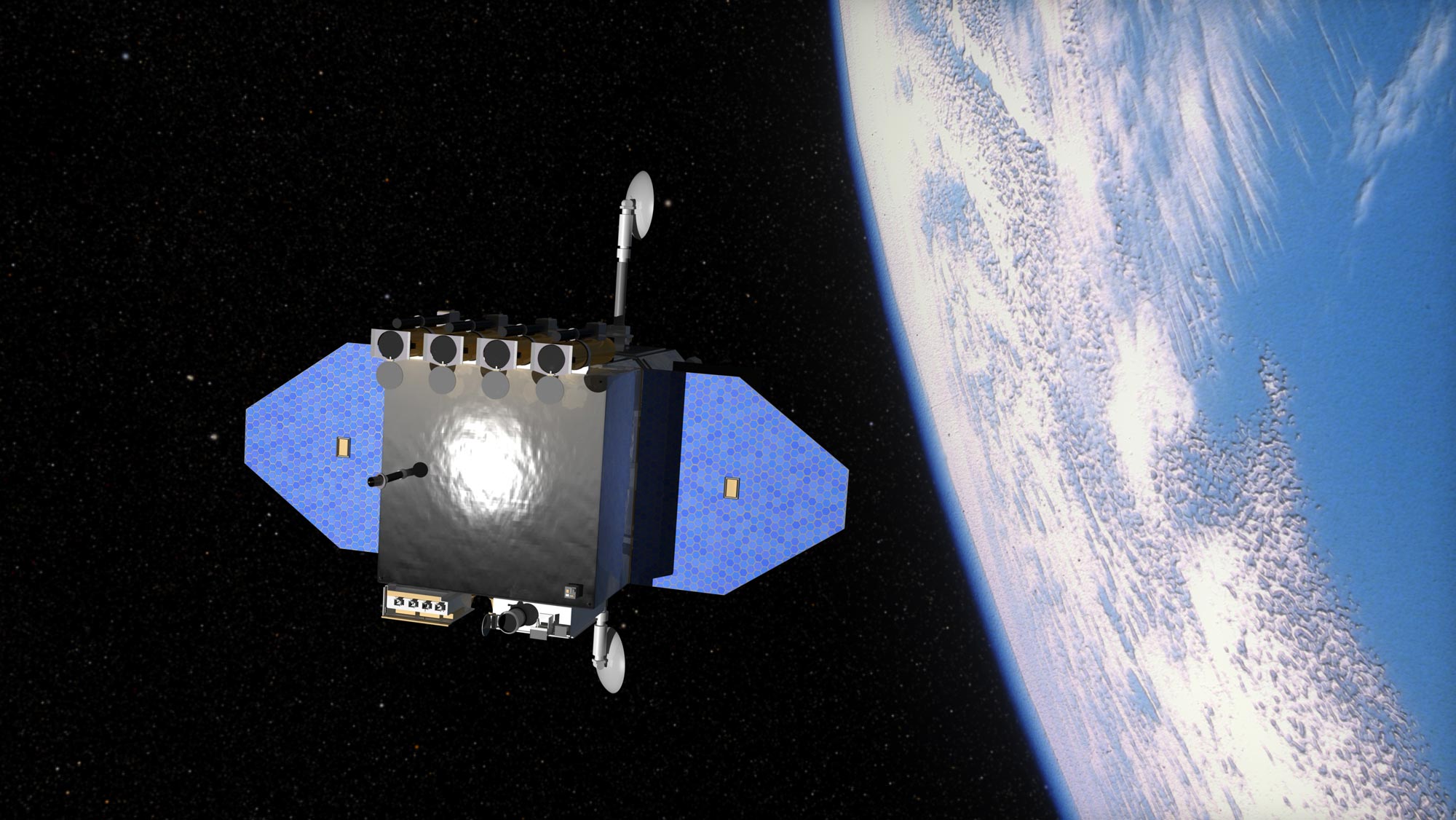
    NASA Solar Dynamics Observatory Orbiting Earth
    Artist’s concept image of the SDO satellite orbiting Earth. Credit: NASA

    NASA’s Solar Dynamics Observatory

    NASA’s Solar Dynamics Observatory (SDO) is a mission launched in February 2010 as part of the Living With a Star (LWS) program. The primary goal of the SDO is to understand the influence of the Sun on the Earth and near-Earth space by studying the solar atmosphere on small scales of space and time and in many wavelengths simultaneously. SDO has been instrumental in providing detailed data about the Sun’s activity and its components such as solar flares, coronal mass ejections (CMEs), and magnetic fields.

    Equipped with a suite of instruments, SDO captures high-resolution images of the Sun in 13 different wavelengths every few seconds. This includes capturing images in ultraviolet, extreme ultraviolet, and visible light spectrums, which help in observing the solar atmosphere with incredible detail. SDO’s data is crucial for understanding the solar variations that influence life on Earth and the technological systems in space. The observatory helps scientists gain insights into the complex solar dynamics and supports efforts to predict solar weather with greater accuracy.

    Never miss a breakthrough: Join the SciTechDaily newsletter.
    Follow us on Google and Google News.

    Astronomy NASA Solar Dynamics Observatory Solar Flares Sun
    Share. Facebook Twitter Pinterest LinkedIn Email Reddit

    Related Articles

    Solar Fury Erupts: Sun Rings In the New Year With X1.8 Flare

    X1.8 Flare Unleashed: NASA Captures Powerful Solar Eruption

    Sun Unleashes Monumental X9.0 Solar Flare – Most Intense in 7 Years – Captured by NASA Observatory

    Monster X7.1 Solar Flare Unleashed: Intense Blast Captured by NASA’s Solar Dynamics Observatory

    Sun Ignites: Unleashing a Powerful X4.5 Solar Flare

    NASA’s Solar Dynamics Observatory Spots Burst of Light and Energy on the Sun: A B-Class Flare

    NASA’s Solar Dynamics Observatory Views M-Class Solar Flare

    NASA’s SDO Reveals Images of X4.9-Class Solar Flare

    NASA’s Solar Dynamics Observatory Views Two New Solar Flares

    Leave A Reply Cancel Reply

    • Facebook
    • Twitter
    • Pinterest
    • YouTube

    Don't Miss a Discovery

    Subscribe for the Latest in Science & Tech!

    Trending News

    The 4,000-Year-Old City That Defied History’s Rules on Wealth and Power

    The World’s Biggest Population Fear Has Flipped – and It Could Change Everything

    This “Fake” Pill Improved Memory and Physical Performance in Just 3 Weeks

    Scientists Say Frequent Ejaculation May Improve Sperm Quality and Fertility

    Scientists Have Found “The Heaven Sword” After Years of Looking

    Can Time Flow in Reverse? A Quantum Breakthrough Challenges Our Assumptions

    Hidden Alzheimer’s Biomarker Could Change How Doctors Prescribe Hormone Therapy

    Koalas Nearly Vanished 100,000 Years Ago – Long Before Humans Arrived

    Follow SciTechDaily
    • Facebook
    • Twitter
    • YouTube
    • Pinterest
    • Newsletter
    • RSS
    SciTech News
    • Biology News
    • Chemistry News
    • Earth News
    • Health News
    • Physics News
    • Science News
    • Space News
    • Technology News
    Recent Posts
    • 17,000 Brain Scans Reveal Surprising Ethnic Differences in Alzheimer’s Biology
    • New Autism Treatment Strategy Restores Key Brain Receptor Function
    • Younger Generations Are Aging Faster – and It May Be Fueling a Surge in Cancer
    • Scientists Turn Ordinary Sunlight Into UV Light in Major Energy Breakthrough
    • New Discovery Could Unlock Quantum Computers the Size of a Coin
    Copyright © 1998 - 2026 SciTechDaily. All Rights Reserved.
    • Science News
    • About
    • Contact
    • Editorial Board
    • Privacy Policy
    • Terms of Use

    Type above and press Enter to search. Press Esc to cancel.