
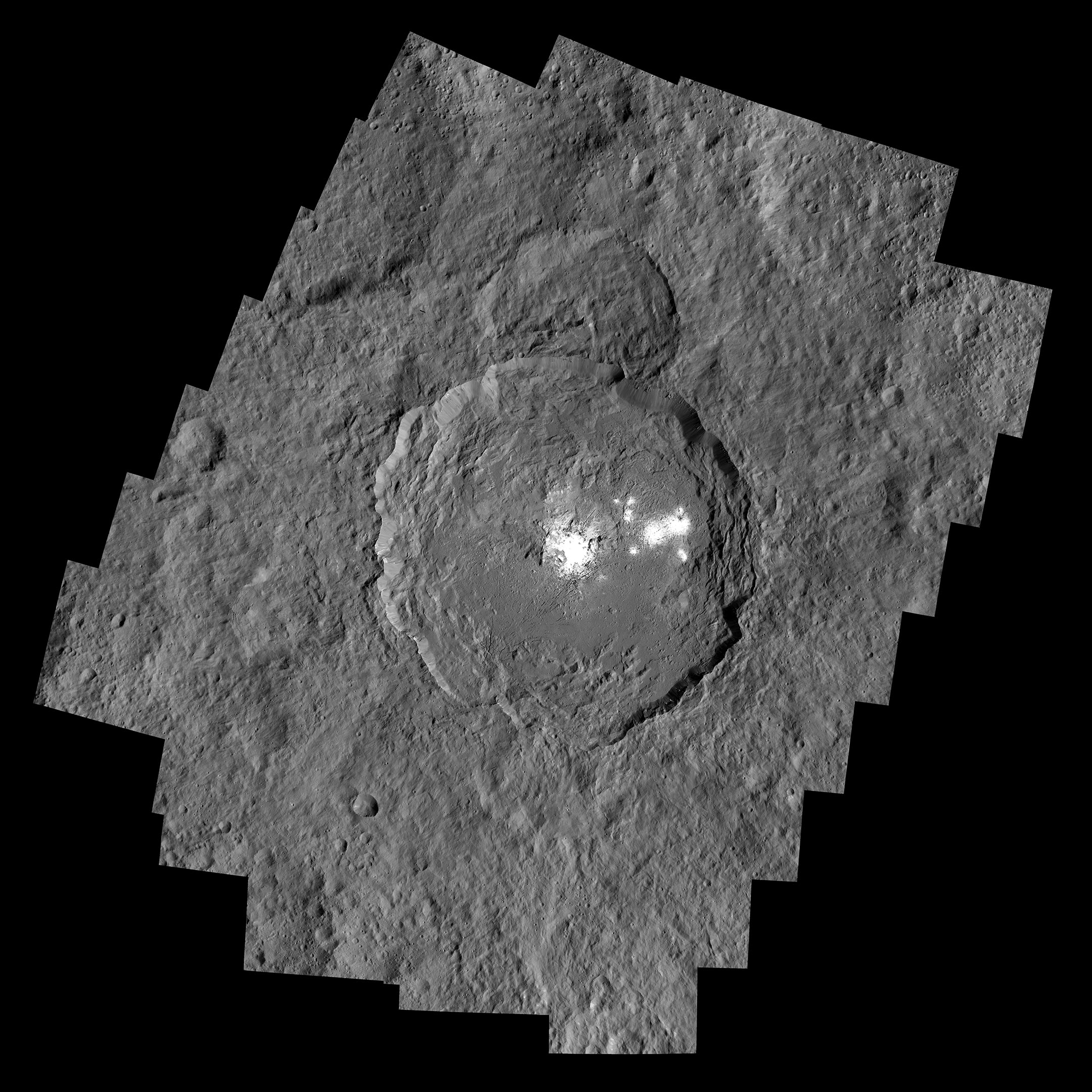
NASA’s Dawn spacecraft reveals new images from the lowest orbit at Ceres, including highly-anticipated views of Occator Crater.
Occator Crater, measuring 57 miles (92 kilometers) across and 2.5 miles (4 kilometers) deep, contains the brightest area on Ceres, the dwarf planet that Dawn has explored since early 2015. The latest images, taken from 240 miles (385 kilometers) above the surface of Ceres, reveal a dome in a smooth-walled pit in the bright center of the crater. Numerous linear features and fractures crisscross the top and flanks of this dome. Prominent fractures also surround the dome and run through smaller, bright regions found within the crater.
NASA’s Dawn spacecraft has revealed marvelous sights on dwarf planet Ceres during its first year in orbit.
“Before Dawn began its intensive observations of Ceres last year, Occator Crater looked to be one large bright area. Now, with the latest close views, we can see complex features that provide new mysteries to investigate,” said Ralf Jaumann, planetary scientist and Dawn co-investigator at the German Aerospace Center (DLR) in Berlin. “The intricate geometry of the crater interior suggests geologic activity in the recent past, but we will need to complete detailed geologic mapping of the crater in order to test hypotheses for its formation.”
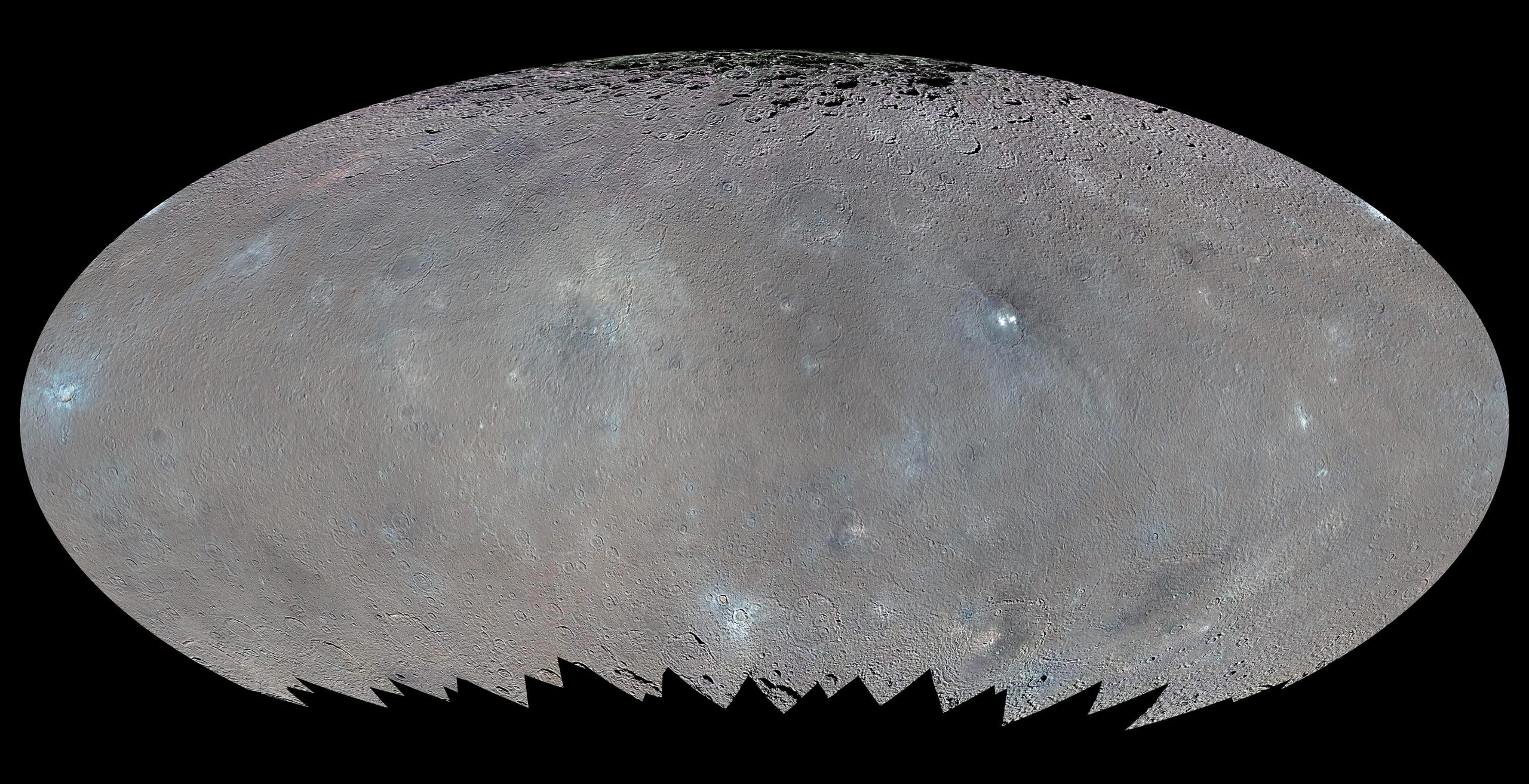
Color Differences
The team also released an enhanced color map of the surface of Ceres, highlighting the diversity of surface materials and their relationships to surface morphology. Scientists have been studying the shapes of craters and their distribution with great interest. Ceres does not have as many large impact basins as scientists expected, but the number of smaller craters generally matches their predictions. The blue material highlighted in the color map is related to flows, smooth plains and mountains, which appear to be very young surface features.
“Although impact processes dominate the surface geology on Ceres, we have identified specific color variations on the surface indicating material alterations that are due to a complex interaction of the impact process and the subsurface composition,” Jaumann said. “Additionally, this gives evidence for a subsurface layer enriched in ice and volatiles.”

Counting Neutrons
Data relevant to the possibility of subsurface ice is also emerging from Dawn’s Gamma Ray and Neutron Detector (GRaND), which began acquiring its primary data set in December. Neutrons and gamma rays produced by cosmic ray interactions with surface materials provide a fingerprint of Ceres’ chemical makeup. The measurements are sensitive to elemental composition of the topmost yard (meter) of the regolith.
In Dawn’s lowest-altitude orbit, the instrument has detected fewer neutrons near the poles of Ceres than at the equator, which indicates increased hydrogen concentration at high latitudes. As hydrogen is a principal constituent of water, water ice could be present close to the surface in polar regions.
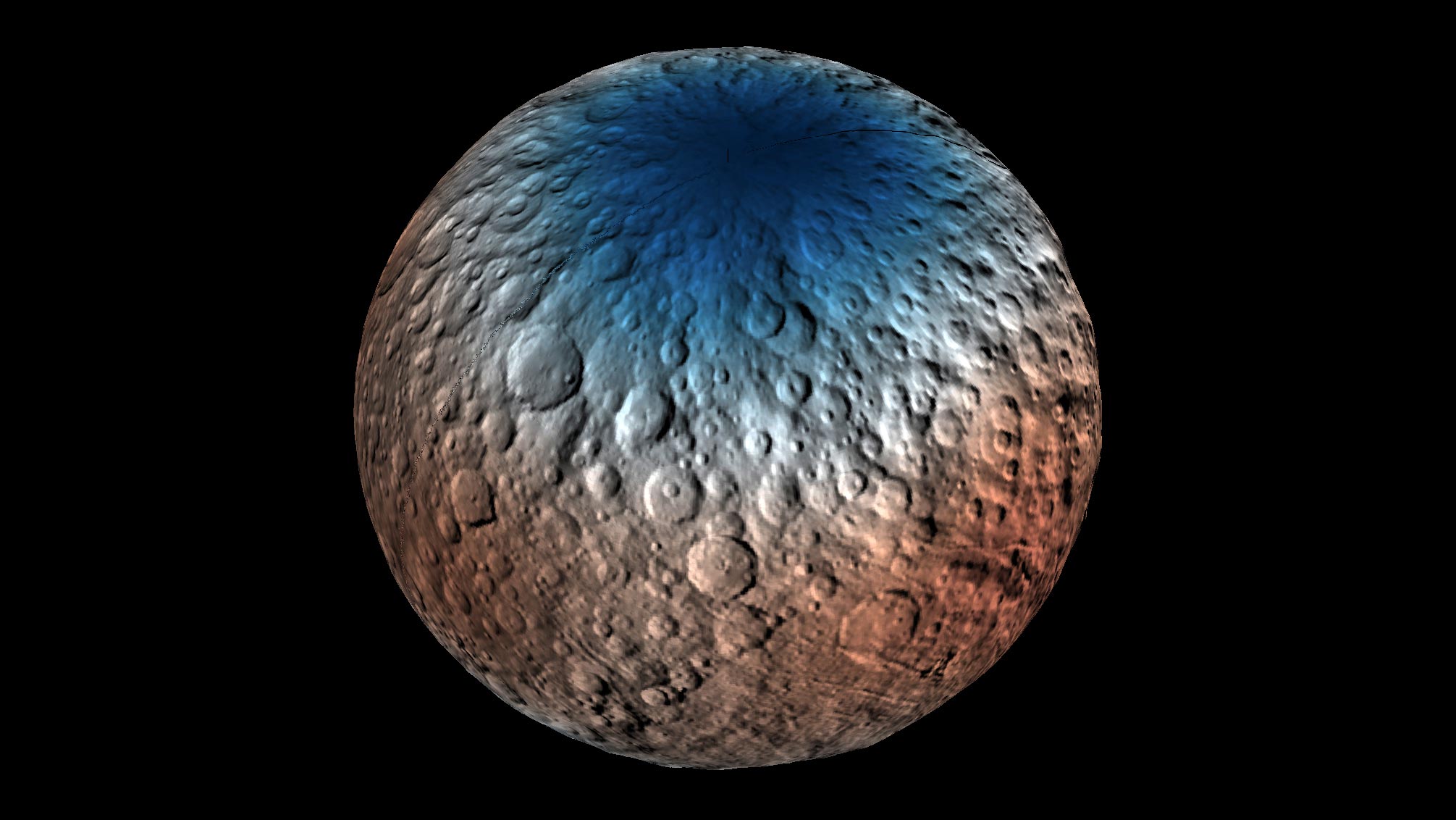
“Our analyses will test a longstanding prediction that water ice can survive just beneath Ceres’ cold, high-latitude surface for billions of years,” said Tom Prettyman, the lead for GRaND and Dawn co-investigator at the Planetary Science Institute, Tucson, Arizona.
The Mystery of Haulani Crater
But the subsurface does not have the same composition all over Ceres, according to data from the visible and infrared mapping spectrometer (VIR), a device that looks at how various wavelengths of sunlight are reflected by the surface, allowing scientists to identify minerals.
Haulani Crater in particular is an intriguing example of how diverse Ceres is in terms of its surface material composition. This irregularly-shaped crater, with its striking bright streaks of material, shows a different proportion of surface materials than its surroundings when viewed with the VIR instrument. While the surface of Ceres is mostly made of a mixture of materials containing carbonates and phyllosilicates, their relative proportion varies across the surface.
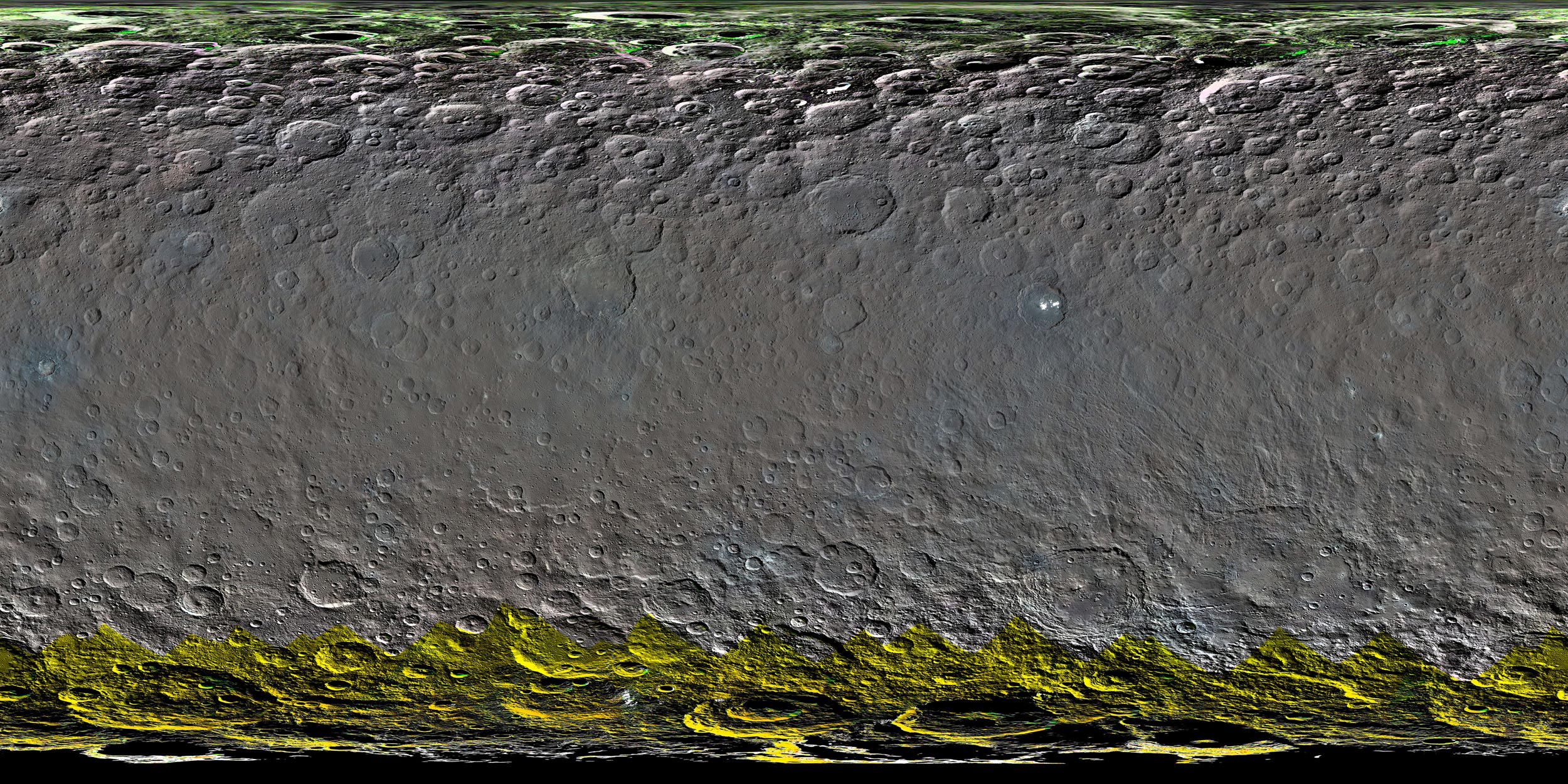
“False-color images of Haulani show that material excavated by an impact is different than the general surface composition of Ceres. The diversity of materials implies either that there is a mixed layer underneath, or that the impact itself changed the properties of the materials,” said Maria Cristina de Sanctis, the VIR instrument lead scientist, based at the National Institute of Astrophysics, Rome.
The Big Picture
Dawn made history last year as the first mission to reach a dwarf planet, and the first to orbit two distinct extraterrestrial targets – both of them in the main asteroid belt between Mars and Jupiter. The mission conducted extensive observations of Vesta during its 14-month orbit there in 2011-2012.
“We’re excited to unveil these beautiful new images, especially Occator, which illustrate the complexity of the processes shaping Ceres’ surface. Now that we can see Ceres’ enigmatic bright spots, surface minerals and morphology in high resolution, we’re busy working to figure out what processes shaped this unique dwarf planet. By comparing Ceres with Vesta, we’ll glean new insights about the early solar system,” said Carol Raymond, deputy principal investigator for the Dawn mission, based at NASA’s Jet Propulsion Laboratory, Pasadena, California.
Never miss a breakthrough: Join the SciTechDaily newsletter.
Follow us on Google and Google News.