
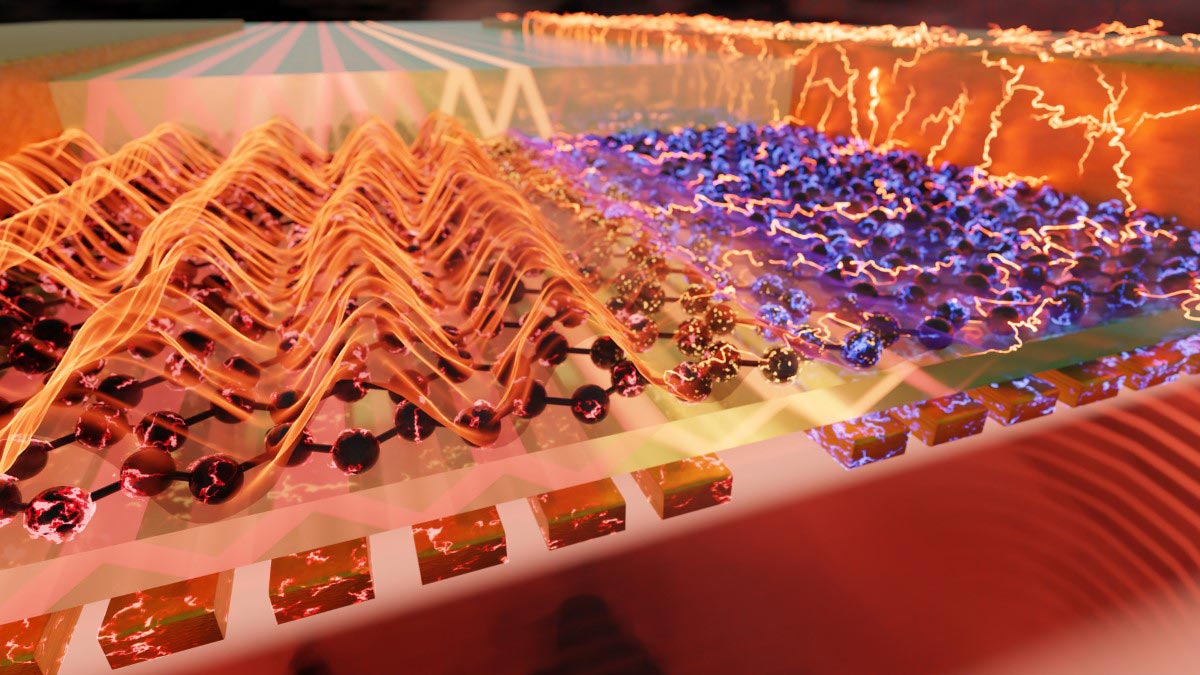
A new device integrating 2D polaritons with an electrical detection system marks a significant advance in nanophotonics, offering superior spectral coverage and signal clarity.
This miniaturized platform could transform applications in sensing and imaging by improving light confinement and detection capabilities.
Polariton Dynamics in Nanophotonics
Polaritons are unique excitations created when electromagnetic waves couple with either charged particles or vibrations within the atomic structure of a material. In nanophotonics, they play a critical role due to their ability to confine light in incredibly tiny spaces, down to nanometer-sized volumes, which is crucial for enhancing interactions between light and matter. Two-dimensional materials—just a single atom thick—are especially effective for creating polaritons. These 2D materials offer extreme light confinement, reduced energy loss (extending polariton lifetimes), and greater tunability than bulk materials.
To further refine light confinement and enhance polaritonic properties, scientists use nanoscale structures known as nanoresonators. When light interacts with a nanoresonator, it excites polaritons that oscillate and resonate at specific frequencies, shaped by the resonator’s material and geometry. This allows for highly precise control of light at the nanoscale, opening new possibilities for advanced optical manipulation.
Advancements and Challenges in Polariton Detection
While the use of polaritons for light confinement is an established practice, there is still room for improvement regarding the methods aimed at probing them. In the past years, optical measurements have become a common choice, but their bulky detectors require external equipment. This limits the miniaturization of the detection system and the signal clarity (known as the signal-to-noise ratio) one can obtain from the measurements, which in turn hinders the application of polaritonic properties in areas where these two features are essential, such as molecular sensing.
Breakthrough in Polariton Integration and Detection
Now, researchers from ICFO Dr. Sebastián Castilla, Dr. Hitesh Agarwal, Dr. David Alcaraz, Dr. Adrià Grabulosa, Matteo Ceccanti, Dr. Roshan Krishna Kumar, led by ICREA Prof. Frank Koppens; the University of Ioannina; Universidade do Minho; the International Iberian Nanotechnology Laboratory; Kansas State University; the National Institute for Materials Science (Tsukuba, Japan); POLIMA (University of Southern Denmark); and URCI (Institute of Materials Science and Computing, Ioannina) have demonstrated in a Nature Communications article the integration of 2D polaritons with a detection system into the same 2D material.
The integrated device enables, for the first time, spectrally resolved electrical detection of 2D polaritonic nanoresonators, and marks a significant step towards device miniaturization.
Advantages of Electrical Spectroscopy in Polariton Research
The team applied electrical spectroscopy to a stack of three layers of 2D materials, specifically, an hBN (hexagonal boron-nitrate) layer was placed on top of graphene, which was layered on another hBN sheet. During the experiments, researchers identified several advantages of electrical spectroscopy compared to commercial optical techniques. With the former, the spectral range covered is significantly broader (that is, it spans a wider range of frequencies, including the infrared and terahertz ranges), the required equipment is significantly smaller, and the measurements present higher signal-to-noise ratios.
Implications of Electro-Polaritonic Platforms for Future Technology
This electro-polaritonic platform represents a breakthrough in the field owing to two main features. First, an external detector for spectroscopy, required by most optical techniques, is no longer needed. A single device serves at the same time as a photodetector and a polaritonic platform, therefore enabling further miniaturization of the system. And second, while in general higher light confinement is detrimental to the quality of this confinement (for instance, shortening durations of light trapping), the integrated device successfully overcomes this limitation. “Our platforms have exceptional quality, achieving record-breaking optical lateral confinement and high-quality factors of up to 200, approximately. This exceptional level of both confinement and quality of graphene significantly enhances the photodetection efficiency,” explains Dr. Sebastián Castilla, first co-author of the article.
Moreover, the electrical spectroscopy approach enables the probing of extremely small 2D polaritons (with lateral sizes of around 30 nanometers). “That was highly challenging to detect with conventional techniques due to the imposed resolution limitations,” he adds.
Castilla now reflects on what future discoveries could be unlocked by their new approach. “Sensing, hyperspectral imaging, and optical spectrometry applications could benefit from this electro-polaritonic integrated platform. For instance, in the case of sensing, on-chip electrical detection of molecules and gases could become possible,” he suggests. “I believe that our work will open the door to many applications that the bulky nature of standard commercial platforms has been inhibiting.”
Reference: “Electrical spectroscopy of polaritonic nanoresonators” by Sebastián Castilla, Hitesh Agarwal, Ioannis Vangelidis, Yuliy V. Bludov, David Alcaraz Iranzo, Adrià Grabulosa, Matteo Ceccanti, Mikhail I. Vasilevskiy, Roshan Krishna Kumar, Eli Janzen, James H. Edgar, Kenji Watanabe, Takashi Taniguchi, Nuno M. R. Peres, Elefterios Lidorikis and Frank H. L. Koppens, 5 October 2024, Nature Communications.
DOI: 10.1038/s41467-024-52838-w
Never miss a breakthrough: Join the SciTechDaily newsletter.
Follow us on Google and Google News.