
Close Menu
    Facebook X (Twitter) Instagram
    SciTechDaily
    • Biology
    • Chemistry
    • Earth
    • Health
    • Physics
    • Science
    • Space
    • Technology
    Facebook X (Twitter) Pinterest YouTube RSS
    SciTechDaily
    Home»Technology»Noise Reduction Algorithm Speeds Graphene Mapping 50 Times Faster
    Technology

    Noise Reduction Algorithm Speeds Graphene Mapping 50 Times Faster

    By Science China PressFebruary 9, 2020No Comments3 Mins Read
    Facebook Twitter Pinterest Telegram LinkedIn WhatsApp Email Reddit
    Share
    Facebook Twitter LinkedIn Pinterest Telegram Email Reddit
    Improved Raman Scanning Speed
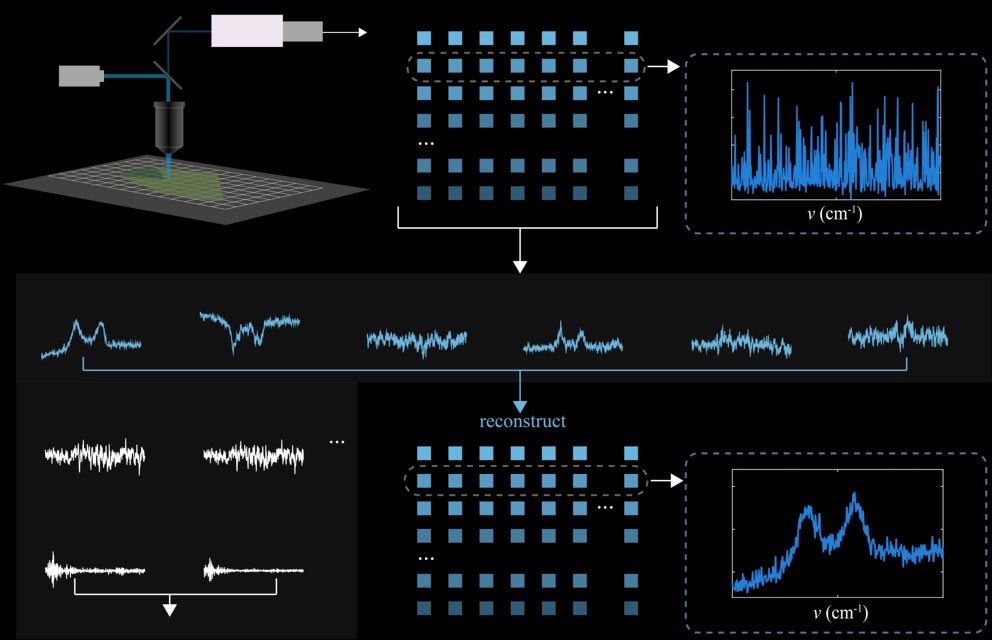
    Denoising algorithm improves Raman scanning speed. Credit: ©Science China Press

    Graphene is always raising high expectations, as a strong, ultrathin, two-dimensional material that could also be the basis for new information technology components.

    Characterization of graphene devices is in high demand. Raman spectroscopy can be used to do this. Laser light is directed at the material sample, and scattered photons provide information about the rotations and vibrations of the molecules therein, as well as the crystal structure.

    On average, only around 1 in 10 million photons is scattered in this way. This not only makes it hard to detect the right information, but it is also very slow: it may take half a second to image one single pixel. The question is if Raman still remains the best option, or if there are better alternatives. University of Twente (UT) researchers Sachin Nair and Jun Gao keep Raman spectroscopy as a starting point, but manage to improve the speed drastically: not by changing the technique itself, but by adding an algorithm.
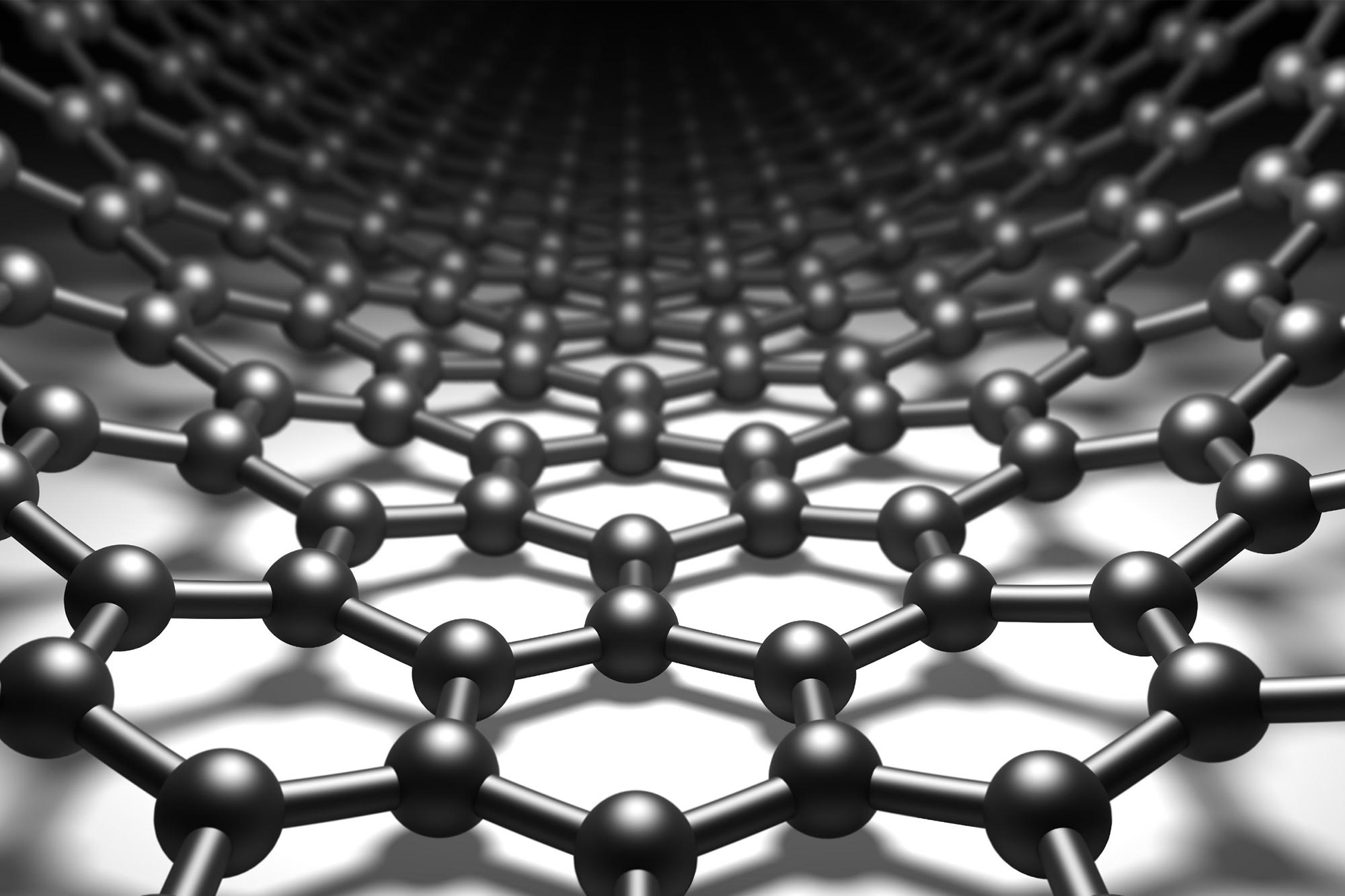
    Graphene Layer Illustration
    Graphene is a carbon allotrope composed of a single layer of atoms organized in a two-dimensional honeycomb lattice nanostructure. Each atom in a graphene sheet is connected to its three nearest neighbors by a σ-bond, and contributes one electron to a conduction band that spans the entire sheet.

    Noise reduction

    This algorithm is not unknown in the world of signal processing and it is called Principal Component Analysis. It is used to improve the signal-to-noise ratio. PCA determines the characteristics of noise and those of the ‘real’ signal. The larger the dataset, the more reliable this recognition is, and the clearer the actual signal can be distinguished. Apart from that, modern Raman instruments have a detector called electron-multiplying charge-coupled device (EMCCD) that improves the signal-to-noise-ratio. The net result of this work is that processing one pixel doesn’t take half a second, but only 10 milliseconds or less. Mapping a single sample doesn’t take hours anymore. An important feature for vulnerable materials like graphene oxide is that the intensity of the laser can be lowered two or three orders of magnitude. These are major steps ahead for getting a fast grip on the materials’ properties.

    Multi-purpose

    Except for graphene, the improved Raman technique can also be used for other two dimensional materials like germanene, silicene, molybdenum disulfide, tungsten disulfide, and boron nitride. Use of the algorithm is not limited to Raman spectroscopy; techniques like Atomic Force Microscopy and other hyperspectral techniques could also benefit from it.

    The research has been done in the group Physics of Complex Fluids of Prof Frieder Mugele, part of UT’s MESA+ Institute. The researchers collaborated with the Medical Cell BioPhysics group and the Physics of Interfaces and Nanomaterials group, both of the University of Twente as well.

    Reference: “Algorithm-improved high speed and non-invasive confocal Raman imaging of two-dimensional materials ” by Sachin Nair, Jun Gao, Qirong Yao, Michael H G Duits, Cees Otto and Frieder Mugele, 13 November 2019, National Science Review.
    DOI: 10.1093/nsr/nwz177

    Never miss a breakthrough: Join the SciTechDaily newsletter.
    Follow us on Google and Google News.

    2D Materials Graphene Science China Press
    Share. Facebook Twitter Pinterest LinkedIn Email Reddit

    Related Articles

    Some Precious Metals – Such As Gold and Silver – Lose Their Conductive Property, If They Are Thin Enough

    Graphene Nanomesh: New Nanotechnology ‘Brick’ for Modern Micromachines

    Faster Electrons From Flatter Graphene

    Unlocking Hidden Frequencies in the Electromagnetic Spectrum With a New Graphene Amplifier

    Scientists Turn Trash Into Valuable Graphene in a Flash

    Laser-Induced Graphene Shrunk Under Microscope’s Eye for Flexible Electronics

    Graphene Surprises Researchers Again: Strange ‘Melting’ Behavior

    New Zoo of Previously Unobserved States in Twisted Bi-Layer Graphene

    “Patterned Regrowth” May Lead to Graphene-Based Circuits

    Leave A Reply Cancel Reply

    • Facebook
    • Twitter
    • Pinterest
    • YouTube

    Don't Miss a Discovery

    Subscribe for the Latest in Science & Tech!

    Trending News

    Scientists Warn That This Common Pet Fish Can Wreck Entire Ecosystems

    Scientists Make Breakthrough in Turning Plastic Trash Into Clean Fuel Using Sunlight

    This Popular Supplement May Interfere With Cancer Treatment, Scientists Warn

    Scientists Finally Solved One of Water’s Biggest Mysteries

    Could This New Weight-Loss Pill Disrupt the Entire Market? Here’s What You Should Know About Orforglipron

    Earth’s Crust Is Tearing Open in Africa, and It Could Form a New Ocean

    Breakthrough Bowel Cancer Trial Leaves Patients Cancer-Free for Nearly 3 Years

    Natural Compound Shows Powerful Potential Against Rheumatoid Arthritis

    Follow SciTechDaily
    • Facebook
    • Twitter
    • YouTube
    • Pinterest
    • Newsletter
    • RSS
    SciTech News
    • Biology News
    • Chemistry News
    • Earth News
    • Health News
    • Physics News
    • Science News
    • Space News
    • Technology News
    Recent Posts
    • Kratom Use Explodes in the US, With Life-Changing Consequences
    • Scientists Uncover Fatal Weakness in “Zombie Cells” Linked to Cancer
    • World-First Study Reveals Human Hearts Can Regenerate After a Heart Attack
    • Why Your Dreams Feel So Real Sometimes and So Strange Other Times
    • Scientists Debunk 100-Year-Old Belief About Brain Cells, Rewriting Textbooks
    Copyright © 1998 - 2026 SciTechDaily. All Rights Reserved.
    • Science News
    • About
    • Contact
    • Editorial Board
    • Privacy Policy
    • Terms of Use

    Type above and press Enter to search. Press Esc to cancel.