
Close Menu
    Facebook X (Twitter) Instagram
    SciTechDaily
    • Biology
    • Chemistry
    • Earth
    • Health
    • Physics
    • Science
    • Space
    • Technology
    Facebook X (Twitter) Pinterest YouTube RSS
    SciTechDaily
    Home»Space»A Star Might Have Faked Its Own Death and Hubble Is Investigating
    Space

    A Star Might Have Faked Its Own Death and Hubble Is Investigating

    By ESA/HubbleFebruary 16, 2025No Comments2 Mins Read
    Facebook Twitter Pinterest Telegram LinkedIn WhatsApp Email Reddit
    Share
    Facebook Twitter LinkedIn Pinterest Telegram Email Reddit
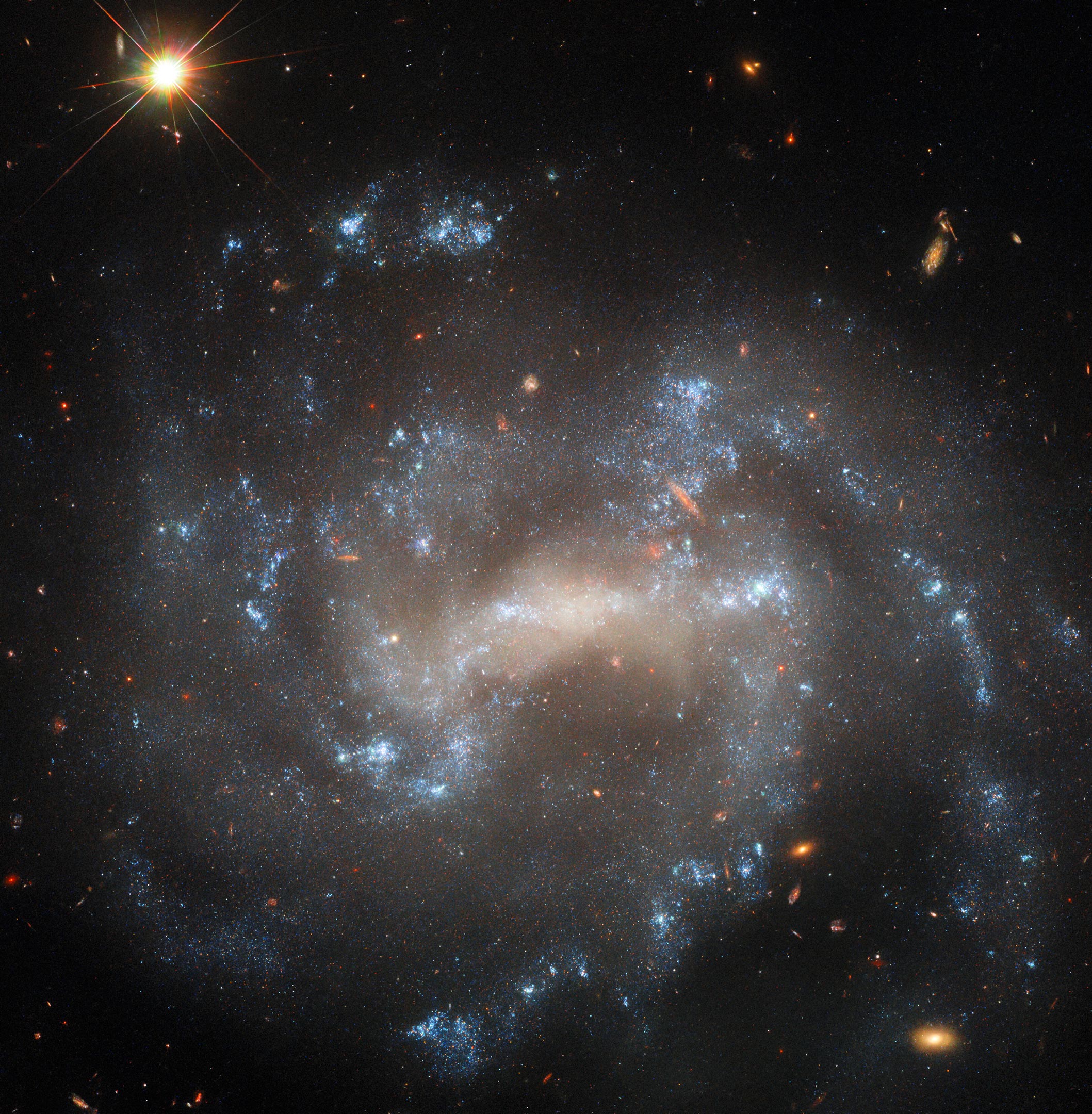
    Spiral Galaxy UGC 5460
    A dazzling spiral galaxy, UGC 5460, shines in this stunning Hubble image, revealing its star-filled bar, winding arms, and brilliant blue clusters. Credit: ESA/Hubble & NASA, W. Jacobson-Galán, A. Filippenko, J. Mauerhan

    The dazzling spiral galaxy in this Hubble Space Telescope image is UGC 5460, located about 60 million light-years away in the constellation Ursa Major. This striking image combines four different wavelengths of light, showcasing the galaxy’s central bar of stars, twisting spiral arms, and clusters of bright blue stars. In the upper left corner of the image, a much closer object appears—a star from our own galaxy, just 577 light-years away.

    UGC 5460 has been home to two recent supernovae, SN 2011ht and SN 2015as. These stellar explosions made the galaxy a prime target for Hubble, which gathered data as part of three separate observing programs designed to study different types of supernovae.

    SN 2015as was what’s known as a core-collapse supernova: a cataclysmic explosion that happens when the core of a star far more massive than the Sun runs out of fuel and collapses under its own gravity, initiating a rebound of material outside the core. Hubble observations of SN 2015as will help researchers understand what happens when the expanding shockwave of a supernova collides with the gas that surrounds the exploded star.

    SN 2011ht might have been a core-collapse supernova as well, but it could also be an impostor called a luminous blue variable. Luminous blue variables are rare stars that experience eruptions so large that they can mimic supernovae. Crucially, luminous blue variables emerge from these eruptions unscathed, while stars that go supernova do not. Hubble will search for a stellar survivor at SN 2011ht’s location, and the explosion’s identity may be revealed at last.

    Never miss a breakthrough: Join the SciTechDaily newsletter.
    Follow us on Google and Google News.

    Astronomy European Space Agency Hubble Space Telescope
    Share. Facebook Twitter Pinterest LinkedIn Email Reddit

    Related Articles

    A Diamond Necklace of Cosmic Proportions

    Hubble Snaps a Stunning Close-Up of a Magnificent Spiral Galaxy

    Extraordinary Hubble Image: Light Bends From the Beyond

    Hubble Space Telescope Sees Volcanic Activity Reforming the Atmosphere on a Rocky Exoplanet

    Hubble Spies a Luminous Heart With Dark Tendrils

    Spectacular Return to the Veil Nebula

    Hubble Spots a Peculiar Sight: Unusual Spiral Galaxy With a Heavy Arm

    A Flash of Life: Hubble Spies an Unusual Planetary Nebula

    Through the Cosmic Clouds: Hubble Spots a Beautiful Stellar Nursery

    Leave A Reply Cancel Reply

    • Facebook
    • Twitter
    • Pinterest
    • YouTube

    Don't Miss a Discovery

    Subscribe for the Latest in Science & Tech!

    Trending News

    Popular GLP-1 Weight-Loss Drugs Linked to 30% Lower Breast Cancer Risk

    A Deadly Fungus Has Found the Perfect Hiding Place: Human Hair Follicles

    Ancient Neanderthal DNA May Give Some People More Muscle

    How a Low-Fat Vegan Diet Helped People Lose Weight Without Counting Calories

    MIT Physicists Zapped a Quantum Crystal With Lasers – and Discovered Something Surprising

    Mushroom Mystery: The Fungus That Makes People See Tiny Humans

    Popular Erectile Dysfunction Drug Linked to Vision-Threatening Eye Disease

    Scientists Find a Smarter Way To Turn Used Coffee Grounds Into Clean Fuel

    Follow SciTechDaily
    • Facebook
    • Twitter
    • YouTube
    • Pinterest
    • Newsletter
    • RSS
    SciTech News
    • Biology News
    • Chemistry News
    • Earth News
    • Health News
    • Physics News
    • Science News
    • Space News
    • Technology News
    Recent Posts
    • Scientists May Have Solved a Long-Standing Melanoma Treatment Mystery
    • Popular Fertility Drug May Raise Miscarriage Risk Without Improving Live Birth Odds
    • This Flesh-Eating Fly Is Back in the U.S. – Scientists Are Tracking Where It Could Strike Next
    • Scientists Survey Mount Ararat’s Mysterious Glacier for the First Time
    • Scientists Turn One of the World’s Hardest-To-Recycle Plastics Into Engine Oil
    Copyright © 1998 - 2026 SciTechDaily. All Rights Reserved.
    • Science News
    • About
    • Contact
    • Editorial Board
    • Privacy Policy
    • Terms of Use

    Type above and press Enter to search. Press Esc to cancel.