
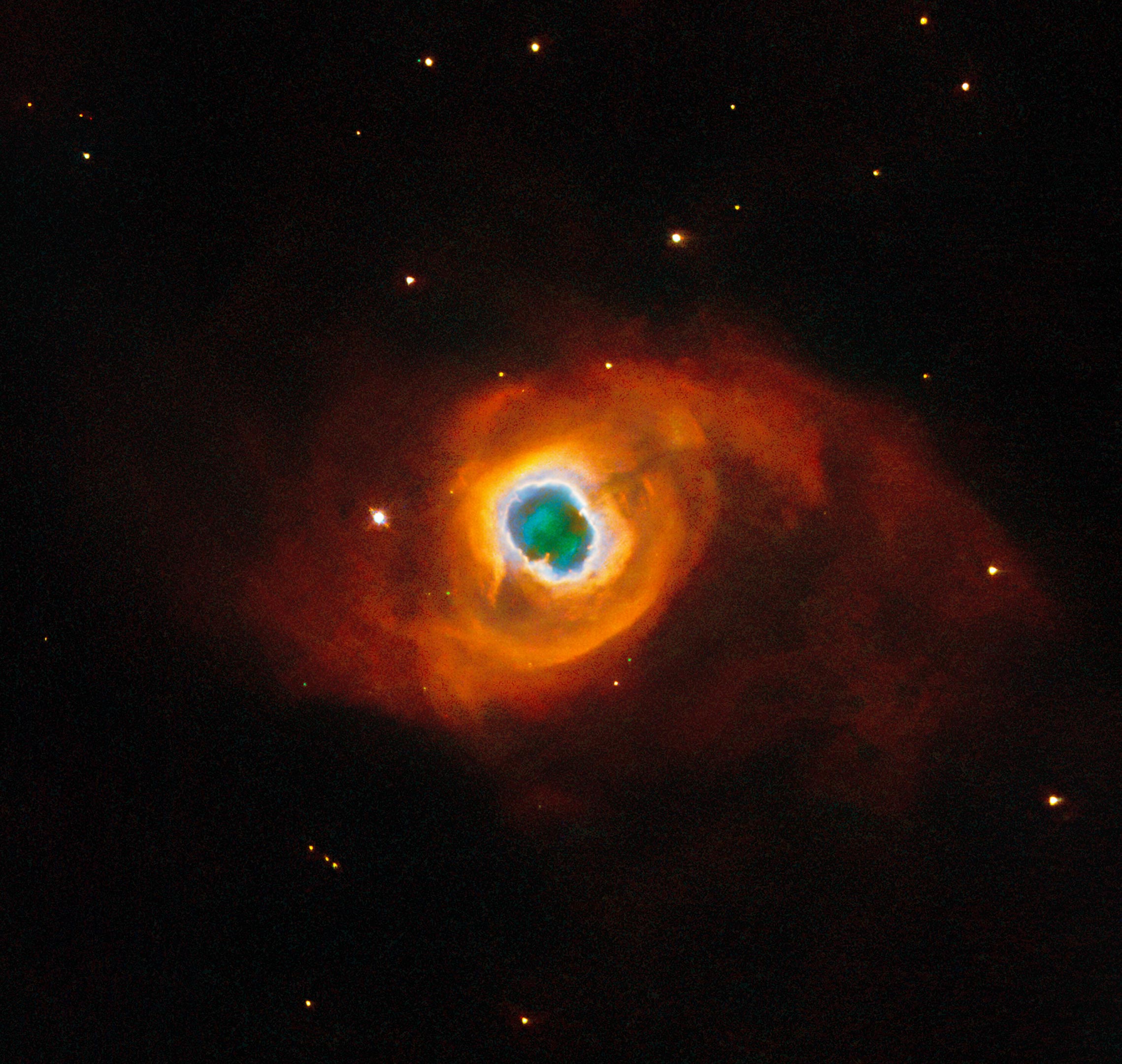
Kohoutek 4-55 is a dazzling planetary nebula captured in vivid color by the Hubble Space Telescope.
Formed by the dramatic death of a giant star, this cosmic cloud glows with energized gases and showcases the universe’s artistry at the end of stellar life. Even more poignantly, the image marks the swan song of a legendary Hubble camera that helped shape our understanding of space.
A Glimpse Into the Cosmic Unknown
The swirling, paint-like clouds in this image might look like something out of science fiction, but they’re entirely real. Captured by the Hubble Space Telescope, this is Kohoutek 4-55, a planetary nebula located about 4,600 light-years away in the constellation Cygnus (the Swan), part of our Milky Way galaxy. What you’re seeing are vast clouds of ionized gas, ejected into space by a dying star.
The Final Act of a Giant Star
Planetary nebulae like this one form during the final stages of a giant star’s life. After burning through its fuel, a red giant star becomes unstable, shedding its outer layers into space. Its hot, dense core contracts and briefly reignites nuclear fusion, emitting powerful ultraviolet radiation. This radiation energizes the surrounding gas, causing it to glow in brilliant colors: red and orange from nitrogen, green from hydrogen, and blue from oxygen.
Kohoutek 4-55 is especially striking due to its layered structure – a bright inner ring, a surrounding fainter shell, and an outer halo of ionized nitrogen. The view is beautiful, but fleeting. In just tens of thousands of years, fusion in the core will stop entirely, leaving behind a white dwarf: a small, dense remnant that can no longer light up the nebula around it.
A Symphony of Ionized Light
This image itself is also a swan song, the final work of one of Hubble’s instruments: the Wide Field and Planetary Camera 2 (WFPC2). Installed in 1993 to replace the original Wide Field and Planetary Camera, WFPC2 was responsible for some of Hubble’s most enduring images and fascinating discoveries.It in turn was replaced by the Wide Field Camera 3 in 2009, during Hubble’s final servicing mission.
The data for this image were taken a mere ten days before the instrument was removed from the telescope, as a fitting send-off for WFPC2 after 16 years’ work. The latest and most advanced processing techniques have been used to bring the data to life one more time, producing this breathtaking new view of Kohoutek 4-55.
Never miss a breakthrough: Join the SciTechDaily newsletter.
Follow us on Google and Google News.