
Close Menu
    Facebook X (Twitter) Instagram
    SciTechDaily
    • Biology
    • Chemistry
    • Earth
    • Health
    • Physics
    • Science
    • Space
    • Technology
    Facebook X (Twitter) Pinterest YouTube RSS
    SciTechDaily
    Home»Space»This Martian “Stone Web” Could Rewrite Mars’ Geological History
    Space

    This Martian “Stone Web” Could Rewrite Mars’ Geological History

    By Ashley Stroupe, NASA's Jet Propulsion LaboratoryMay 22, 20253 Comments4 Mins Read
    Facebook Twitter Pinterest Telegram LinkedIn WhatsApp Email Reddit
    Share
    Facebook Twitter LinkedIn Pinterest Telegram Email Reddit
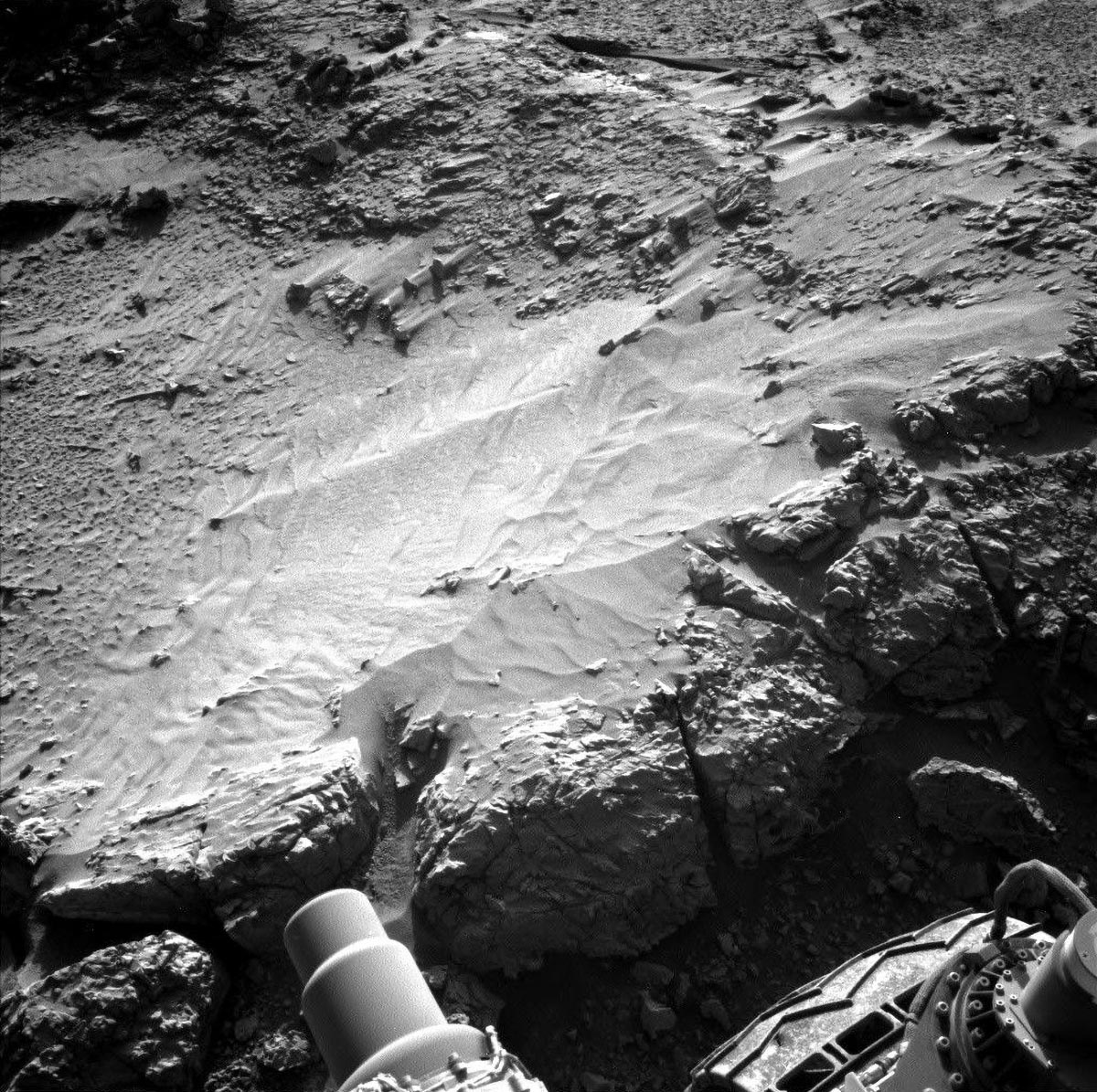
    NASA Mars Rover Curiosity Sol 4539
    NASA’s Mars rover Curiosity acquired this image using its Left Navigation Camera on May 14, 2025 — Sol 4539, or Martian day 4,539 of the Mars Science Laboratory mission — at 00:57:26 UTC. Credit: NASA/JPL-Caltech

    Curiosity arrived at a ridge-rich site that might be Mars’ version of a boxwork structure, but a perched wheel prevented close analysis. Instead, the rover unleashed a suite of cameras and sensors to document its strange new surroundings while prepping for a Friday return.

    Curiosity has rolled into another fascinating part of Mars, and this one might be the most exciting yet. We’re now at the edge of what could be a boxwork structure—a striking pattern of tough, web-like ridges first seen from orbit (see image below). Ever since we spotted it in satellite images, we’ve been eager to investigate it up close.

    These initial observations mark the beginning of that exploration. We’re aiming to find out whether these ridges, especially the prominent one in front of us, truly belong to a boxwork formation. But there’s a small challenge: one of Curiosity’s front wheels is resting on a pebble, and moving the robotic arm right now could risk slipping. So instead of using the arm, we’re capturing as much science as we can remotely and will gently reposition the rover for a closer look later this week.

    NASA Mars Reconnaissance Orbiter Boxwork Formation
    Scientists think that ancient groundwater formed this weblike pattern of ridges, called boxwork, that were captured by NASA’s Mars Reconnaissance Orbiter on December 10, 2006. The agency’s Curiosity rover will study ridges similar to these up close in 2025. Credit: NASA/JPL-Caltech/University of Arizona

    High-Tech Imaging and Remote Sensing Sweep

    Before we move, Curiosity is using its powerful Mastcam to take a sweeping mosaic of the landscape all around. These wide-angle images help us track how the terrain changes with elevation along the rover’s path. Mastcam will also take a closer look at “Temblor Range,” a nearby ridge we previously crossed—our wheel tracks are still visible there.

    Next up, Mastcam will photograph a trough similar to others we’ve seen in the area. These formations are especially intriguing because their origin is still uncertain. It will also re-image the AEGIS target selected in an earlier plan.

    Meanwhile, the ChemCam instrument is firing its laser at a rugged peak named “Glendale Peak,” part of the potential boxwork ridge. It’s also capturing a high-resolution mosaic of Texoli Butte. After that, Mastcam will circle back to take detailed photos of Glendale Peak as well.

    Maintaining the Rover’s Heat Defense System

    In parallel with all the imaging is our monthly test and maintenance of our backup pump for the Heat Rejection System (HRS). The HRS is a fluid loop that distributes the heat from the rover’s power source to help keep all the subsystems within reasonable temperatures. We need to periodically make sure it stays in good working order, just in case our primary pump has issues.

    Positioning for a Closer Look at Martian Terrain

    After all the imaging, the rover will bump 30 centimeters backwards (about 12 inches) to come down off the pebble and put the interesting science targets in the arm workspace. This should leave us in a position where it is safe to unstow the arm and put instruments down on the surface.

    Atmospheric Science and Autonomous Targeting

    On the second, untargeted sol of the plan, we have some additional atmospheric science, including a large dust-devil survey, as well as a Navcam suprahorizon movie and a Mastcam solar tau to measure the dust in the atmosphere. We finish up with another autonomous targeting of ChemCam with AEGI.

    Written by Ashley Stroupe, Mission Operations Engineer at NASA’s Jet Propulsion Laboratory

    Never miss a breakthrough: Join the SciTechDaily newsletter.
    Follow us on Google and Google News.

    Curiosity Rover Geology JPL Mars NASA Planets
    Share. Facebook Twitter Pinterest LinkedIn Email Reddit

    Related Articles

    Martian “Spiderwebs” Revealed: Curiosity Captures Stunning 360° Panorama

    Mars Mystery Deepens: Curiosity Uncovers a Secret Lattice of Bizarre Ridges in Gale Crater

    NASA’s Curiosity Rover Discovers Surprise Clues to Ancient Water on Mars

    NASA’s Curiosity Rover Views Rhythmic Rock Layers on Mars

    Tantalizing Science and Dangerous Hazards: NASA’s Curiosity Mars Rover Reaches Long-Awaited Salty Region

    NASA’s Curiosity Rover Spots a “Doorway” on Mars

    Searching for “Ground Truth” on Mars: Planetary Geologist To Lead Next Phase of Curiosity Rover Project

    NASA’s Curiosity Mars Rover Explores a Changing Landscape – Video Tour of Martian Mountain

    See NASA’s Curiosity Rover’s Stunning 360-Degree View Atop “Mont Mercou” on Mars

    3 Comments

    1. Clyde Spencer on May 22, 2025 11:19 am

      “After all the imaging, the rover will bump 30 centimeters backwards (about 12 inches) to come down off the pebble …”

      It sounds like Rover is sitting on something much larger than a pebble, which has a specified size range. It is more likely a ‘cobble’ or small ‘boulder.’

      Reply
    2. Eric M. Jones on May 24, 2025 8:16 am

      What is the scale of this web structure?

      Reply
    3. Robin C on May 24, 2025 9:47 am

      Must be fairly large to be visible from orbit.

      Reply
    Leave A Reply Cancel Reply

    • Facebook
    • Twitter
    • Pinterest
    • YouTube

    Don't Miss a Discovery

    Subscribe for the Latest in Science & Tech!

    Trending News

    First-of-Its-Kind Discovery: Homer’s Iliad Found Embedded in a 1,600-Year-Old Egyptian Mummy

    Beyond Inflammation: Scientists Uncover New Cause of Persistent Rheumatoid Arthritis

    A Simple Molecule Could Unlock Safer, Easier Weight Loss

    Scientists Just Built a Quantum Battery That Charges Almost Instantly

    Researchers Unveil Groundbreaking Sustainable Solution to Vitamin B12 Deficiency

    Millions of People Have Osteopenia Without Realizing It – Here’s What You Need To Know

    Researchers Discover Boosting a Single Protein Helps the Brain Fight Alzheimer’s

    World-First Study Reveals Human Hearts Can Regenerate After a Heart Attack

    Follow SciTechDaily
    • Facebook
    • Twitter
    • YouTube
    • Pinterest
    • Newsletter
    • RSS
    SciTech News
    • Biology News
    • Chemistry News
    • Earth News
    • Health News
    • Physics News
    • Science News
    • Space News
    • Technology News
    Recent Posts
    • After Decades, MIT Researchers Capture the First 3D Atomic View of a Mysterious Material
    • Your Favorite Fishing Spot Is Turning Brown – and the Fish Are Changing
    • 380-Million-Year-Old Fish Fossil Reveals Secrets of Life’s First Steps Onto Land
    • Mezcal “Worm” in a Bottle Mystery: DNA Testing Reveals a Surprise
    • Scientists Turn Red Lettuce Green, Unlocking Hidden Nutrients
    Copyright © 1998 - 2026 SciTechDaily. All Rights Reserved.
    • Science News
    • About
    • Contact
    • Editorial Board
    • Privacy Policy
    • Terms of Use

    Type above and press Enter to search. Press Esc to cancel.