
Close Menu
    Facebook X (Twitter) Instagram
    SciTechDaily
    • Biology
    • Chemistry
    • Earth
    • Health
    • Physics
    • Science
    • Space
    • Technology
    Facebook X (Twitter) Pinterest YouTube RSS
    SciTechDaily
    Home»Health»Researchers Reverse Diabetes in a Mouse Model Using Modified Stem Cells
    Health

    Researchers Reverse Diabetes in a Mouse Model Using Modified Stem Cells

    By Boston's Children's HospitalNovember 16, 2017No Comments4 Mins Read
    Facebook Twitter Pinterest Telegram LinkedIn WhatsApp Email Reddit
    Share
    Facebook Twitter LinkedIn Pinterest Telegram Email Reddit
    New Research Provides Cell-based Therapy for Type 1 Diabetes
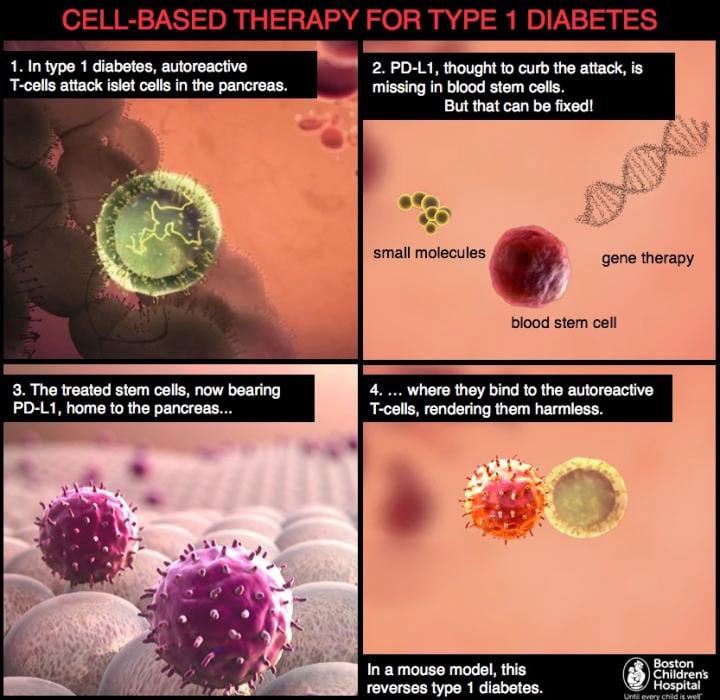
    In type 1 diabetes, autoreactive T-cells attack insulin-producing islet cells in the pancreas (frame 1). Fiorina and colleagues showed that the network of genetic regulatory factors controlling production of a protein called PD-L1 is altered in blood stem cells from diabetic mice and humans. They then showed that PD-L1 production could be stimulated by treating blood stem cells with gene therapy or with small molecules (frame 2). The treated stem cells, now bearing PD-L1, home to the pancreas (frame 3), where they bind to the autoreactive T-cells, rendering them harmless (frame 4). In a mouse model, this reverses type 1 diabetes. Credit: Andrea Panigada/Nancy Fliesler

    Researchers at Boston Children’s Hospital have successfully reversed type 1 diabetes in a mouse model by infusing blood stem cells pre-treated to produce more of a protein called PD-L1, which is deficient in mice (and people) with type 1 diabetes. The cells curbed the autoimmune reaction in cells from both mice and humans and reversed hyperglycemia in diabetic mice.

    Findings were published today in Science Translational Medicine. “There’s really a reshaping of the immune system when you inject these cells,” says Paolo Fiorina, MD, PhD, of Boston Children’s, senior investigator on the study.

    The study shows that the treated stem cells, given to mice, home to the pancreas where islet cells are made. Almost all the mice were cured of diabetes in the short term, and one third maintained normal blood sugar levels for the duration of their lives. The treatment was effective whether PD-L1 production was stimulated through gene therapy or pre-treatment with small molecules.

    The powers of PD-L1

    Previous studies have tried using immunotherapies for type 1 diabetes, aiming to curb the autoimmune attack on the body’s islet cells. These attempts have failed, in part because the therapies have not targeted diabetes specifically. Autologous bone-marrow transplant — infusing patients with their own blood stem cells to reboot their immune system — has helped some patients, but not all.

    “Blood stem cells have immune-regulatory abilities, but it appears that in mice and humans with diabetes, these abilities are impaired,” says Fiorina, in Boston Children’s Division of Nephrology. “We found that in diabetes, blood stem cells are defective, promoting inflammation and possibly leading to the onset of disease.”

    A team led by Fiorina and first author Moufida Ben Nasr, PhD, also of Boston Children’s, began by profiling the transcriptome of blood stem cells to find out what proteins the cells are making.

    Using a gene expression microarray, they found that the network of genetic regulatory factors (microRNAs) controlling production of PD-L1 is altered in blood stem cells from diabetic mice and humans. This prevents production of PD-L1, even early in the disease.

    They further showed that PD-L1 has a potent anti-inflammatory effect in the context of type 1 diabetes.

    PD-L1 is known as an immune “checkpoint” molecule. It binds to the PD-1 receptor (inhibitory programmed death 1) on the inflammatory T-cells that are activated to cause autoimmune reactions. This causes the T-cells to die or become anergic (or inactive).

    When Fiorina, Ben Nasr and colleagues introduced a healthy gene for PD-L1 into the stem cells, using a harmless virus as the carrier, the treated cells reversed diabetes in the mice. Fiorina and colleagues also found they could achieve the same effect by treating the cells with a “cocktail” of three small molecules: interferon beta, interferon gamma and polyinosinic-polycytidylic acid.

    “We think resolution of PD-L1 deficiency may provide a novel therapeutic tool for the disease,” Ben Nasr says.

    Publication: Moufida Ben Nasr, etal., “PD-L1 genetic overexpression or pharmacological restoration in hematopoietic stem and progenitor cells reverses autoimmune diabetes,” Science Translational Medicine, 2017: Vol. 9, Issue 416, eaam7543; DOI:10.1126/scitranslmed.aam7543

    Never miss a breakthrough: Join the SciTechDaily newsletter.
    Follow us on Google and Google News.

    Boston Children's Hospital Diabetes Immunobiology Medicine Popular Stem Cells
    Share. Facebook Twitter Pinterest LinkedIn Email Reddit

    Related Articles

    $1 Million Bet on a Cure: Reprogramming the Immune System To Stop Type 1 Diabetes

    Scientists Just Turned Stomach Cells Into Insulin Producers to Treat Diabetes

    Diabetes Medications Linked to Multiple Sclerosis: New Study Uncovers Surprising Connection

    Fixing Shoulder Pain: Harvard Scientists Develop a Method To Restore Damaged Tendons and Muscles

    Researchers Generate Blood-Forming Stem Cells in the Lab Using Pluripotent Stem Cells

    Stem Cell Researchers Use iPS Cells to Find Drugs For Rare Blood Disorder

    Engineered Stem Cells Suppress HIV in Living Tissues

    Transplants Without the Need for Lifelong Immunosupression

    Stem Cells Help Re-grow Healthy Heart Muscle After Heart Attack

    Leave A Reply Cancel Reply

    • Facebook
    • Twitter
    • Pinterest
    • YouTube

    Don't Miss a Discovery

    Subscribe for the Latest in Science & Tech!

    Trending News

    Scientists Warn That This Common Pet Fish Can Wreck Entire Ecosystems

    Scientists Make Breakthrough in Turning Plastic Trash Into Clean Fuel Using Sunlight

    This Popular Supplement May Interfere With Cancer Treatment, Scientists Warn

    Scientists Finally Solved One of Water’s Biggest Mysteries

    Could This New Weight-Loss Pill Disrupt the Entire Market? Here’s What You Should Know About Orforglipron

    Earth’s Crust Is Tearing Open in Africa, and It Could Form a New Ocean

    Breakthrough Bowel Cancer Trial Leaves Patients Cancer-Free for Nearly 3 Years

    Natural Compound Shows Powerful Potential Against Rheumatoid Arthritis

    Follow SciTechDaily
    • Facebook
    • Twitter
    • YouTube
    • Pinterest
    • Newsletter
    • RSS
    SciTech News
    • Biology News
    • Chemistry News
    • Earth News
    • Health News
    • Physics News
    • Science News
    • Space News
    • Technology News
    Recent Posts
    • Kratom Use Explodes in the US, With Life-Changing Consequences
    • Scientists Uncover Fatal Weakness in “Zombie Cells” Linked to Cancer
    • World-First Study Reveals Human Hearts Can Regenerate After a Heart Attack
    • Why Your Dreams Feel So Real Sometimes and So Strange Other Times
    • Scientists Debunk 100-Year-Old Belief About Brain Cells, Rewriting Textbooks
    Copyright © 1998 - 2026 SciTechDaily. All Rights Reserved.
    • Science News
    • About
    • Contact
    • Editorial Board
    • Privacy Policy
    • Terms of Use

    Type above and press Enter to search. Press Esc to cancel.