
Monumental rock art in Arabia reveals how ancient communities survived, thrived, and expressed identity in a once forbidding desert landscape.
Recent research has revealed the important role played by early human communities who settled in northern Arabia soon after the extreme dryness of the Last Glacial Maximum (LGM). Their movements were closely tied to the reappearance of seasonal water sources, and they left behind an extraordinary legacy of rock carvings.
An international team of archaeologists made the discovery through the Green Arabia Project, which is led by the Heritage Commission of the Saudi Ministry of Culture. The collaboration also includes researchers from the Max Planck Institute of Geoanthropology, KAUST (King Abdullah University of Science and Technology), University College London, Griffith University, and several other institutions.
In their investigation, the researchers documented more than 60 rock art panels featuring 176 engravings across three previously unstudied sites: Jebel Arnaan, Jebel Mleiha, and Jebel Misma, situated on the southern edge of the Nefud Desert in northern Saudi Arabia.
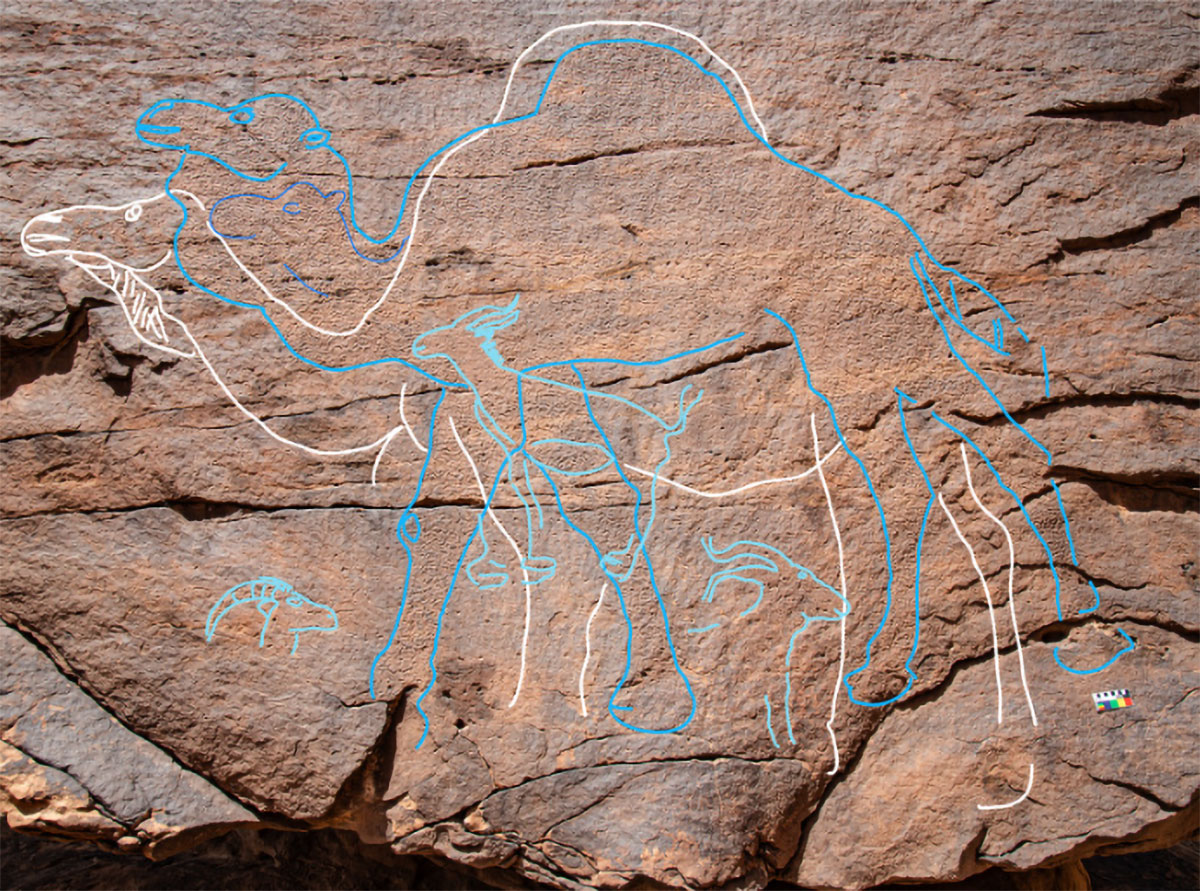
The carvings mainly depict animals such as camels, ibex, equids, gazelles, and aurochs. Among them are 130 figures created on a life-sized scale, with some images reaching up to 3 meters in length and over 2 meters in height.
A Window Into the Past Environment
The engravings date to between 12,800 and 11,400 years ago, a period when seasonal water bodies reappeared in the region following extreme aridity.
These water sources, confirmed through sediment analysis, supported early human expansions into the desert interior and offered rare opportunities for survival.
“These large engravings are not just rock art – they were probably statements of presence, access, and cultural identity,” said lead author, Dr Maria Guagnin from Max Planck Institute of Geoanthropology.
Dr Ceri Shipton, co-lead author from the Institute of Archaeology, University College London, said: “The rock art marks water sources and movement routes, possibly signifying territorial rights and intergenerational memory.”
Unlike previously known sites where engravings were hidden in crevices, the Jebel Mleiha and the Jebel Arnaan panels were etched onto towering cliff faces, some up to 39 meters high, in visually commanding locations.
One panel would have required ancient artists to climb and work precariously on narrow ledges, underscoring the sheer effort and significance of the imagery.
Cultural Connections and Unique Identity
Artifacts, including Levantine-style El Khiam and Helwan stone points, green pigment, and dentalium beads, suggest long-distance connections to Pre-Pottery Neolithic (PPN) populations in the Levant region.
However, the scale, content, and placement of the Arabian engravings set them apart.
“This unique form of symbolic expression belongs to a distinct cultural identity adapted to life in a challenging, arid environment,” said Dr Faisal Al-Jibreen, from the Heritage Commmission, Saudi Ministry of Culture.
“The project’s interdisciplinary approach has begun to fill a critical gap in the archaeological record of northern Arabia between the LGM and the Holocene, shedding light on the resilience and innovation of early desert communities,” said Michael Petraglia, lead of the Green Arabia project.
Reference: “Monumental rock art illustrates that humans thrived in the Arabian Desert during the Pleistocene-Holocene transition” by Maria Guagnin, Ceri Shipton, Faisal Al-Jibreen, Giacomo Losi, Amir Kalifi, Simon J. Armitage, Finn Stileman, Mathew Stewart, Fahad Al-Tamimi, Paul S. Breeze, Frans van Buchem, Nick Drake, Mohammed Al-Shamry, Ahmed Al-Shammari, Jaber Al-Wadani, Abdullah M. Alsharekh and Michael Petraglia, 30 September 2025, Nature Communications.
DOI: 10.1038/s41467-025-63417-y
Never miss a breakthrough: Join the SciTechDaily newsletter.
Follow us on Google and Google News.
1 Comment
So people were around in the Middle East before Moses got there, let alone Adam and Eve…….mmmmmm!