
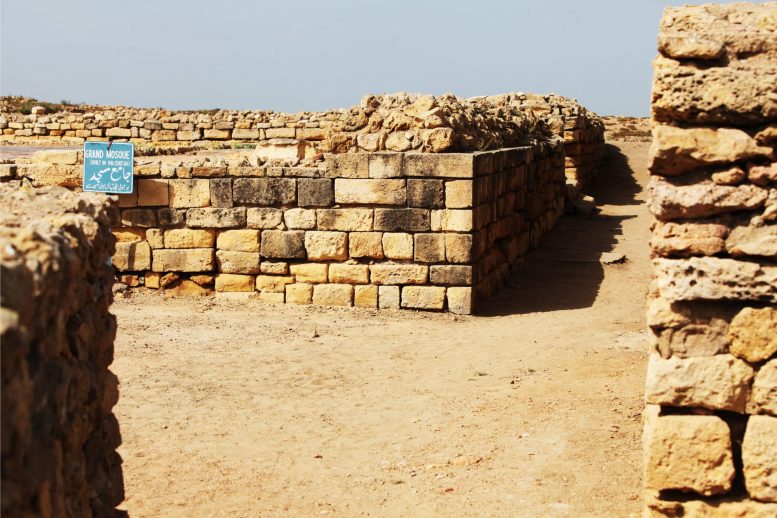
Cambridge scientists linked megadroughts to the Indus Civilization’s decline, uncovering seasonal rainfall disruptions and adaptive responses.
According to recent findings by Cambridge University researchers, an ancient stalagmite from a Himalayan cave contains evidence of multiple prolonged and severe droughts that may have led to the collapse of the Indus Civilization during the Bronze Age.
The onset of the dry spell, which began roughly 4,200 years ago and persisted for over 200 years, coincided with the reorganization of the Indus Civilization, a sprawling urban civilization that encompassed parts of present-day Pakistan and India.
The research identified three protracted droughts — each lasting between 25 and 90 years — during this arid period. “We find clear evidence that this interval was not a short-term crisis but a progressive transformation of the environmental conditions in which Indus people lived,” said study co-author Prof Cameron Petrie, from Cambridge’s Department of Archaeology.
The researchers charted historic rainfall by examining growth layers in a stalagmite collected from a cave near Pithoragarh, India. By measuring a range of environmental tracers — including oxygen, carbon, and calcium isotopes — they obtained a reconstruction showing relative rainfall at seasonal resolution. They also used high-precision Uranium-series dating to get a handle on the age and duration of the droughts.

“Multiple lines of evidence allow us to piece together the nature of these droughts from different angles — and confirm they are in agreement,” said lead author of the research Alena Giesche, who conducted the research as part of her Ph.D. in Cambridge’s Department of Earth Sciences.
Droughts’ Dual Impact on Agriculture
Giesche and the team identified distinct periods of below-average rainfall in both the summer and winter seasons. “The evidence for drought affecting both cropping seasons is extremely significant for understanding the impact of this period of climate change upon human populations,” said Petrie. He adds that the droughts during this period increased in duration, to the point where the third would have been multi-generational in length.
The findings support existing evidence that the decline of the Indus megacities was linked to climate change. “But what’s been a mystery until now is information on the drought duration and the season they happened in,” said Giesche. “That extra detail is really important when we consider cultural memory and how people make adaptations when faced with environmental change.”
According to Petrie: “The archaeological evidence indicates that over a 200-year period, the ancient inhabitants took various steps to adapt and remain sustainable in the face of this new normal.” During this transformation, larger urban sites were depopulated in favor of smaller rural settlements towards the eastern extent of the area occupied by Indus populations. At the same time, agriculture shifted towards reliance on summer crops, especially drought-tolerant millets, and the population transitioned to a lifestyle that appears to have been more self-reliant.
Bridging Archaeology and Palaeoclimatology
Megadroughts have recently become a popular cause to explain a number of cultural transformations, including the Indus Valley, explains David Hodell, study co-author from Cambridge’s Department of Earth Sciences: “But the links are generally fuzzy because of difficulties involved in comparing climatic and archaeological records.” This is now changing because, “Palaeoclimate records are becoming progressively better at refining changes in rainfall on a seasonal and annual basis, which directly affects people’s decision-making,” said Hodell.
The team is now looking to expand their climate reconstructions to western parts of the Indus River Region, where the winter rainfall system becomes more dominant than the Indian Summer Monsoon, “What we really need are more records like this, from a west-east oriented transect across the region where the summer and winter monsoons interact — and, crucially, capturing the beginning of this arid period,” said Giesche.
“Currently, we have a huge blind spot on our maps extending across Afghanistan and Pakistan where the Indian summer monsoon and the Westerlies interact,” said Prof Sebastian Breitenbach, co-author and palaeoclimatologist at Northumbria University. “Sadly, the political situation is unlikely to allow for this kind of research in the near future.”
“There’s more work to be done by both palaeoclimatologists and archaeologists,” said Hodell. “We are fortunate in Cambridge to have the two departments next door to one another.”
Reference: “Recurring summer and winter droughts from 4.2-3.97 thousand years ago in north India” by Alena Giesche, David A. Hodell, Cameron A. Petrie, Gerald H. Haug, Jess F. Adkins, Birgit Plessen, Norbert Marwan, Harold J. Bradbury, Adam Hartland, Amanda D. French and Sebastian F. M. Breitenbach, 4 April 2023, Communications Earth & Environment.
DOI: 10.1038/s43247-023-00763-z
Tracking down how interacting rain zones influenced the Indus Civilisation has been one of the questions at the center of the TwoRains Project, a collaboration between Cambridge and Banaras Hindu University, which was funded by the European Research Council (ERC).
Never miss a breakthrough: Join the SciTechDaily newsletter.
Follow us on Google and Google News.