

Close Menu
    Facebook X (Twitter) Instagram
    SciTechDaily
    • Biology
    • Chemistry
    • Earth
    • Health
    • Physics
    • Science
    • Space
    • Technology
    Facebook X (Twitter) Pinterest YouTube RSS
    SciTechDaily
    Home»Health»Depression May Be an Early Warning Sign of Parkinson’s and Dementia
    Health

    Depression May Be an Early Warning Sign of Parkinson’s and Dementia

    By Shanghai Jiao Tong University Journal CenterJanuary 16, 2026No Comments4 Mins Read
    Facebook Twitter Pinterest Telegram LinkedIn WhatsApp Email Reddit
    Share
    Facebook Twitter LinkedIn Pinterest Telegram Email Reddit
    Very Depressed Man Close Up
    Mood changes in older adults are often attributed to life circumstances or declining health, but new population-level evidence suggests they may sometimes reflect earlier shifts within the brain itself. By tracking health patterns over many years, researchers identified a distinct timeline in which depressive symptoms appear well before certain neurological disorders become clinically visible. Credit: Shutterstock

    Depression that appears later in life is often viewed as a response to declining health, but emerging evidence suggests it may sometimes signal deeper neurological changes.

    Recent findings indicate that depression emerging later in life may reflect more than an emotional reaction to physical illness. Instead, it may signal the early stages of serious neurological conditions. A large nationwide study published in General Psychiatry offers the strongest long-term evidence so far, showing that depressive symptoms often appear years before a diagnosis of PD or LBD and can stay elevated well into the course of these diseases.

    To explore this link, researchers analyzed extensive Danish national health records. They carried out a retrospective case–control study involving 17,711 people who were diagnosed with PD or LBD between 2007 and 2019. These individuals were matched by age and sex with people who had other long-term medical conditions, including rheumatoid arthritis, chronic kidney disease, and osteoporosis.

    Depression Before and After Diagnosis

    The analysis revealed a consistent trend. Depression was more common and appeared earlier in individuals who later developed Parkinson’s disease or Lewy body dementia compared with those diagnosed with other chronic illnesses.

    As diagnosis approached, the likelihood of depression increased gradually and was highest during the three years immediately beforehand. Elevated rates of depression also persisted after diagnosis, remaining higher in patients with Parkinson’s disease or Lewy body dementia than in the comparison groups.
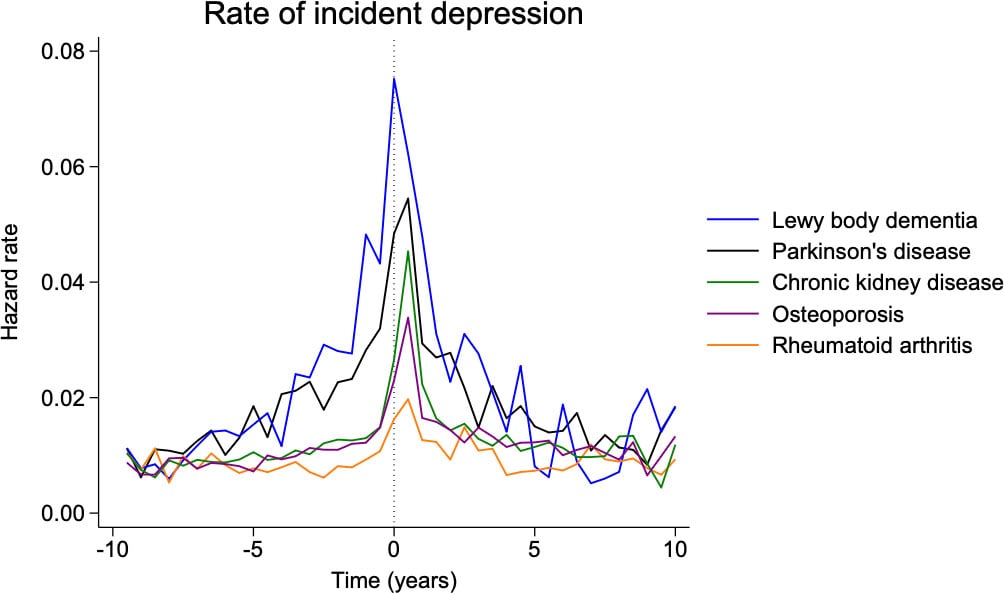
    Depression Risk Before and After Diagnosis of Major Chronic Diseases
    Hazard rate of incident depression preceding and following diagnosis of Parkinson’s disease, Lewy body dementia, rheumatoid arthritis, chronic kidney disease and osteoporosis. ‘0’ represents the date of diagnosis of Parkinson’s disease, Lewy body dementia, rheumatoid arthritis, chronic kidney disease and osteoporosis. Credit: Christopher Rohde, Martin Langeskov-Christensen, Lene Bastrup Jørgensen, Per Borghammer, Søren Dinesen Østergaard

    Notably, the observed rise in depression could not be attributed solely to the emotional challenges of managing a long-term medical condition. Other chronic illnesses that can cause significant physical limitations did not show a similar increase in depression rates. This pattern points to a possible connection between depression and early neurodegenerative processes in the brain, rather than depression being only a response to worsening physical health.

    Differences Between Parkinson’s Disease and Lewy Body Dementia

    The association was particularly pronounced in Lewy body dementia. Individuals with this condition experienced higher levels of depression than those with Parkinson’s disease, both before their diagnosis and in the years that followed. According to the researchers, variations in how these diseases progress and affect brain chemistry may help account for the difference.

    “Following a diagnosis of PD or LBD, the persistent higher incidence of depression highlights the need for heightened clinical awareness and systematic screening for depressive symptoms in these patients.” first author Christopher Rohde noted “Thus, our main conclusion—that PD/LBD are associated with a marked excess depression risk preceding and following diagnosis when compared with other chronic conditions—remains valid.”

    The authors emphasize that this does not mean everyone with depression will develop Parkinson’s disease or dementia. Instead, they recommend greater awareness and closer monitoring when depression appears for the first time in older adults.

    While there is currently no cure for Parkinson’s disease or Lewy body dementia, addressing depression early could improve quality of life and overall care for patients as these diseases develop.

    Reference: “Depression preceding and following the diagnosis of Parkinson’s disease and Lewy body dementia” by Christopher Rohde, Martin Langeskov-Christensen, Lene Bastrup Jørgensen, Per Borghammer and Søren Dinesen Østergaard, 3 December 2025, General Psychiatry.
    DOI: 10.1136/gpsych-2025-102405

    Never miss a breakthrough: Join the SciTechDaily newsletter.
    Follow us on Google and Google News.

    Aging Brain Depression Mental Health Parkinson's Disease Psychiatry
    Share. Facebook Twitter Pinterest LinkedIn Email Reddit

    Related Articles

    Could an “Exercise Pill” Fight Depression? Scientists Want To Find Out

    Patients Once “Paralyzed by Life” Show Lasting Recovery With Implanted Nerve Therapy

    How Brain Signals Could Revolutionize Personalized Depression Treatment

    Scientists Have Revealed a Unique Neural Signature for Depression

    Avoiding Neurodegeneration: Scientists Discover That Managing Emotions Better Could Prevent Pathological Aging

    Brain Mapping Method Illuminates Targets for Treating Depression and Parkinson’s Disease

    Simple Blood Test Can Accurately Reveal Underlying Neurodegeneration (Dementia, ALS)

    Antidepressant Power of Lactate Revealed in New Research

    Study Links Brain Cells to Depression – Brings Hope for Targeted Treatment Options

    Leave A Reply Cancel Reply

    • Facebook
    • Twitter
    • Pinterest
    • YouTube

    Don't Miss a Discovery

    Subscribe for the Latest in Science & Tech!

    Trending News

    Scientists Warn That This Common Pet Fish Can Wreck Entire Ecosystems

    Scientists Make Breakthrough in Turning Plastic Trash Into Clean Fuel Using Sunlight

    This Popular Supplement May Interfere With Cancer Treatment, Scientists Warn

    Scientists Finally Solved One of Water’s Biggest Mysteries

    Could This New Weight-Loss Pill Disrupt the Entire Market? Here’s What You Should Know About Orforglipron

    Earth’s Crust Is Tearing Open in Africa, and It Could Form a New Ocean

    Breakthrough Bowel Cancer Trial Leaves Patients Cancer-Free for Nearly 3 Years

    Natural Compound Shows Powerful Potential Against Rheumatoid Arthritis

    Follow SciTechDaily
    • Facebook
    • Twitter
    • YouTube
    • Pinterest
    • Newsletter
    • RSS
    SciTech News
    • Biology News
    • Chemistry News
    • Earth News
    • Health News
    • Physics News
    • Science News
    • Space News
    • Technology News
    Recent Posts
    • Kratom Use Explodes in the US, With Life-Changing Consequences
    • Scientists Uncover Fatal Weakness in “Zombie Cells” Linked to Cancer
    • World-First Study Reveals Human Hearts Can Regenerate After a Heart Attack
    • Why Your Dreams Feel So Real Sometimes and So Strange Other Times
    • Scientists Debunk 100-Year-Old Belief About Brain Cells, Rewriting Textbooks
    Copyright © 1998 - 2026 SciTechDaily. All Rights Reserved.
    • Science News
    • About
    • Contact
    • Editorial Board
    • Privacy Policy
    • Terms of Use

    Type above and press Enter to search. Press Esc to cancel.