
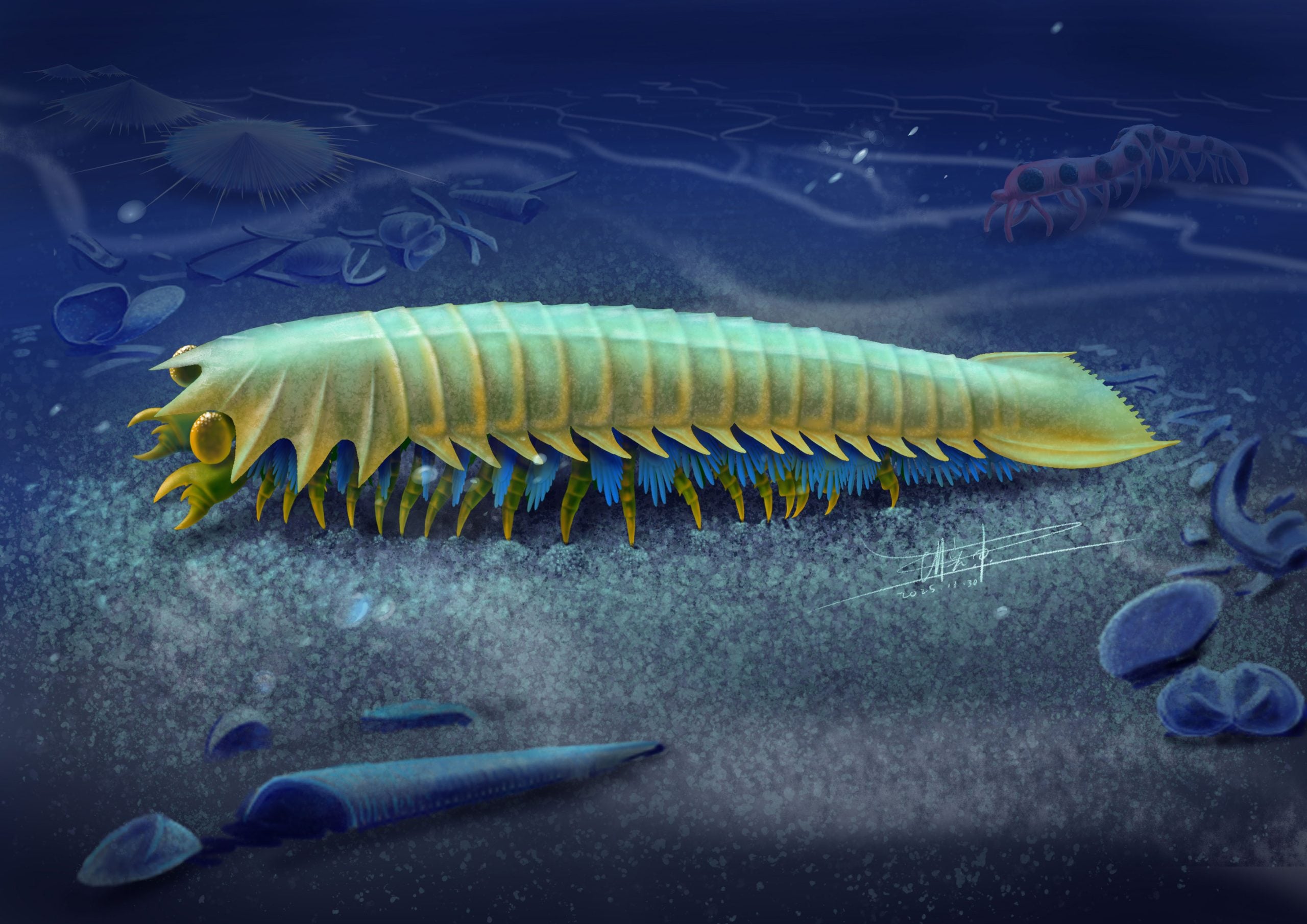
Scientists from the University of Leicester and Yunnan University identified an ancient member of the chelicerate group.
Beneath the rock surrounding a tiny fossil from southern China, two small limbs had remained hidden for 518 million years. When researchers finally looked inside, those appendages offered a rare glimpse of the evolutionary path that eventually produced the pincers of scorpions and the fangs of spiders.
The fossil belongs to Urokodia, an ancient marine animal examined by scientists from Yunnan University and the University of Leicester. Its anatomy contains the earliest known evidence of the structures that developed into spider fangs, according to research published in Nature.
Fangs have become central to the popular image of spiders, from the Black Widow to the radioactive spider responsible for Spider-Man’s powers. In living spiders, however, these structures are practical hunting tools used to grip prey and often inject venom.
Spiders belong to a much larger group of invertebrates called chelicerates, which also includes scorpions, ticks and horseshoe crabs. More than 100,000 chelicerate species have been described. They possess jointed limbs and external skeletons, but their defining feature is a pair of specialized front appendages called chelicerae. Depending on the animal, chelicerae function as pincers or as fangs that stab and hold prey.
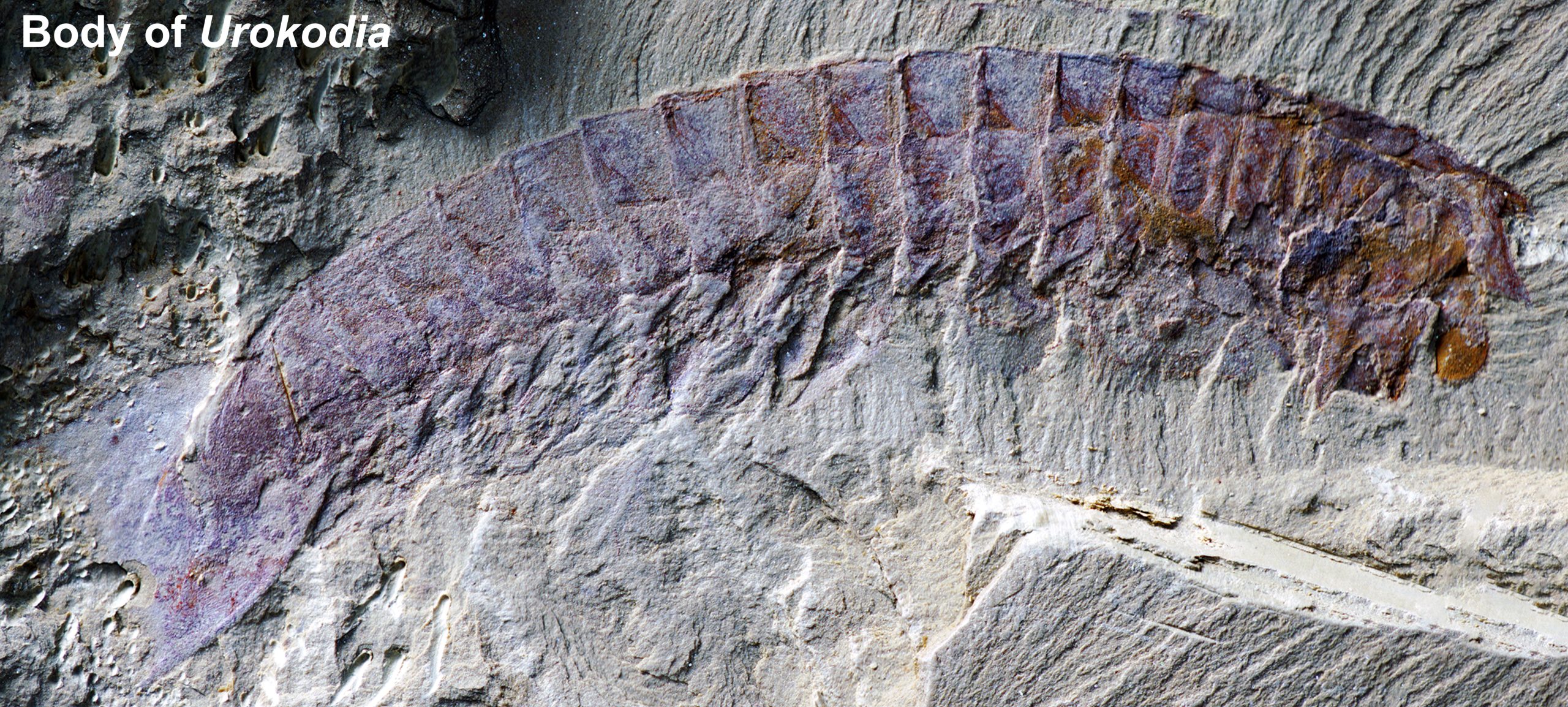
Urokodia bridges ancient and modern forms
The Urokodia fossils came from the Chengjiang fossil site in Yunnan Province, China. The research appeared on the 42-year anniversary of the site’s discovery, which revealed an exceptionally preserved marine community from an early period in animal evolution.
At only about 2 to 3 cm long, Urokodia looked very different from a modern spider or scorpion. It had a narrow, segmented body, jointed limbs arranged along its underside, and large eyes mounted on stalks at the front.
Those unfamiliar features made its evolutionary identity difficult to recognize from its outward appearance alone. To determine where it belonged on the animal family tree, the researchers needed to examine anatomy that remained concealed within the surrounding stone.
X-rays reveal hidden anatomy
The scientists used X-ray tomography to investigate the fossils without cutting them open. The technique works much like a medical scan, collecting images from multiple angles so researchers can reconstruct structures buried inside solid material.
The scans revealed that much of the animal’s soft anatomy had survived in a mummified state for hundreds of millions of years. Soft tissues normally decay rapidly, so their preservation gave the researchers evidence that would have been invisible from the fossil’s exposed surface.
Most importantly, the images uncovered two pincer-like limbs immediately behind the animal’s eyes. Their position and structure identified them as early chelicerae, linking Urokodia to the group that later produced spiders, scorpions and ticks.
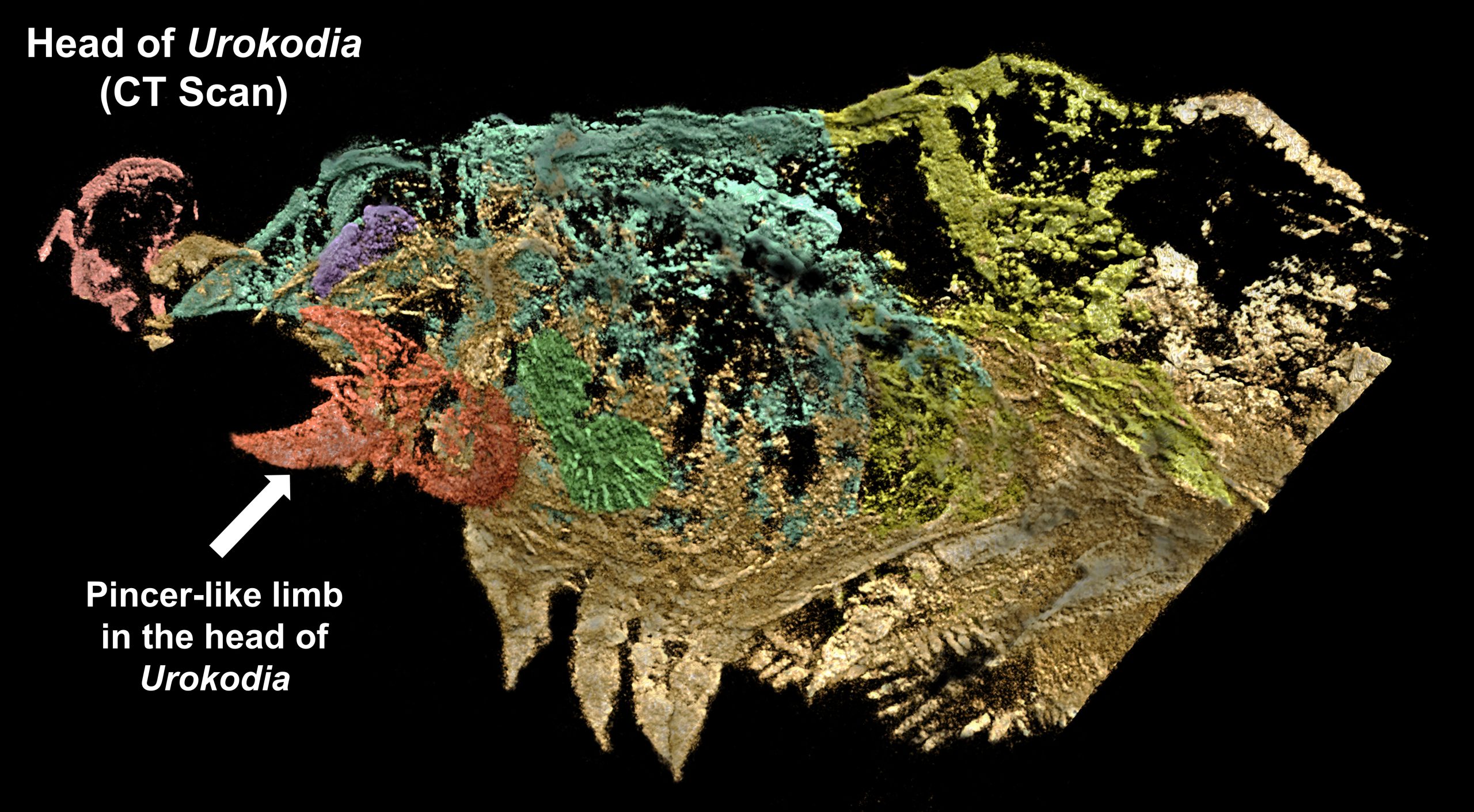
The scans also revealed features on the animal’s legs that may have functioned as book gills. These layered breathing organs resemble the pages of a book and allow aquatic animals to absorb oxygen from water. Similar structures are still found in horseshoe crabs, suggesting that Urokodia breathed in a comparable way.
Early pincers reshaped predation
Chelicerates eventually became one of the most successful animal groups in both marine and terrestrial environments. Their specialized front limbs provided a versatile way to seize, pierce, and process food, helping later members of the group develop into effective predators.
The discovery suggests that the basic equipment behind spider fangs emerged in the ocean more than half a billion years ago. Over immense spans of evolutionary time, the small pincers seen in Urokodia were modified into the varied feeding structures used by modern chelicerates.
Although films such as Arachnophobia portray spiders as major dangers to people, most species pose little threat. Their fangs and venom evolved primarily to subdue animals far smaller than humans.
The study was led by Professor Yu Liu of Yunnan University, who is also a Visiting Professor at the University of Leicester.
Professor Liu said: “We were using X-ray tomography analysis of these fossils to reveal their soft anatomy buried in the rocks for hundreds of millions of years, when suddenly we noticed the pincer-like limbs at the front of the animal. We knew immediately that this was a very exciting fossil and indeed a distant ancestor of living chelicerates like scorpions and spiders.”
Co-author Professor Mark Williams from the University of Leicester School of Geography, Geology and the Environment said: “Urokodia was part of an ancient ecosystem of over 200 different types of animals living in the seas over 500 million years ago. These spectacularly preserved fossils provide real insights into how life was evolving on our planet at the very dawn of animals.”
Reference: “Urokodia sheds light on the origin of chelicerae and book gills of Chelicerata” by Yu Liu, Lorenzo Lustri, Huijuan Mai, Mark Williams, Liming Liu, Yani Tang, Thomas H. P. Harvey and Xianguang Hou, 1 July 2026, Nature.
DOI: 10.1038/s41586-026-10713-2
This study was supported by a grant from the Department of Science and Technology of Yunnan Province (202401BC070012) to Professor Yu Liu, who is further funded by the Yunnan Revitalization Talent Support Program.
Never miss a breakthrough: Join the SciTechDaily newsletter.
Follow us on Google and Google News.
1 Comment
This is fascinating!