

New modeling suggests that tens of thousands of languages were spoken between 1,000 and 3,000 years ago, and that their decline began long before European colonial expansion.
Around 7,500 languages are spoken or signed today, but that number captures only one moment in a much longer and less visible history. Before written records, was humanity even more linguistically diverse? Did the spread of farming erase languages as expanding agricultural societies displaced smaller hunter-gatherer communities, or did growing populations first create conditions for more languages to develop?
Researchers from Spain, the United States and Germany reconstructed possible changes in worldwide language diversity across the past 12,000 years. Their study, published in Science, indicates that the number of languages rose through most of the Holocene, peaked roughly 1,000 to 3,000 years ago, and then fell quickly.
“This paper presents an innovative approach to understanding the dynamics of human cultural diversity in the past, addressing one of the central yet least accessible questions in the human sciences. Progress has been limited not by a lack of theoretical interest but by the exceptional difficulty of observing the relevant dynamics empirically,” says Marcus Hamilton of the University of Texas at San Antonio.
Models reconstruct a missing record
Almost no direct evidence survives showing how many languages existed before writing emerged about 6,000 years ago, and the historical record remains incomplete until comparatively recent periods. To bridge that gap, the researchers brought together ethnographic evidence, prehistoric population estimates, and statistical and social computational modeling.
Their starting point was information from 171 hunter-gatherer and fishing societies whose traditional movement and subsistence patterns had not been deeply altered through contact with food-producing communities. The records helped the researchers estimate how large ethnolinguistic groups may have been near the start of the Holocene.
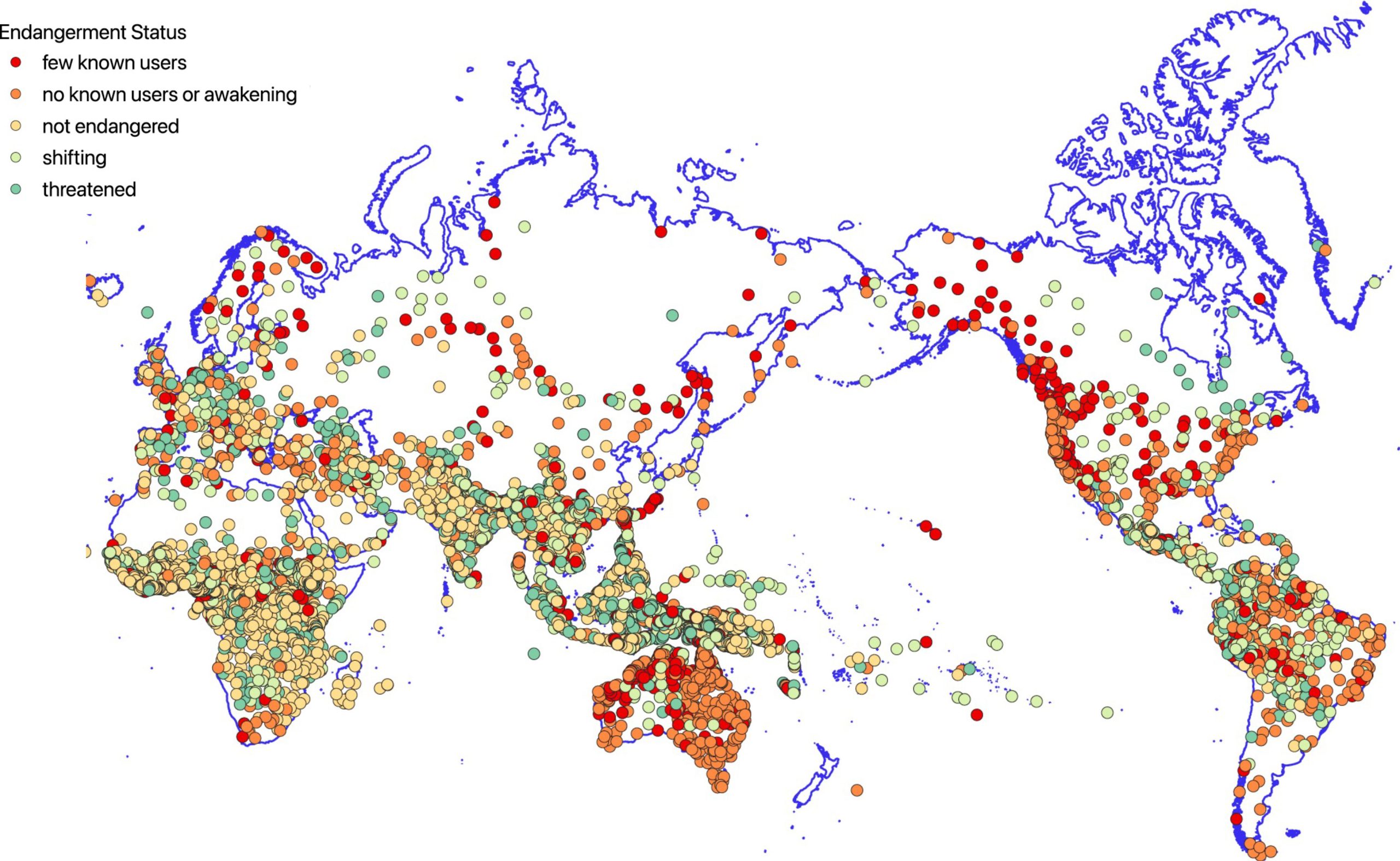
They paired those estimates with reconstructions placing the global population 12,000 years ago at approximately 4.4 million to seven million people. If most ethnolinguistic groups represented separate languages, the models suggest that roughly 4,500 to 6,200 languages existed during the early Holocene. A wider range of plausible estimates extended from about 3,300 to 7,800.
“One of the first surprises was that the world immediately before agriculture was probably not exceptionally rich in languages. There were most likely fewer languages than there are today. Linguistic diversity then grew alongside the human population for thousands of years,” says Russell Gray, Director of the Department of Linguistic and Cultural Evolution at the Max Planck Institute for Evolutionary Anthropology in Leipzig.
Language diversity peaked surprisingly late
Agriculture, new technologies and more reliable food supplies supported enormous population growth. At the same time, human communities expanded in size, allowing larger numbers of people to communicate through the same language.
The researchers accounted for these competing trends by generating thousands of possible pathways between early Holocene estimates and the present. Their models allowed the average population represented by each language to rise over time while incorporating separate reconstructions of global population change.
The exact historical path cannot be known, but the simulations repeatedly produced the same broad result. The number of languages grew through most of the Holocene and usually reached its high point between about 1,000 and 3,000 years ago. Many model trajectories suggest an increase of roughly ten times compared with early Holocene levels, meaning tens of thousands of languages may have existed at the peak.
“The most unexpected result is how recent the peak appears to have been. The period of greatest linguistic diversity may have occurred not in the remote Paleolithic, but during the era of expanding states and early empires,” says Claire Bowern of Yale University.
The researchers refer to this interval as a linguistic “golden age.” It has received little attention partly because the historical documents that survived were largely created by expanding societies whose languages later became dominant.
Language loss predates European colonialism
After this linguistic high point, diversity appears to have fallen rapidly, particularly over the past two thousand years. That pattern challenges the idea that the current crisis of language endangerment began solely with European colonial expansion about 500 years ago.
European colonialism unquestionably accelerated language replacement across vast regions. The models indicate, however, that the decline began earlier as multinational states and empires expanded. These societies brought formerly separated populations into sustained contact while spreading politically dominant languages alongside institutions, technologies, cultural traditions and pathogens.
The analysis cannot determine which individual empires, geographic regions or historical episodes drove the worldwide decline. It instead indicates that a substantial loss of language diversity must have occurred before the modern era.
Survivors distort today’s linguistic picture
As a result, the languages still spoken today may not reflect the full diversity that once existed. Languages used by expanding populations had a greater chance of surviving, while those belonging to populations that were absorbed, displaced or reduced were more likely to disappear.
This selective bottleneck may also have changed how often particular grammatical patterns, sounds and other linguistic traits appear worldwide. Common features are often interpreted as especially easy to learn, efficient for communication or compatible with human cognition. The findings suggest that population expansion and language extinction may also have shaped which features became widespread.
“The languages we see today are the survivors of a massive and highly selective historical bottleneck. A linguistic feature may be common not because it is inherently superior, but because it happened to be carried by populations that expanded. Extinction may have shaped linguistic diversity much more profoundly than we previously appreciated,” says Damian Blasi, lead author of the study and researcher at the Catalan Institution for Research and Advanced Studies (ICREA) and Harvard University.
Languages are often passed between generations together with religious beliefs, kinship practices, social institutions and other forms of cultural knowledge. The researchers therefore argue that the same bottleneck may have erased many cultural traditions without leaving direct historical traces.
The authors emphasize that their study offers a broad global reconstruction, not a direct inventory of prehistoric languages. The results rely on assumptions about the sizes of early ethnolinguistic groups and the long-term relationship between language numbers and human population. Regional patterns almost certainly varied, and the model cannot recreate individual short-term collapses caused by war, disease, or environmental disruption.
Even so, the main pattern remained stable across many modeling choices and alternative assumptions. Rather than declining steadily from an exceptionally diverse Paleolithic past, language diversity appears to have risen alongside population growth, reached a brief and unusually high peak, and then contracted severely on a global scale.
Reference: “The rise and fall of language diversity through the Holocene” by D. E. Blasi, M. J. Hamilton, R. D. Gray and C. L. Bowern, 23 July 2026, Science.
DOI: 10.1126/science.adx4343
Funding: Branco Weiss Foundation, Harvard University Data Science Initiative, Max-Planck-Gesellschaft, National Science Foundation
Never miss a breakthrough: Join the SciTechDaily newsletter.
Follow us on Google and Google News.