

Certain gut bacteria were linked to slower or faster biological aging.
The communities of bacteria living in the gut may carry clues about how rapidly the body is aging. Researchers at the University of Hawaiʻi at Mānoa found that certain microbial patterns were associated with faster or slower biological aging, adding to evidence that gut health is connected to longevity.
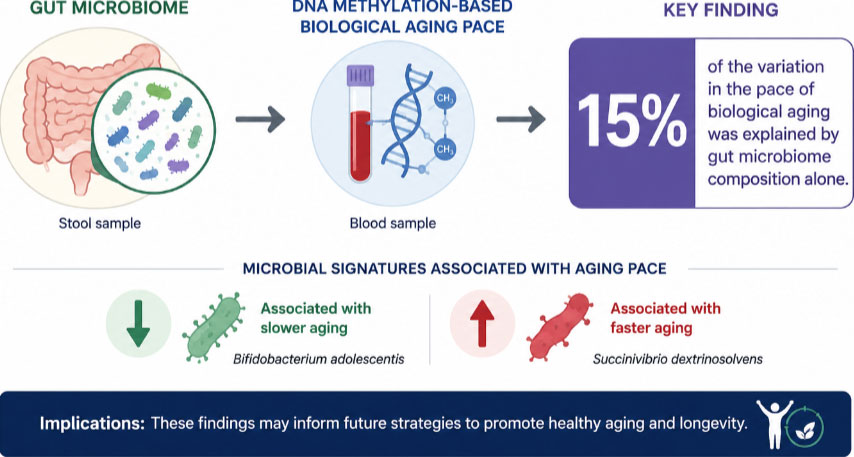
Published in Scientific Reports, the study found that variation in gut bacteria accounted for about 15% of the differences in participants’ biological aging rates. The results indicate that the gut microbiome contains measurable information about aging processes occurring at the molecular level.
“This study advances our understanding of the relationship between the gut microbiome and biological aging,” said senior author Alika K. Maunakea of the UH Mānoa John A. Burns School of Medicine. “We found that microbial patterns in the gut were significantly associated with molecular measures of aging, even independent of chronological age. These findings open important new directions for understanding how modifiable biological systems influence long-term health trajectories and longevity.”
Blood and stool reveal aging patterns
Researchers examined stool and blood samples from 123 adults spanning a wide range of ages. They compared the bacteria present in each participant’s gut with blood-based biomarkers designed to estimate the body’s rate of aging. Chronological age simply counts the years a person has lived, while biological aging measures are intended to reflect how quickly the body is changing physiologically.
Gut microbial composition was specifically associated with DunedinPACE, a next-generation biomarker that measures the pace of biological aging. Several bacterial species showed especially strong relationships with aging patterns. Bifidobacterium adolescentis was among the clearest microbial signatures associated with slower aging, while Succinivibrio dextrinosolvens had one of the strongest associations with faster aging.
Gut microbes may reflect resilience
Lead author Braden P. Kunihiro said the results demonstrate why the gut microbiome is attracting greater attention in precision health research.
“The gut microbiome is highly responsive to lifestyle, diet, environment and other everyday exposures,” Kunihiro said. “Our findings suggest that the microbiome may reflect important aspects of biological resilience and aging in ways that could eventually help inform future wellness and healthy aging strategies.”
Native Hawaiian and Pacific Islander participants were also included in the research, helping represent populations that have historically been overlooked in studies of aging and the microbiome. Co-author Ruben Juarez said the findings could help clarify how social conditions and environmental exposures leave lasting biological effects.
“The microbiome exists at the intersection of behavior, environment and human biology,” Juarez said. “Studies like this help illuminate potential pathways through which lived experiences and social factors influence long-term health outcomes.”
The association does not prove cause
The researchers cautioned that the observed relationship does not demonstrate that gut bacteria directly control the pace of aging. Additional studies will be needed to determine whether deliberately changing the microbiome can influence how quickly the body ages.
“This is an important early step toward understanding the gut microbiome’s relationship with healthy aging,” Maunakea said. “Future research will help clarify the mechanisms involved and whether these microbial signatures may eventually contribute to precision approaches for promoting long-term health and wellness.”
Reference: “Gut microbiome signatures associate with DNA methylation-based biological aging” by Braden P. Kunihiro, Brennan Y. Yamamoto, Ruben Juarez and Alika K. Maunakea, 14 July 2026, Scientific Reports.
DOI: 10.1038/s41598-026-52974-x
This study was supported in part by the National Institute on Minority Health and Health Disparities (NIMHD) under grant numbers R01MD016593 and R56MD014630, and by the University of Hawaii Epigenomics Core of the Consortium of Research Advancement Facilities and Training, partly supported by the National Institute of General Medical Sciences (NIGMS) of the National Institutes of Health (NIH) under grant number P20GM139753.
Never miss a breakthrough: Join the SciTechDaily newsletter.
Follow us on Google and Google News.
1 Comment
“At the intersection of” is an expression that really needs to go.