
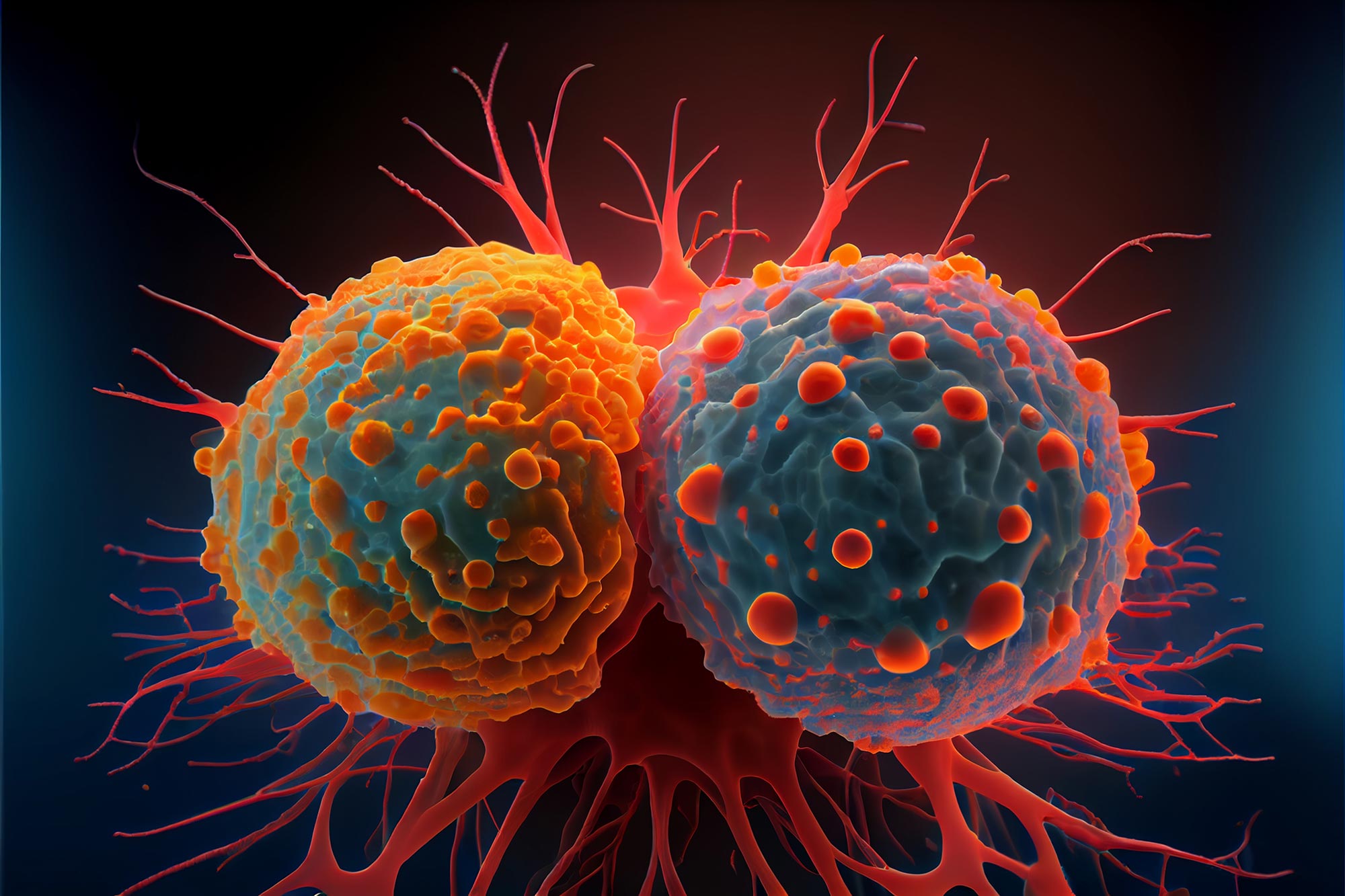
Chemotherapy may kill most ovarian cancer cells, but the few that survive can turn dangerously active. By releasing fructose, they may help nearby tumor cells break free and spread.
Researchers at The Wistar Institute uncovered this unexpected chain reaction while studying treatment-induced cellular senescence, a state in which damaged cancer cells stop dividing but remain metabolically active. The findings, published in Nature Aging, reveal that fructose can function not only as a source of energy but also as a message passed between tumor cells.
“Some cancer cells that survive chemotherapy aren’t dividing anymore, but they’re still biologically active,” said Aidan Cole, Ph.D., a postdoctoral fellow in the lab of Katherine Aird, Ph.D., at The Wistar Institute and first author on the study. “Instead, they continue to release molecules that send signals to nearby cells. Our study is among the first to show that a nutrient—in this case, fructose—can act as one of those signals.”
This lingering activity may help explain a major challenge in ovarian cancer treatment. Platinum-based chemotherapy can initially shrink tumors, but the disease returns in most patients. Ovarian cancer also tends to undergo metastasis, the process in which cancer cells break away from the original tumor and form new growths elsewhere. Metastasis accounts for roughly 90% of ovarian cancer deaths.
Fructose Emerges as the Hidden Messenger
To determine whether chemotherapy survivors were influencing other cells, the researchers collected the substances those cells released. They then exposed cancer cells to that material without transferring the surviving cells themselves. The released substances were enough to increase the cancer cells’ ability to detach and spread in preclinical models.
“As far as we know, this is the first time anyone has shown, in a preclinical model rather than just a dish, that it’s the molecules these cells release—not the cells themselves—that drive the cancer’s spread,” said Cole.
The team then worked backward to identify the signal responsible. Their experiments pointed to fructose, which the treatment-surviving cells produced and released into their surroundings. Nearby cancer cells responded by becoming less tightly attached to one another, an important early step in metastasis.
Could Sugary Diets Influence Tumor Behavior?
Fructose is naturally present in fruit, but it is also widely used in sweetened drinks and processed foods, often as part of high fructose corn syrup. The researchers found that chemotherapy was not necessary for fructose to produce the effect. In their preclinical experiments, consuming amounts comparable to the high levels found in sugary drinks also encouraged cancer cells to spread.
The findings raise an important question: whether unusually high fructose consumption can influence an existing tumor’s behavior.
The question could be especially relevant in the United States, where high fructose corn syrup may supply about 8% to 20% of total daily calories for some people. Unlike genetic changes or many other factors that shape cancer progression, dietary exposure can potentially be adjusted. Clinical research will be needed before doctors can determine whether such changes should become part of ovarian cancer care.
Cholesterol Loss Helps Cancer Cells Escape
The researchers also investigated what fructose was doing inside nearby tumor cells. Using several large-scale analytical methods, including a CRISPR screen, they found that the sugar suppressed cholesterol production.
Although cholesterol is usually discussed in relation to cardiovascular disease, cells also use it as a structural component of their membranes. In the ovarian cancer models, lower cholesterol weakened the connections holding tumor cells together. Once those bonds loosened, the cells could detach more easily and move away from the original tumor.
That discovery led the team to examine statins, a widely prescribed class of drugs that reduces cholesterol production. About 39 million people in the United States take these medications. In the study’s experimental models, statins alone weakened the adhesion between cancer cells and promoted their escape.
“We haven’t tested this effect in patients yet, but it raises questions about combining cholesterol-lowering drugs with chemotherapy, especially since ovarian cancer is most common in postmenopausal women who are often already on statins,” said Katherine Aird, Ph.D., professor and co-leader of the Molecular and Cellular Oncogenesis Program in the Ellen and Ronald Caplan Cancer Center at The Wistar Institute, and senior author of the study.
A Mechanism That May Extend Beyond Ovarian Cancer
Cells that no longer divide were once considered largely harmless, but researchers increasingly recognize that they can remain active and release a mixture of proteins, nutrients, and other molecules known collectively as a senescence-associated secretome. Those signals can reshape nearby tissue long after treatment ends.
Aird and her colleagues are now investigating whether fructose-driven detachment also occurs in other tumors that commonly spread through the torso.
“We think other cancers that spread within the torso — pancreatic, colon, liver — could behave similarly. We can’t call it universal yet, but we think the effects are not just limited to ovarian cancer,” said Aird.
Reference: “The chemotherapy-induced senescence-associated secretome promotes cell detachment and metastatic dissemination through metabolic reprogramming” by Aidan R. Cole, Raquel Buj, Apoorva Uboveja, Evan Levasseur, Alexander Tom, Hui Wang, Katarzyna M. Kedziora, Adam Chatoff, Andrea Andress Huacachino, Mariola M. Marcinkiewicz, Amandine Amalric, Baixue Yang, Naveen Kumar Tangudu, Emily Noonan, Jeff Danielson, Miho Naruse, Amal Taher Elhaw, Sierra White, Danyang Li, Callen T. Wallace, Frederick Keeney, Felicia Lazure, Esther Elishaev, Lauren Borho, Hope A. Townsend, Robin D. Dowell, Aaron Clauset, Dorota E. Jazwinska, Matthew S. Laird, Huda Atiya, Denarda Dangaj, Lan G. Coffman, George Tseng, Steffi Oesterreich, Andrew Kossenkov, Qin Liu, Ana P. Gomes, Aditi U. Gurkar, Francisco J. Schopfer, Francesmary Modugno, Simon C. Watkins, Ioannis K. Zervantonakis, Benjamin G. Bitler, Wayne Stallaert, Nadine Hempel, Nathaniel W. Snyder and Katherine M. Aird, 30 July 2026, Nature Aging.
DOI: 10.1038/s43587-026-01172-5
This study was supported by the National Institutes of Health grants R37 CA240625, R01 CA259111, R01 CA298386, P50 CA272218, T32 GM133332, R01 CA242021, R21 CA267050, R21 CA291905, and U01 AG077923; American Cancer Society grant RSG-19-113-01-CCG; Ovarian Cancer Research Alliance grant MIG-2023-2-1018; Congressionally Directed Medical Research Program grants HT9425-23-1-0436, W81XWH2110338, OC210139, and OC230324; HERA Ovarian Cancer Foundation; Melanoma Research Foundation; Janet Burroughs Ovarian Cancer Foundation; Silicon Valley Community Foundation Chan Zuckerberg Initiative DAF grant 2023-329680; UPMC Hillman Cancer Center; and The Wistar Institute.
Never miss a breakthrough: Join the SciTechDaily newsletter.
Follow us on Google and Google News.